
Disclosure: Meeple Mountain received a free copy of this product in exchange for an honest, unbiased review. This review is not intended to be an endorsement.
Meeple Mountain’s founder, Andy Matthews, spent some time last fall with Harris Hill Products, Inc., the team behind the new gaming device Board. After Andy finished the demo, he reached out to me because I do a lot of gaming-as-a-family nights at the Bell household with my wife and two kids, ages 12 and 9.
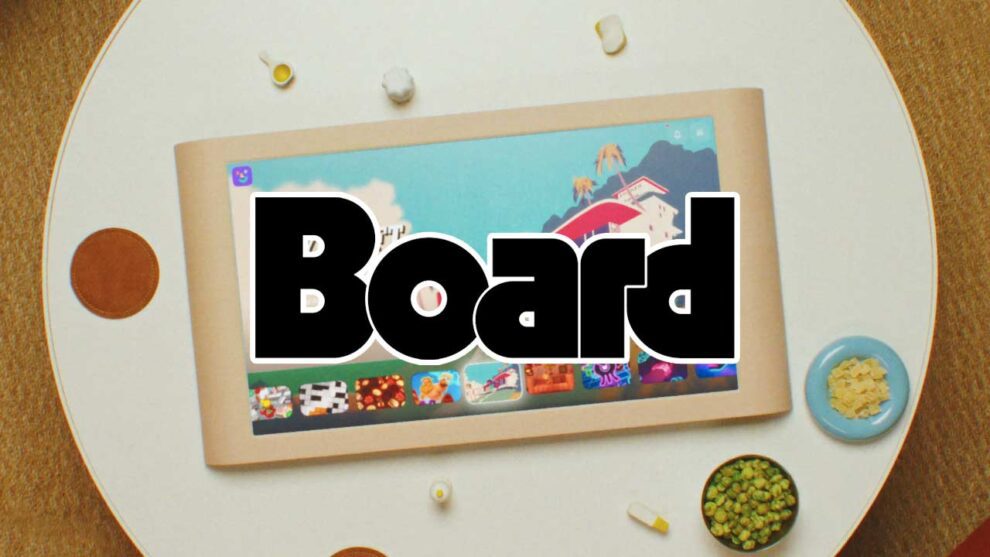
I looked at the brief Board commercial on the company’s home page, and while the video was certainly splashy, I initially did not want to wade into the waters here. “My only question,” I started in a note to Andy, “revolves around the games…the games don’t necessarily look like board games so much as video games.” Don’t get me wrong—I play video games every week, sometimes every day. But the Board looked like an oversized iPad that used physical components to manipulate the screen, in a similar fashion to Beasts of Balance.
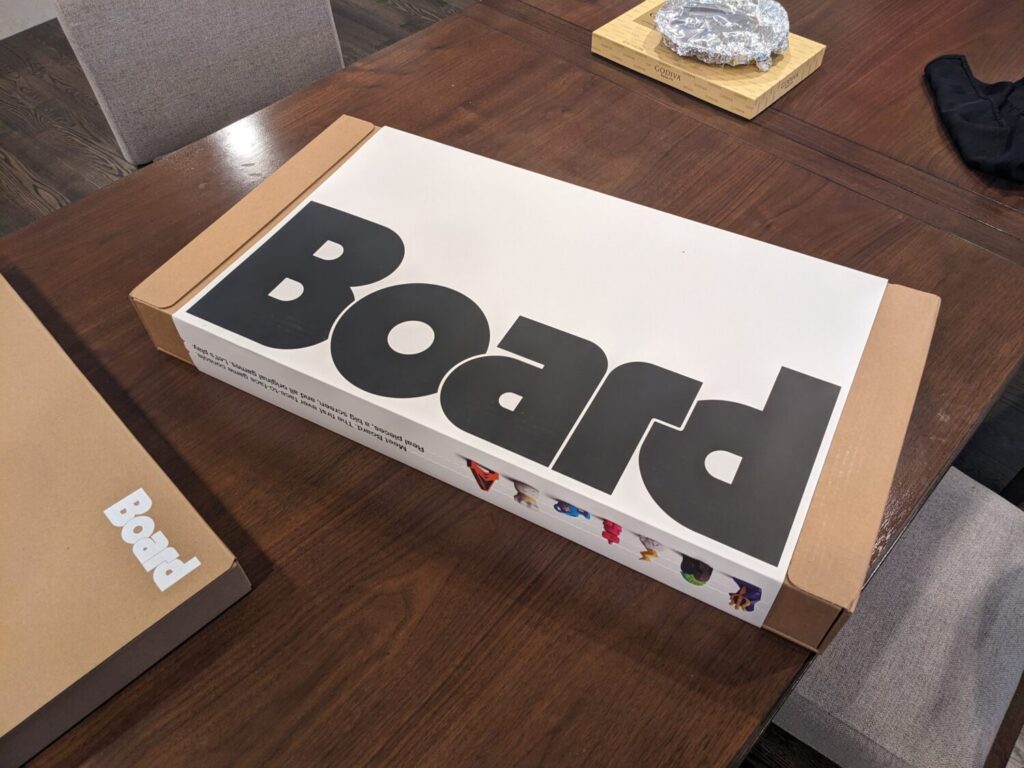
I’m a tabletop games reviewer, not a video game reviewer, so I wanted to make sure everyone knew who they were asking about doing a review here. Still, I knew the kids would get a kick out of trying Board, so I volunteered to give this a go. About a month later, the Board showed up in a box so loud that the company’s logo was splashed across the front: “BOARD”, it read, in a large, white font.
Because the timing was so close to Christmas, we decided to include this as a gift from “Santa” (we still have the hooks in our 9-year-old on the mysteries of Santa Claus), so my wife and I stashed the Board as a gift under the tree. After we opened all our other gifts, we pulled out the Board.
“What is this?” said the 9-year-old. He ripped off the wrapping paper, and within minutes, the Board was set up on our living room coffee table, ready to roll.
Over a six-week span that included time both at our home and on a road trip to Atlanta, Board proved to be a resilient tool in our quest to keep the kids engaged. That’s because I was both right and wrong about what Board is. Board is a board game platform. It’s also a video game platform. And it’s more accurate to simply describe the device as something all families need more of these days: a chance to bring people physically together to play games.
What is Board?
I’ll do to you what Andy did to me: it’s best for you to visit the Board.fun website. That’s because as a concept, it’s not quite right to say that Board is a 24” iPad. It’s a gaming dashboard that houses as many games as you want to purchase, each with its own physical accessories to manipulate that particular game’s intentions on the Board’s large touch screen.
In this way, Board is a toy that is meant to be used by one or more players seated or standing around a physical table. It’s a beautiful piece of tech, with a magnetic white cover surrounding the Board’s edges and a footprint that would look like art were it not for a large white power cord winding from the side of the device to your wall. (This version of The Board can’t work without being consistently tied to AC power, so that limited the number of spaces it could occupy in my living room.)
Getting Board set up seems easy, although my unit was partially set up in advance prior to shipping. “Plug and play” never felt more true than the Board unit; once we connected it to my wifi network, we were rolling. The main display will look familiar to anyone who has turned on a device with a side-scrolling menu in the last 20 years, with a touchscreen display that shows off the screen’s incredible detail and easy controls to navigate each game. (Currently, there is no App Store-style buying area, but I’ll be shocked if this isn’t already in the works.)
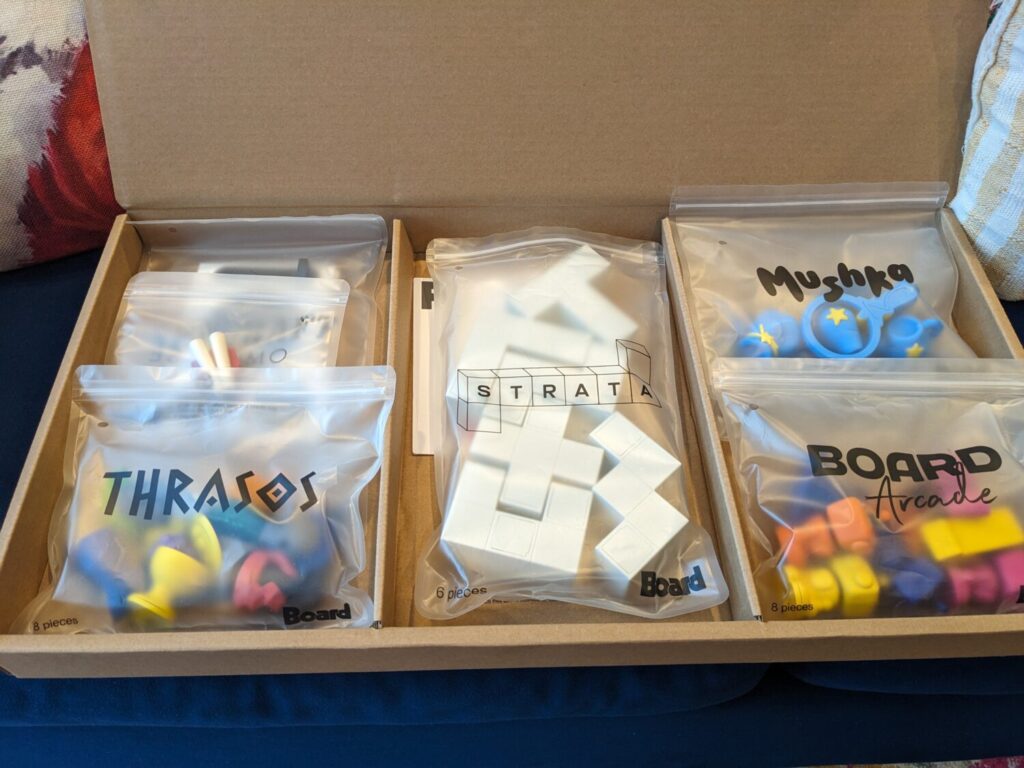
Tapping “Play Now” on any of the games leads to a brief loading screen before players can jump into a game. First, the screen alerts you to pull out the pieces needed for the game you’ve selected. Each Board comes with a components box, with handsomely-packaged transparent Ziploc-style bags that store each game’s pieces. The game Chop Chop has a handful of cutting, cleaning, and seasoning components, all of which come in a bag labeled with the game’s title and the number of pieces held by the bag, so it’s easy to find what you need quickly.
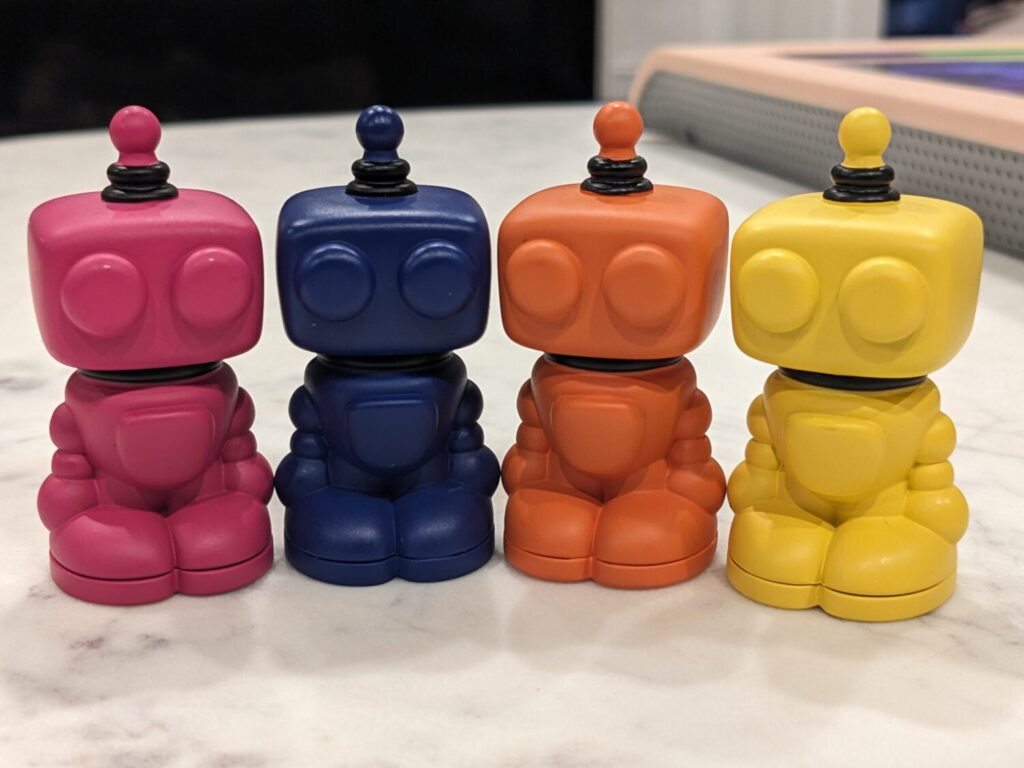
Each of those components has small contacts on the bottom, used to interact with the screen without interrupting the “feel” of what it might be like to move a spaceship around the screen, or to place polyomino pieces in the proper places. The one thing I’m still shocked about, a dozen hours’ worth of time into my play experience with Board: we haven’t once had an issue with a piece not making the screen react the way it was supposed to react.
I can’t even imagine the number of hours that were put in by the team at Board to test this product. The part that has impressed me most with Board is the care put in to deliver an A+ experience from a user interface perspective. Everything—everything—works. The components all do what they are supposed to do. I’ve never had a game crash. All the in-progress games we have saved later launched from the appropriate save state. Save for a single hiccup where my Board didn’t see my wifi network (the very first time I turned it on), everything about the experience has been smooth.
So, as a tech product in a world where tech products don’t always seem to do what they say they will do, Board gets my highest recommendation. But I’m a board game reviewer, so I’m going to spend the rest of this article describing why you should buy a Board for your home: the games.
I also want to highlight a critical feature: I have spent more time playing games side-by-side, in person, with my children using Board than I have in months. And this is coming from a guy who plays board games with his kids every week.
The Games
The Founders Edition unit that was sent for review came pre-loaded with about a dozen games. As of press time, the only game that has been announced and includes components in my package but isn’t yet playable is Thrasos, a two-player strategy title.
Most, if not all, of the games that come with Board at launch will make a video game player feel right at home. This is especially true as a person who has been playing video games for more than 40 years (i.e., me). All the titles here are credited to development teams that one assumes were contracted to make the first batch of simpler, more generic games, made to focus on delivering ideas that have worked for generations rather than real innovation.
This is not a slight, in part because it is obvious that Board’s long-term future will include licensed IP and titles converted from other platforms over time. For example, Space Rocks is blatantly a multiplayer Asteroids-style tabletop experience. Using a chunky spaceship token, each player uses their ship to point the ship’s weapons and blast onscreen asteroids and UFOs to earn points. Space Rocks lets players rack up scores individually or in a team format.
Here’s the irony of the Space Rocks experience that opened my eyes to Board’s potential: I take my kids to the largest arcade in the US, Galloping Ghost, a few times a year. I’m ALWAYS trying to get them to play the old arcade games there, including titles like Asteroids. I love the trackball interface used to control the ship in Asteroids, and Asteroids is difficult because all games from “back in the day” were difficult. Of course, Asteroid’s graphics are so old that the screen doesn’t even show the game in color, an immediate turnoff for the kids.
With Space Rocks? You would have thought the kids discovered something shockingly innovative. “Daddy, let’s do Space Rocks! You get to fly a spaceship that shoots a ‘megabeam’ and blows up asteroids!” (At this point, I looked at my wife and whispered something akin to “my kids think I don’t know what Asteroids is”, but we both agreed: who cares, if it gets the kids to sit with us for half an hour to shoot bright pink laser beams at a series of rocks.)
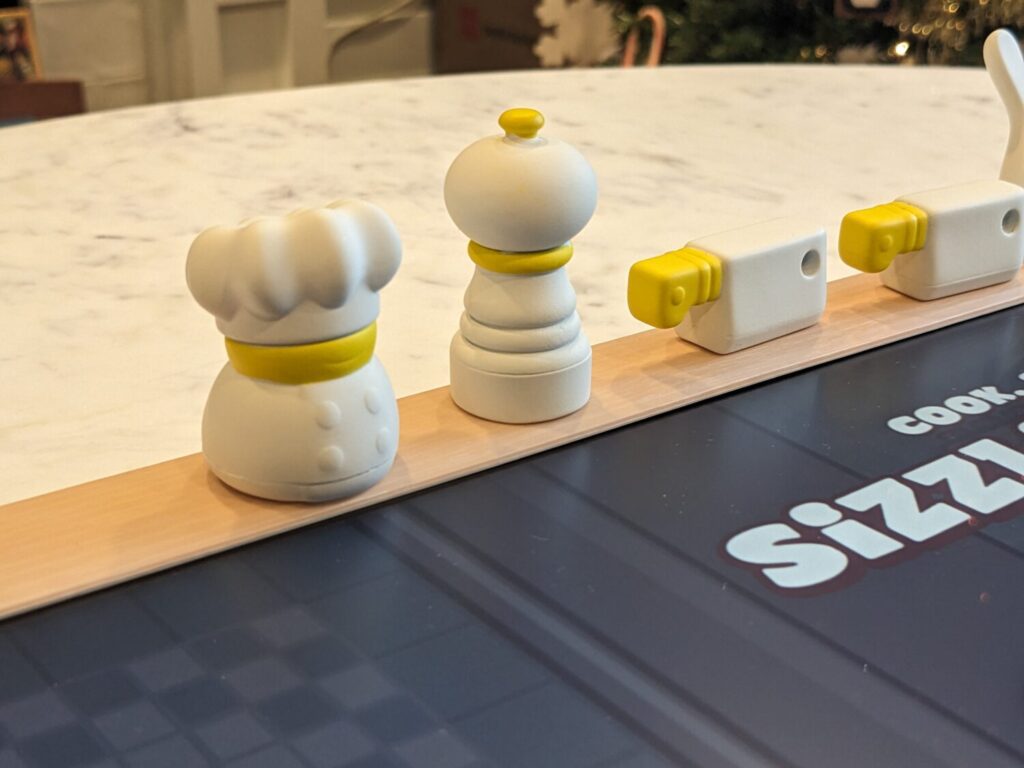
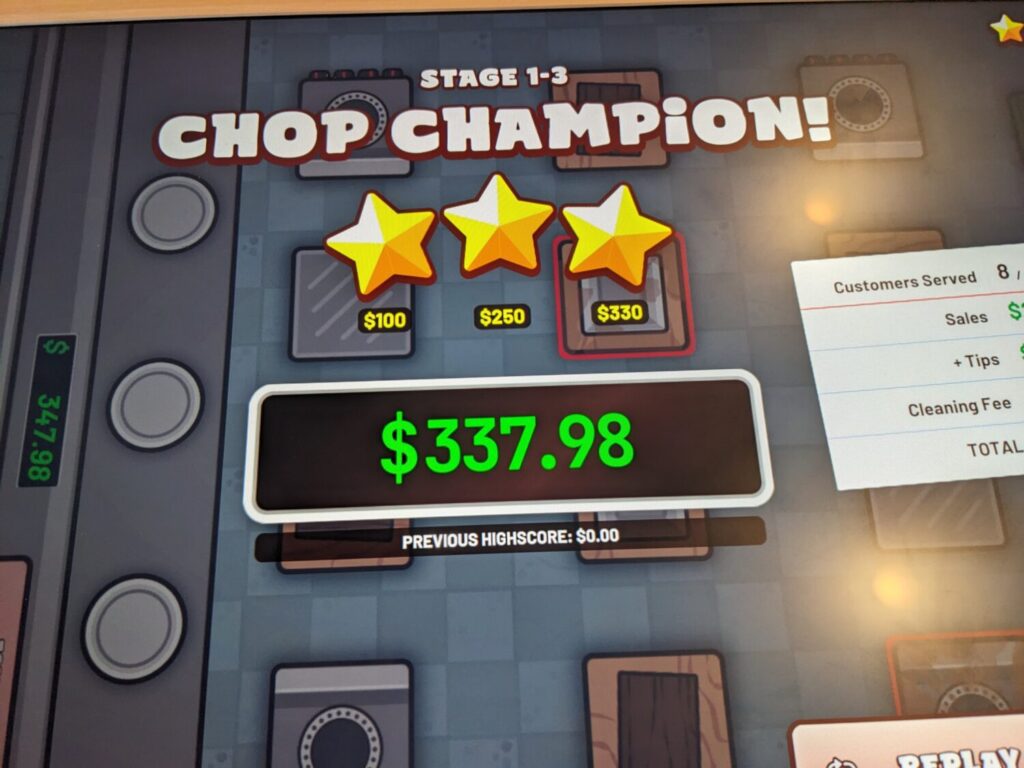
That continued with some of the other games. Chop Chop—the game with the most hours logged by far on our device—reminded some of the guys in my review crew of Overcooked, but here with a much simpler interface mixed with the chaos of trying to complete orders for customers within a set timeframe. But the Chop Chop components are the reason we keep playing: with three players, we make one person responsible for calling out each order, one person is cutting onions with the knife component or putting potatoes into a frier while making sure to clean our cutting boards regularly using the sponge bit, while one person is finger-dragging items out of a fridge and cutting tomatoes to make sure we have all the right ingredients.
Chop Chop might be the game that is most emblematic of what makes the Board platform shine for my family. There’s yelling, sometimes screaming. [“TOMATO SOUP! TOMATO SOUP! TOMATO SOUP!”] All three of us are hunched around the Board, doing our various tasks to fulfill meal orders fast (and those VIPs tip well, but man are they impatient!!). When the round is over—when the sweet, glorious Dinner Rush is done and that $20 cleaning fee is earned for keeping our stove tops free from germs—getting a three-star score always leads to the players high-fiving each other.
Let’s just agree on something: you want to spend more time high-fiving your kids, right?
Save the Bloogs is blatantly a Lemmings game. It’s a good Lemmings-style game, with a peaceful musical soundtrack and dozens of minute-long missions that kept my 12-year-old engaged for an hour one day during the holiday break. Still, it’s a Lemmings game. Starfire feels like a mix of tennis, Pong, and Asteroids, using the same components employed for Space Rocks. Snek and Mushka feel more like activities than games, particularly Mushka, a title that lets everyone manage a digital pet.
My kids are video game players—standard stuff like games on the Roblox platform, Minecraft, Fortnite, FIFA, Madden and other sports games, and nearly anything on the Nintendo Switch. What we, as parents, hate most about those platforms is when a child grabs a tablet and heads off to their room to join the Brain Rot-o-sphere of endlessly samey games, alone yet together with a bunch of strangers online. The difference with Board is why I’m not moving Board from my coffee table: I never have a problem with the kids interacting together over the same game, solving puzzles together or fulfilling lunch orders from angry customers.
Now, that does come with a minor share of problems—kids wanting to play their game (the 12-year-old loves Save the Bloogs; the 9-year-old can’t stop playing Chop Chop), or arguments that arise over what they will play together. No problem. These are the kinds of issues I love in my household, because they are always tied to interaction. I need my kids to understand more of the different ways they will navigate conflict—at home, and abroad—and Board offers that, too.
Spycraft
When the Board was shipped to my home, there was one additional game besides Thrasos that was not quite ready for play: Spycraft. The game had the look of an adventure game with a spy theme and a dash of Where in the World is Carmen Santiago?, for those of us of a certain age. The art style was gorgeous, albeit a style that was illustrated with a single image on the Board’s home page.
We reached out to Board’s CEO, Brynn Putnam, and they indicated Spycraft would launch in late January, so we held our review in the hopes that playing this might change my opinion on one front: I really didn’t think the device truly had something for every kind of gamer. There are plenty of space-themed retro-style shooting games, from Space Rocks to Starfire. There are physical puzzle games, such as Omakase and Strata. There’s a game that takes elements of the old game Breakout, modernized for gamers of the now.
But there are no platforming-style action games. I think the device could do with some party games for adult crowds that use some of the included physical components. No trivia games that make use of an occasional dexterity challenge. In fact, there are a few categories that need filling, games that will come with time.
So, when Spycraft launched, my kids and I jumped right into the adventure; hopes were high, as I was really excited for something that pushed harder into a game with a story and ways to progress through a longer title.
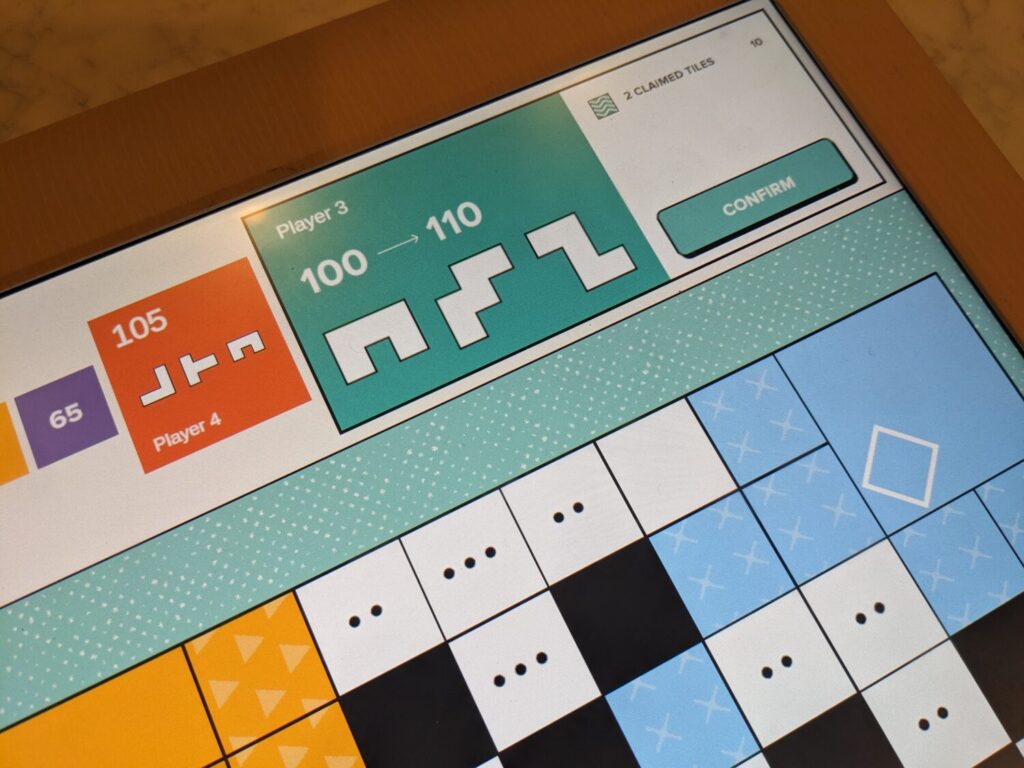
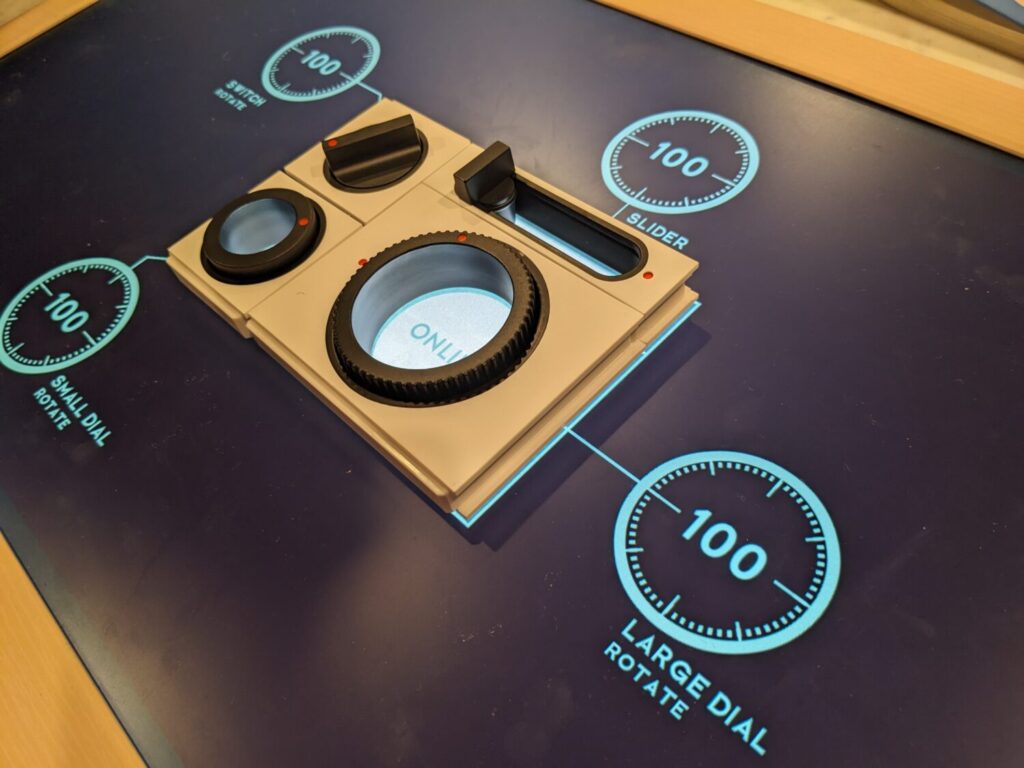
Spycraft comes with a seven-component “spy kit”—a dial, a slider, squares with cutouts for circular components—which can be mixed and matched based on the needs of the game. The game’s setting is the late 1960s, and Spycraft feels like a Bond film without the action set pieces. Players take on the role of an agent working to defeat “Madman”, an evil crop of spies aligned a bit like S.P.E.C.T.R.E. from the Bond flicks.
Using a variety of puzzle challenges, Spycraft does an excellent job of integrating its spy kit to do things as simple as dismantling power boxes with a screwdriver to using a codebreaking device to encrypt room keys. Later challenges ask players to solve codes, search Tokyo for secret lairs, and work backwards to figure out the chronology behind dastardly deeds committed by Madman agents. By the time you are using a piece of the spy kit to zoom in on clues from a hotel window in New York City, you’ll be just as hooked as my kids and I were as we solved puzzle after puzzle.
Of the launch titles, Spycraft does the best job of showing off the platform’s potential, although Chop Chop comes close. In some ways, Spycraft made me feel like I did a thousand years ago when I first played the game Duck Hunt on my Nintendo Entertainment System. “Wait…it’s like I’m really shooting ducks with this light gun plugged into the front of my gaming system!” Spycraft has some moments that make the player feel really clever, especially when bouncing between moving around maps on screen, to zooming in on specific elements of a screen, to knocking out puzzles by opening a briefcase to analyze various clues.
Add in the production elements, and Spycraft is a blast. While Spycraft is the only game we have seen thus far to occasionally have a glitch pop up, the issues have never broken a game and we’ve already noticed fewer glitches than when we first started our game. Each time we fire up Spycraft, the kids and I (now joined by my wife, who heard everyone else ranting and raving about the experience) find ourselves hunched over the Board, excited to see what Spycraft has left to offer.
Buy It
Every parent knows the deal: it’s amazing how quickly kids move on from something they supposedly wanted for months when the holidays arrive. Even at my house, my wife and I still have stories of gifts that went unloved just hours after being opened on past Christmas holidays. It’s hard to keep the attention span of a child, right?
Board does an exceptional job of combining the love affair kids have with screens and getting those same kids to play games on screen together “IRL.” My 9-year-old asked me to play Strata, Space Rocks or Chop Chop every single day for three weeks when Board first entered the house. He hasn’t done that with anything we own, ever, for such a sustained stretch. It nearly brought tears to my eyes when he asked me to join him for a two-player game of Chop Chop on the same day he was punished for talking to his family in a rude tone.
“Daddy…are you doing anything right now?” he started, almost begrudgingly. “I was going to play some more Chop Chop.”
[me, stammering, near tears]: “Sure thing, son…fire it up.” I paused, still in shock. “Can I work the fridge this time?”“Sure. Today, we are doing BBQ.” (He likes that one of the campaign missions is to serve up barbecue, but he insists on calling barbecue “B-B-Q”, like he knows something I don’t.)
And, there we were, working our restaurant together, calling out orders, yelling at one another when a serving plate needed to be cleaned, or when a dreaded yellow order slip came in from a VIP offering a 90% tip if we could nail their order faster than other tickets.
Board is already creating the kinds of memories that we’ll remember 10, 20, 30 years from now, with a laugh and a hoot about the experience of what brings people together.
For this, and many other reasons, I highly recommend the purchase of a Board system for your home. That privilege won’t come cheap—at press time, Board’s Founder Edition sells for about $600—but in a world where my upcoming PS5 purchase is gonna run me $600 for the system and a couple of extra controllers, $500+ feels like the going rate for high-end tech.
But the value is where it’s at. Even though I’m using a review copy of Board provided by the manufacturer, I will buy a unit of my own based on what we’ve seen so far. And Board is not a subscription service platform: the system and the 12 start titles are your first purchase, then games are sold individually because players will need the physical components to play each title.
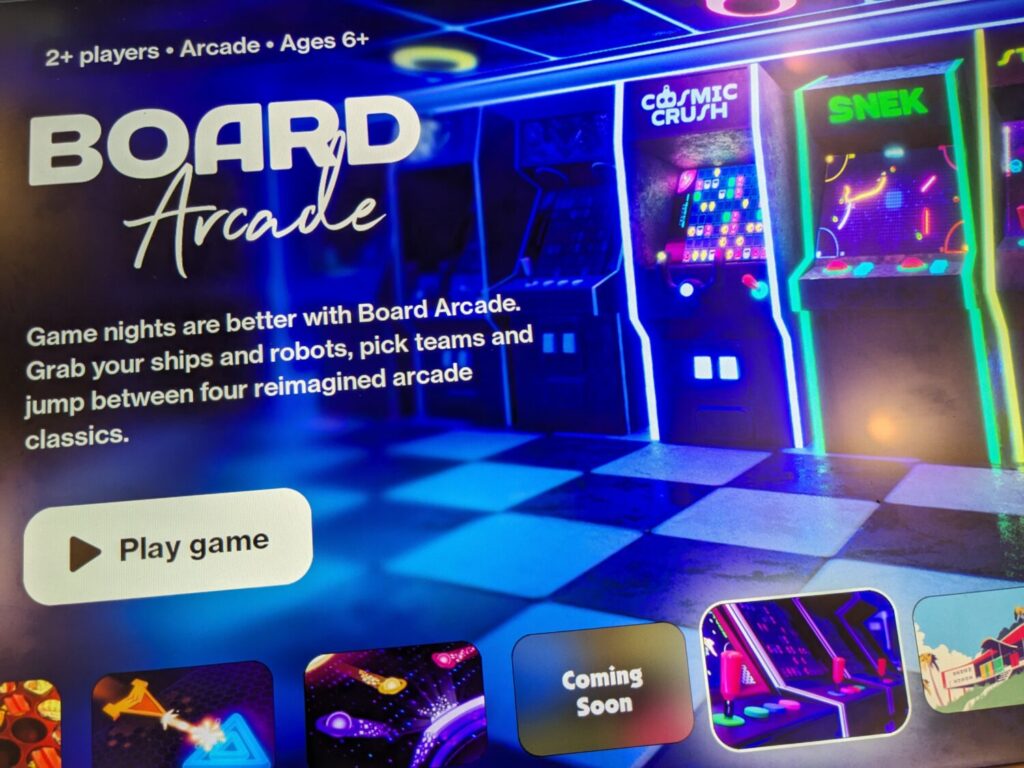
Board is a revelation. And the future is being previewed on the device’s home page. Sports games are coming. More adventure titles are inbound. Board Tabletop? Looks like we are about to get good, old-fashioned board games that can be played on the device. The tech is already amazing and the apps in development are limitless.
Jump on the Boardwagon, people!