Disclosure: Meeple Mountain received a free copy of this product in exchange for an honest, unbiased review. This review is not intended to be an endorsement.
Destruction of your enemies is hardly a new concept in board games. Monopoly can only end if you bankrupt your opponents. Risk doesn’t stop until you’ve wiped everyone else off the face of the Earth. Board gaming and zero-sum game design have been best buddies for decades, but to many, it’s become a tired-out trope. This probably explains why so many publishers these days prefer games where player interaction is minimized, helping cement the term “multiplayer solitaire” into the industry lexicon.
Black Rose Wars: Rebirth does not care for any of this. It’s a game that borderline ignores industry wisdom simply because it can. You’re encouraged to mess with your opponents from turn one, and every move is designed to either help you at someone else’s expense or straight-up hurt them.
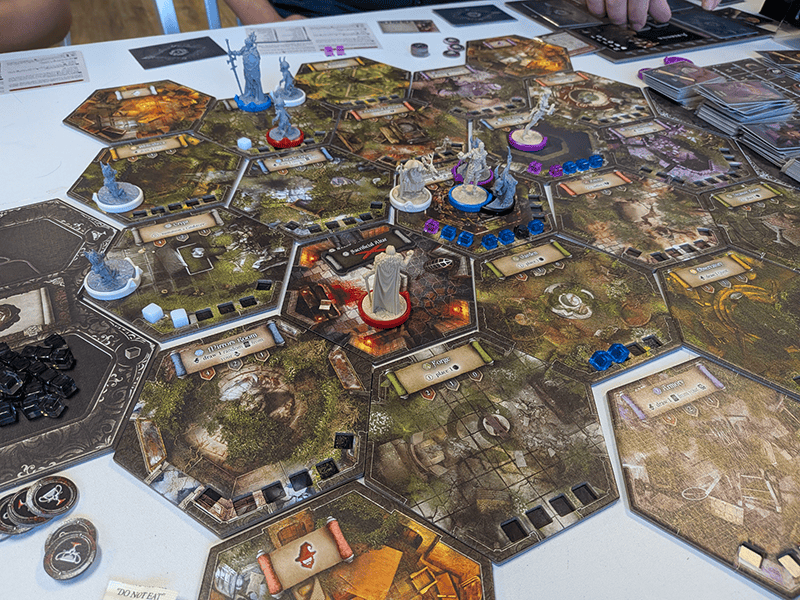
Friendship Was Never an Option
Which makes perfect sense, given the whole theme going on here. You play as a powerful mage, and leading the Black Rose Lodge is the prize, much like a crazed motorcyclist yearning for the Isle of Man TT. The Lodge has seen better days, though, and with your magic, you might be able to restore some of its former glory, hence the “Rebirth” in the title. You’re not the only one with this wild idea, either, as several other mages have shown up with the exact same plan.
Don’t relax too hard, though, because even the Lodge itself is a living entity, and she’s judging you. Slack off like this is some euro board game, and everybody loses.
As if the theme wasn’t already a huge selling point for me, the game itself ties several mechanisms together wonderfully. This arena battle combines worker placement, area control, deck building, and programming. On paper, it sounds like the world’s most obnoxious design imaginable, yet somehow it all works and, more importantly, elevates the entire experience.
I’m not going to explain every single detail because there are a ton of rules, but here’s the basic idea.
First up, Events. This is where the Black Rose expresses her contempt for the homewreckers invading her Lodge. Flip a card, and you’ll get either an instant or persistent effect designed to annoy you and everyone else at the table. The Black Rose also earns points through these events, because apparently tormenting her wannabe tenants isn’t enough. If you don’t have a Quest, you draw one here as well, giving you a side objective to score points and eventually exploit for a reward.
Six Flavors of Violence
After everyone groans at the Event, it’s time to Study. You draw two cards from your Grimoire, aka your deck, then choose four cards from the six available Schools. Take a gander at those four cards, add two to your hand, and toss the other two into the public discard pile. This is the deckbuilding portion of the game, and perhaps one of its most important aspects.
Each School represents a different gimmick, and you pick one of the six as your starting deck. Some are straightforward, while others can get quite complex. Do you want to hurt others while hurting yourself? Agony. Summon creatures to do crimes on your behalf? Technomancy. Love combos? Alchemy. Area control? Shamanic. Dislike having friends? Nightmare. Did you play Warlock in World of Warcraft? Hex.
These decisions matter because they shape the spells in your book, not just this turn but future turns as well. Adding cards opens up more elaborate combos while giving you plenty of opportunities to set up some nasty mind games. And almost every spell is double-sided, meaning your hand of six cards can represent 12 different spells. If you have friends with analysis paralysis, they are going to melt here.
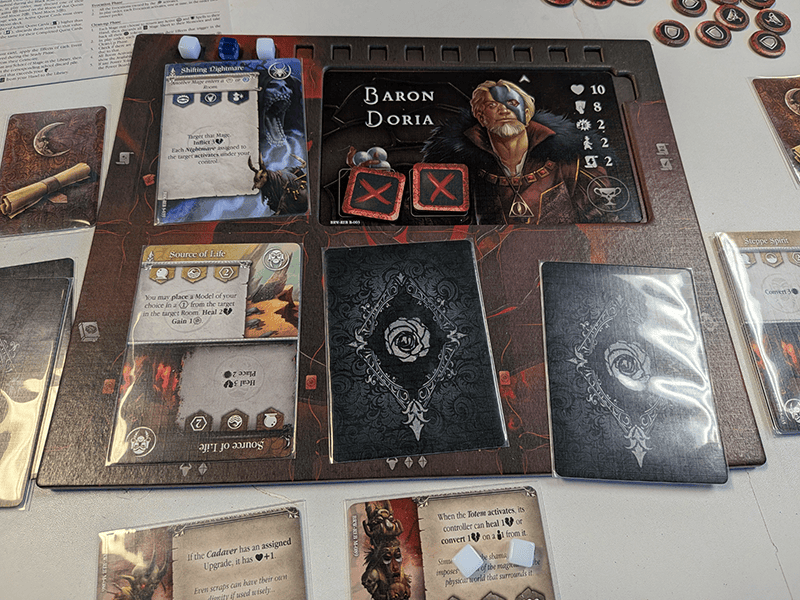
Speaking of setting up combos, you’ll then give your hand a long examination before slapping your cards into spell slots, face down. The numbered slots have to be played in order, while the fourth Quick Spell slot can be played at any point. Once everyone has programmed their spells, it’s time for Actions.
I Cast Fist
On your turn, you perform one or two actions. The most obvious is casting a spell, where you flip one of your cards and resolve its effect. Traps and Defense cards are the exception, as they are cast face down and wait for their trigger before springing themselves on someone. That could mean another player walking into a particular room or using a spell to hurt you.
Besides spells, you can use physical actions. Exploring lets you move and activate a room. Rooms have their own abilities, ranging from hurting someone in an adjacent room or drawing another Quest card. You can also physically assault someone, because running out of spells doesn’t mean you ran out of options. Finally, you can activate one of your Summons, letting them move around and punch people while wearing your badge.
This cycle continues until everyone is out of actions. Then you activate all Evocations, perform the usual end-of-round bookkeeping, and start the whole process over with another Event. This continues until someone hits the point threshold and triggers the final round.
There are a few details worth noting. Killing another player earns you a Trophy, although they simply respawn afterward because apparently death is just a minor inconvenience here. The player who dealt the most damage gets bonus points, followed by the second-highest damage dealer and everyone else who participated. Trophies also matter at the end game, since whoever has the most gets another bonus.
Some Assembly Required
Players can also rebuild destroyed rooms. Some spells give Instability cubes to a room, representing the game’s area-control element. Once all the slots are filled, the room is reconstructed at the end of the round, awarding points to everyone involved. Better yet, its common ability upgrades to a significantly stronger version that can be used once per round.
And I have to bring up the Forgotten spells. These require you to march towards the center of the Lodge and sacrifice a good chunk of your hand to draw a single Forgotten Spell to abuse next round. Once you use it, it’s gone from the game. These spells are just as balanced as a pregnant sperm whale on a tightrope, and that’s by design.
Hopefully this long description illustrates the point that this is not a game you bring to a family gathering. It is complex, unforgiving, and demands your attention. Concepts like catch-up mechanisms do not exist here. If Magic: The Gathering were a board game, it would likely be close to this. I’ve read comparisons to the old game Wiz War, but this is far too sophisticated.
That sophistication does come at a cost. It’s hard for new players to join because there is a small battalion of icons to memorize, and building your deck is so free-form that coming up with effective combos can feel like a task even Hercules would decline. The rulebook doesn’t make it easy either. It explains the basics well but doesn’t go much further, and the inconsistent card terminology doesn’t help. The fact that their official FAQ is over a dozen pages should tell you everything.
Controlled Chaos
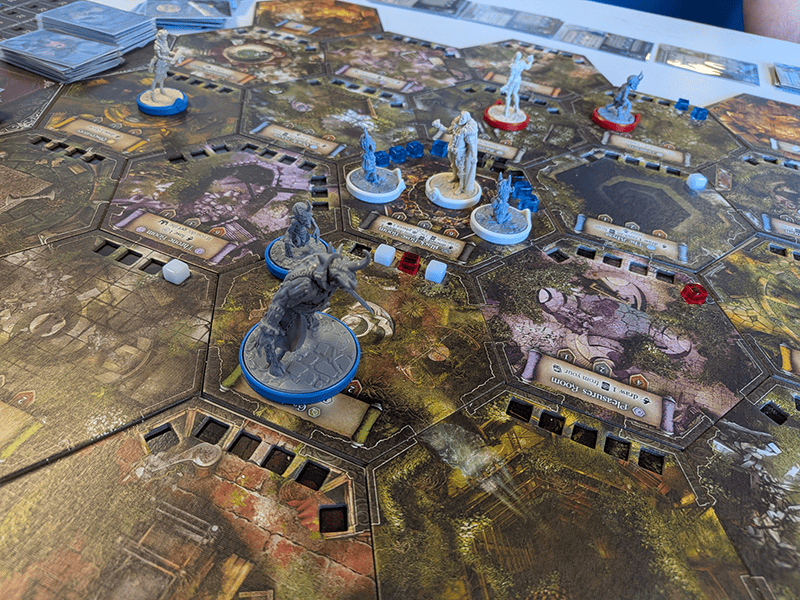
And yet, despite all this nonsense, it’s still a fantastic experience that feels genuinely original and respects your tactics. What I particularly enjoy is how much the game rewards paying attention and making your own decisions. Preparing your Spells, selecting the schools, positioning yourself around the Lodge, and deciding when to take a risk or hold back all play a major role. There is plenty of luck involved, but it rarely feels unfair because everyone is dealing with the same uncertainty.
The uncertainty is also where most of the animosity comes in, and it’s from a human choice rather than a systematic one. Your opponent is nearby, and they are planting those cards. Are they going on the defensive, a full-on assault, or something else? Even when you have a plan figured out, another player might pull something unexpected that throws everything off track. Those problems create genuine human interaction and competition, with a system that seems to reward gut feelings over raw optimization.
More importantly, you are almost never disengaged. Everyone is constantly damaging each other, disrupting plans, rebuilding rooms, and generally making a nasty mess of the Lodge. Yet it rarely feels personal. One moment you’re screwing someone over because it’s the best move available, and the next your attention is somewhere completely different. That constant interaction means every game develops its own brand of chaos.
Reliably Inconsistent
Sometimes that chaos might play too big a part. Game length is inconsistent, with some games lasting around 90 minutes while others can easily go twice that. A lot depends on player decisions and which Event cards come up, but the Schools aren’t always created equal either.
Some feel far more interesting to play than others, while certain Schools are simply better at generating points. If Shamanic isn’t picked, there won’t be many points earned, while a table full of Nightmare players can feed the Black Rose a boatload of points and potentially hand her the game. It’s also quite possible that everyone keeps pounding on the weakest player, since there are no diminishing returns, which can leave players feeling sour.
Black Rose Wars: Rebirth is a ridiculous game, and I mean that as a compliment. It’s aggressive, complicated, wildly overproduced, and about as far from multiplayer solitaire as you can get. There is a checklist of reasons to bounce off it, especially if you prefer games that explain themselves quickly and let you take your turn. But there are those of us who enjoy games that throw us into the deep end with little explanation.
Everything about Black Rose Wars is turned up to eleven, maybe even twelve, and somehow, all that absurdity is exactly what makes it so memorable.