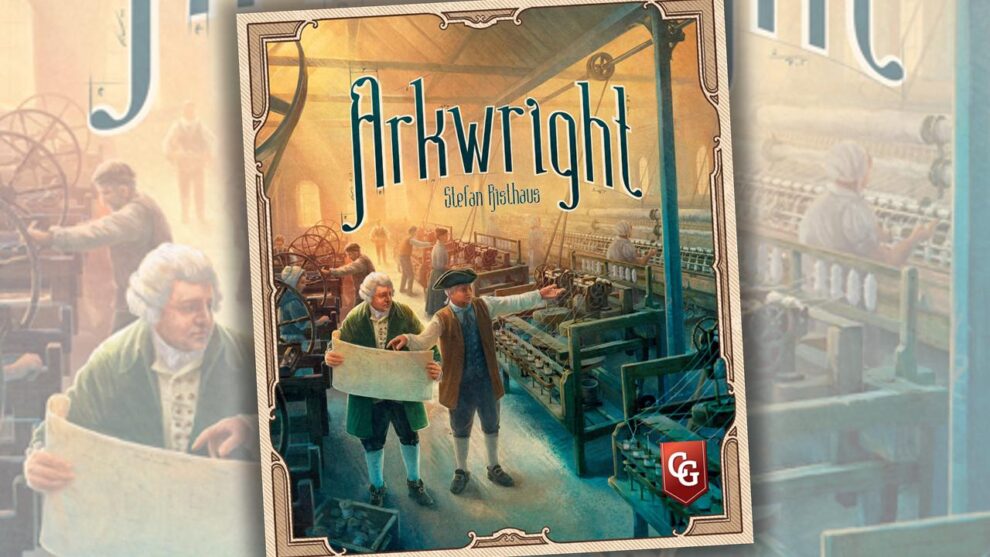

Disclosure: Meeple Mountain received a free copy of this product in exchange for an honest, unbiased review. This review is not intended to be an endorsement.
About five years ago, I had the chance to play a friend’s copy of the game Arkwright (originally published in 2015 by Spielworxx.) My buddy Jason was a huge fan and wanted to show off his copy to our strategy gaming group, so we got a three-player game rolling at my place. About four hours later, we came up for air to talk through our thoughts: mostly positive, a bit too long, a lifestyle game that really needed to be played often to be truly fulfilling.
My favorite game of all time—then, and now—is City of the Big Shoulders, now known as Chicago 1875: City of the Big Shoulders. “City BS”, as it is known in my circles, is a special game for a lot of reasons. Its focus is on the city of Chicago, in a period where a somewhat shocking number of famous companies were born there: Oscar Mayer, Quaker Oats, Kraft, Florsheim Shoes, Schwinn, Swift & Co., and many more. It’s the only game I’ve ever played that successfully combined the stock manipulation mechanics of popular gaming systems (such as incremental capitalization of 18xx games) with a straightforward worker placement mechanic that drives the middle phases of each round. It’s also a knife fight, a game that has epic swings and great competition, in a format that best accommodates exactly four players.
But most importantly, City BS is a factory operation game…just like Arkwright. In both games, players must serve as both investors and as factory forepersons, trying their best to run efficient organizations by spitting out the most goods to make the most money and raise their portfolio valuations above the competition.
In 2025, Capstone Games released Arkwright: Anniversary Edition in the US; a big thanks to their team for sending an “open box” copy of the game for review. After a couple plays with two different groups and the use of a solo/automa bot that can be incorporated into the game, I still think City of the Big Shoulders is my preferred factory operations game system…but I have a much greater respect for what Arkwright is trying to achieve.
“I’m in the Cutlery Game”
Arkwright: Anniversary Edition is based on the 2015 release Arkwright, an economic action selection game for 2-4 players. My plays of the new version went just like the play I mentioned above…no matter what the box says, the game takes anywhere from 60-90 minutes per player, longer with slower players. (My “Waterframe” full play at four players took five hours and 15 minutes, and a couple of those players are pretty quick decision makers. Expect any play of Arkwright to take an entire afternoon!)
Over the course of five decades—or three in the “Spinning Mule” variant—players operate and invest in a single business comprising up to four different factories that produce food, cutlery, clothing and lamps for the fine people of England starting in the year 1770. Players begin the game with 15 shares in their business, selling then buying (then maybe selling again) more shares with the ability to invest only in themselves during the game. By the end of play, the player with the most valuable portfolio is the winner.
Naturally, there’s a lot more to it than that…and if you want a detailed breakdown of the rules, I invite you to seek out the mostly excellent 52-page rulebook and the detailed, double-sided player aid for more details.
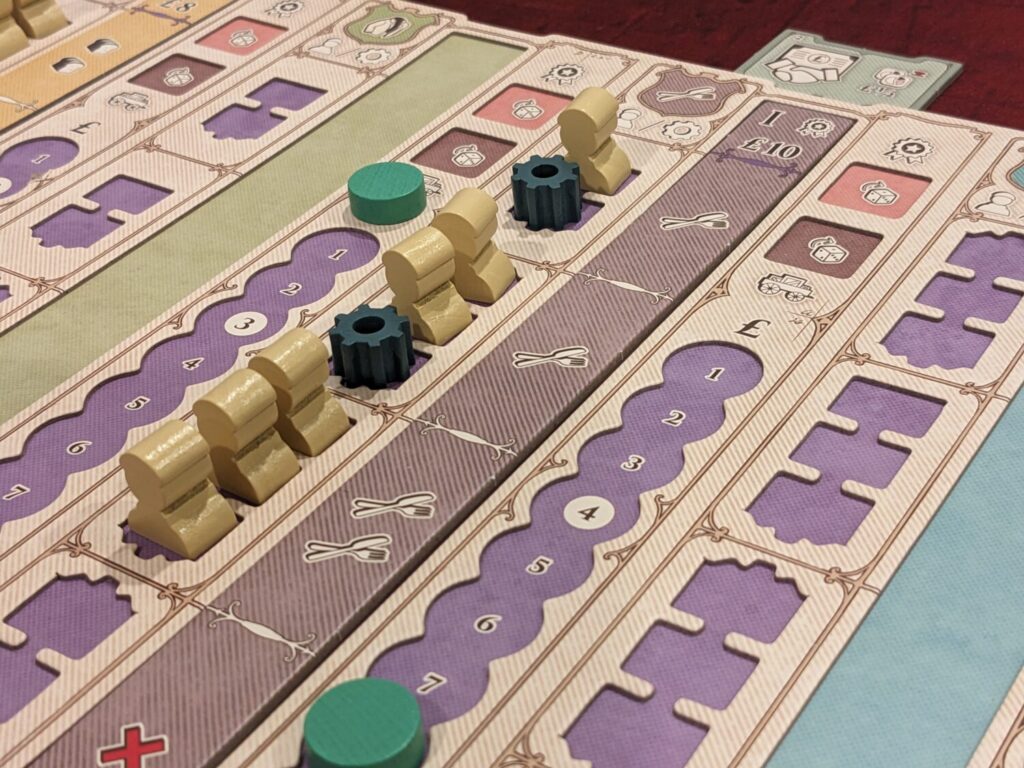
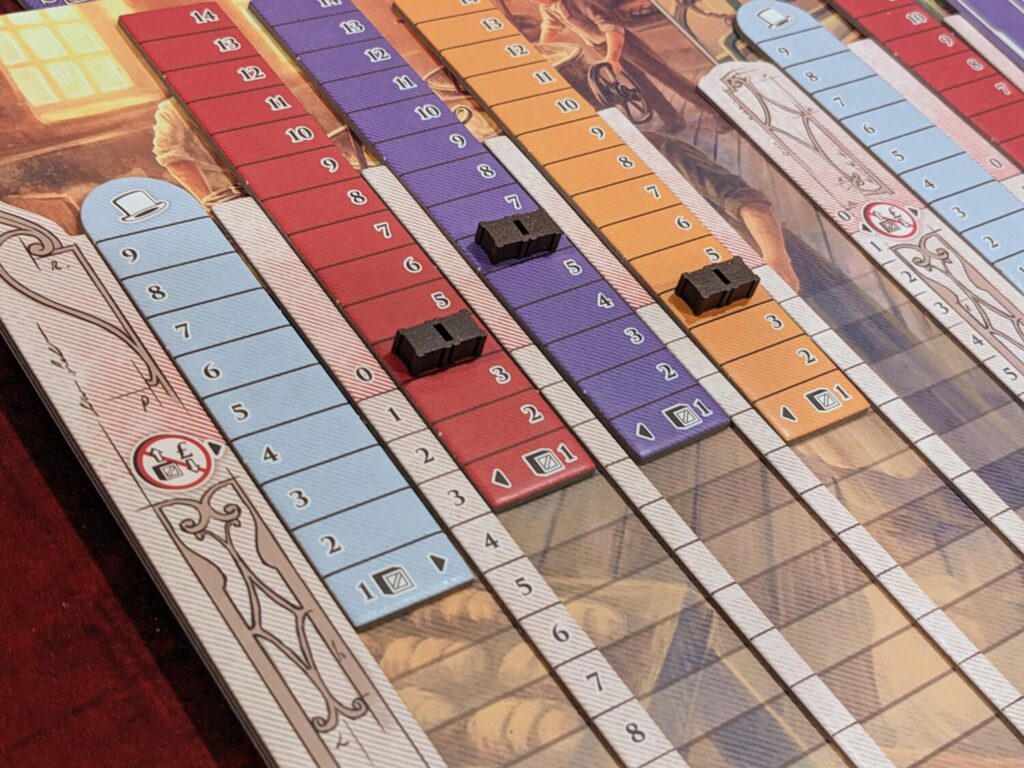
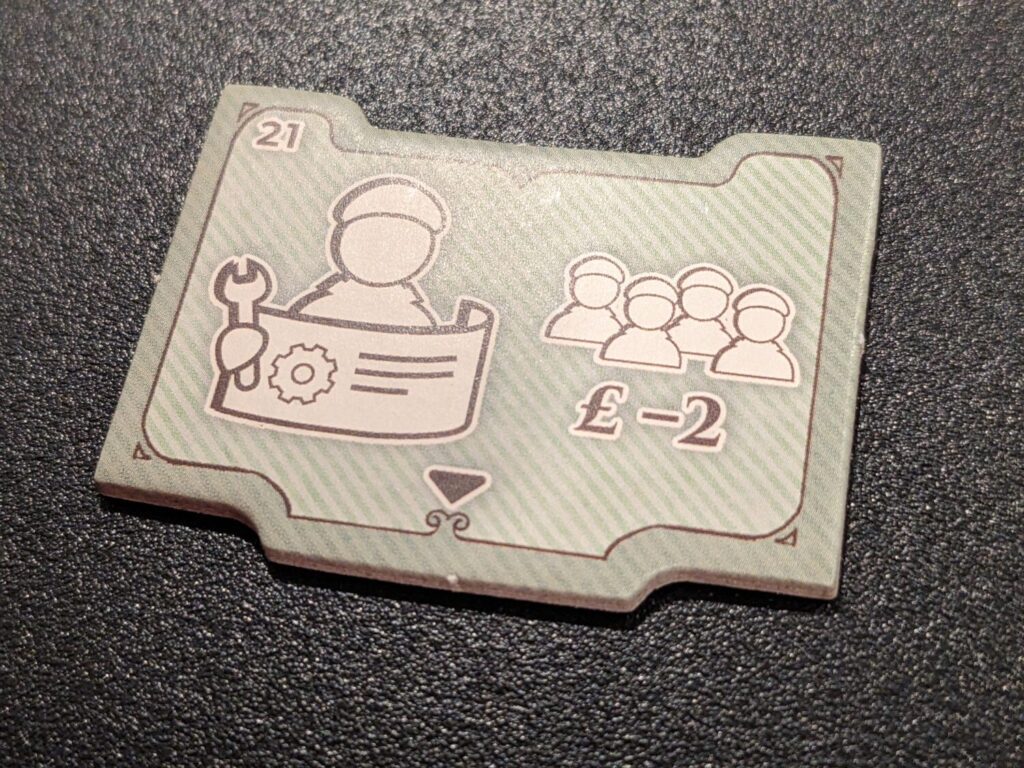
The guts of the game are very straightforward. Each turn, a player pays an administrative cost (between 2-10 pounds) to slot an action tile and complete that action, which could range from opening new factories to improving the quality of their product to automating workers using machines to improve efficiency and lower labor costs. Each turn in a decade ends with the production of that decade’s “featured good” (food, etc.), and when the players’ supply outpaces England’s demand, things get spicy as players try their best to make the most appealing goods they can. The higher the appeal, the more likely it is that your goods will sell…and that’s the way your stock price will go up during the game.
I’ll give Arkwright this much: the full, five-round game is pretty epic. Even though each player begins the game with two factories, seeding the initial stages with what appears to be massive competition between featured goods, competition is ultimately light in the first decade or two. (There’s a “neutral importer” that always presents competition for the players, but it is a non-factor early on.)
As other players enter new markets, and as demand’s upwards creep slowly grows (never nearly at the pace of production), one or more markets become a fantastic game of wits as everyone fights to price, temporarily market, and permanently increase the quality of their items while selling enough goods to satisfy the needs of the people.
Turn order might be more important in Arkwright than nearly any of the heavier economic games I have tabled recently. It was shocking how often players stared at the board and considered one of their bonus actions, as they tried to math out the best price to sell their cutlery or their lamps knowing that competitors in the same business were going later in turn order. Manipulating turn order is a very tricky balance—usually, the player with the least valuable portfolio gets the chance to change it between decades, and having a middle-of-the-pack portfolio is often a major negative, particularly early on.
Arkwright has a buffet of individual player powers, upgraded action tiles, and ships that can be drafted as a bonus action at the end of some turns. Staring at all the tiles on display can be overwhelming, even for an experienced player…and that often slows a player’s turn to a halt. And that’s before one has to make last-second pivots based on things like the price and appeal changes that might affect your ability to sell enough goods at the end of each “cycle”, or round (there are four cycles in each decade, so 20 turns per player in the Waterframe version of the game).
The balancing act of everything on display here is both the best and worst thing about the game.
I Could Just Work in a Train Game
Arkwright: Anniversary Edition is a must for fans of the base game, and that starts with the mostly stellar production granted to this game.
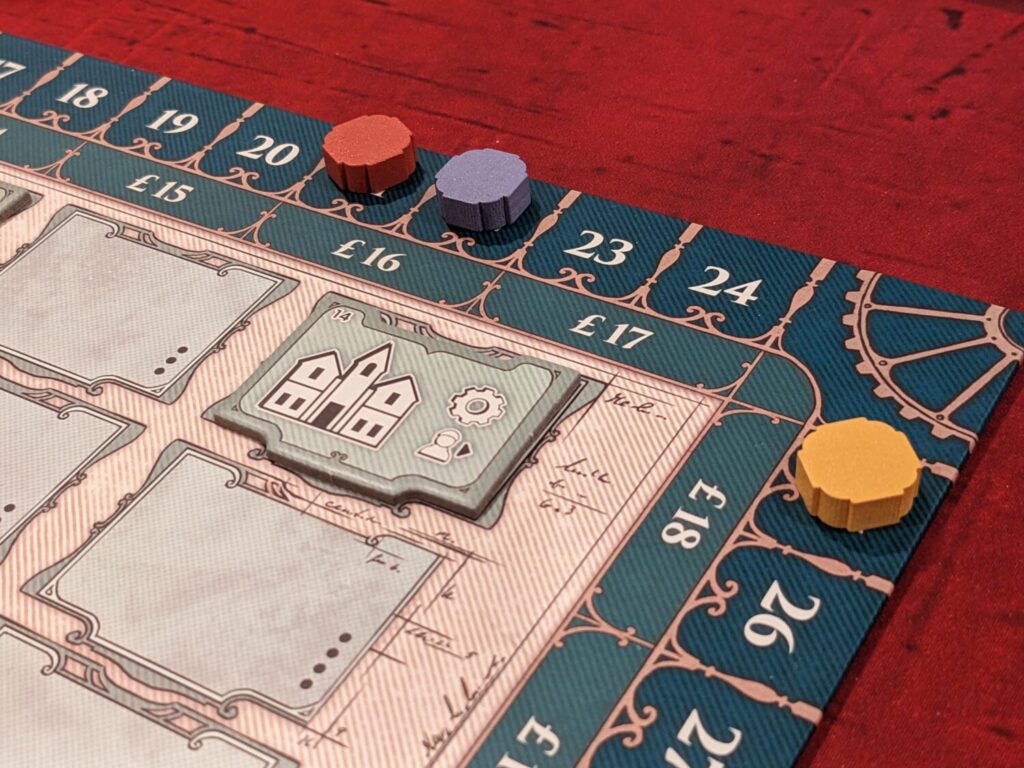
I had friends watch older teach videos of Arkwright’s original form, and those same players marveled at how the new game looks on the table. You are still going to need that player aid to sort through the dozens of tiles, but the layout, the player boards, the employment market board…it all works. The bits are fancy, the warehouse and factory boards are nice, and those employee tokens do a nice job of conveying the general workforce.
One somewhat negative element, which seems to be happening in game productions more and more: some of the player boards, and especially the employment market board, will be severely warped by the end of even your first play. My copy of the game is an open box copy, meaning it was likely used at demo tables prior to my acquisition, so I can’t comment as much on the copy I was sent…but I also did a play with my buddy Fil, who opened his personal copy of the game in order to let me see a fresh production copy. By the end of that 5+ hour game, the employment board looked like a boat, the way the board was bending in the middle.
There’s also one minor mistake on the player aid—two of the action tile icons were accidentally swapped—but this is fairly easy to parse and didn’t disrupt my plays once players understood the issue.
The rulebook is honestly magnificent…not a word I use often when it comes to rulebooks nowadays. While it is massive, at 52 pages (!!!), the rulebook does such a great job of explaining game concepts, providing detailed examples, and providing a more detailed glossary of all the tiles in the appendix. For heavy game enthusiasts (or publishers working on anniversary/reprint editions of older games), Arkwright: Anniversary Edition provides an exemplary format I hope others consider when developing their own productions.
I really don’t have many issues with Arkwright as a game. I have a major issue with Arkwright in terms of play time.
I think Arkwright shines best at four players; of my three plays, I enjoyed four-player jockeying for market position the most. But, that’s always going to be a four-hour game, minimum. With some players in my network, it might be a six-hour game.
In that amount of time, I almost certainly have to play Arkwright on the weekend. And if I’m getting four players together to play games on a weekend, I have so many games I enjoy that will hit the table first in this weight class. (I could play almost all of my 18xx games in six hours, for example.) Also, the setup and teardown times are no joke, and establishing companies and drafting tiles in the pre-game scenario might take a while.
Like the actions in the game, Arkwright is an investment. However, it’s an investment I recommend if you have the patience, the right playgroup, and the willingness to enjoy somewhat ruthless play. The Capstone anniversary edition of Arkwright is beautiful and many of its production elements are winners. Make sure to carve out enough time to play the full version of the game; while it’s great that the Spinning Mule variant is an option, I think the five-round Waterframe version is the one I will come back to try for future plays.