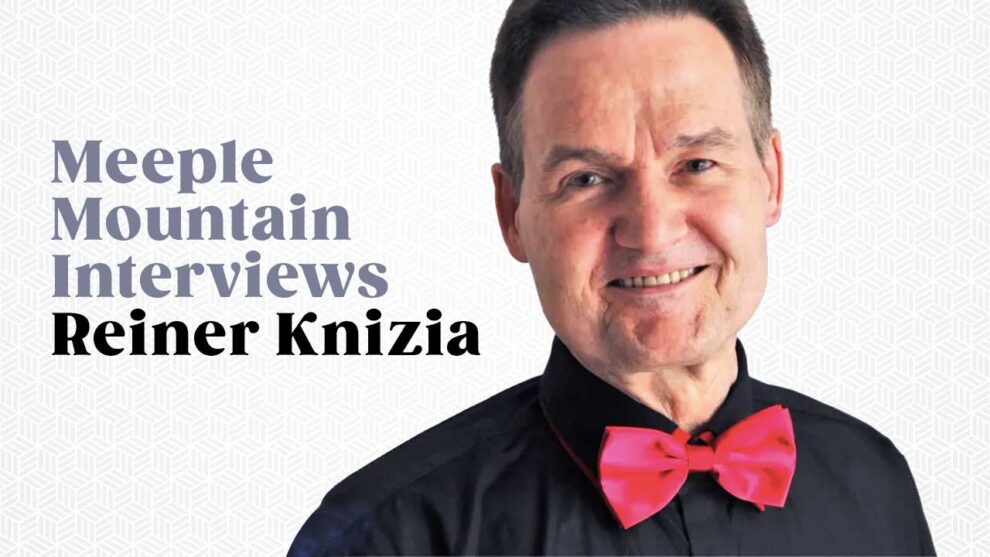


To celebrate the completion of our Reiner Knizia Alphabet series, Meeple Mountain’s Andy Matthews and Dr. Andrew Holmes interviewed Dr. Reiner Knizia, one of the most pre-eminent game designers of all time. Join our two team member as they chat, laugh, and delve into the 40 year career of “The Doctor”.
Reiner Knizia Interview Transcript
And here’s the transcript of the interview for those who are interested in reading along.
AM: Hey, everyone, this is Andy Matthews with Meeple Mountain. With me is Dr. Andrew Holmes and the estimable Dr. Reiner Knizia, who has agreed to appear with us for an interview. We’re going to be spending the next 30 to 45 minutes asking him some questions and we are extremely excited to have his time. So let’s go ahead and get started.
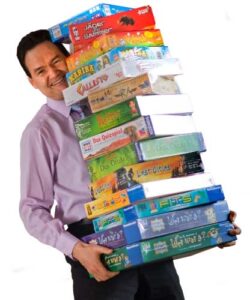 AM: Reiner, you’re one of the most successful board game designers in the world. You’ve had 100s of games published over 40 careers, and we have been spending the past year celebrating your game designs with our Reiner Knizia Alphabet series, from A to Z. Looking back over your career, what would you say are some of your high moments and maybe even some of your low moments? Maybe when you looked back and said, yes, I nailed it, or maybe I wish I would have done something different.
RK: I’m, I’m, I’m very happy that I can really say I only had high moments throughout my life. My life was not struck by any disasters, nor conwood. I had some significant changes in my life when I went to the U.S. to study at Syracuse University, so that was a big shift in my university life. Then I went to England for 18 months and got stuck there, but deliberately for 23 years. So these are changes if you count locations, I lived a year in Vienna, in Austria, I love Vienna, the city.
RK: So, I’ve learned that when I go for a change, and of course, the major one, I haven’t even mentioned the change of jumping out of my current career in finance into my self-employed little company, this game design. So these were major changes, but all of them turned out very well, all of them were thought through, well, and I think I used all the opportunities. So, from university where I enjoyed to teach and to research, to going into IT and banking, where you can, so to speak, run very big wheels, with lots of money involved, meet interesting people. This is always the thing you have a big network you meet people. And then, of course, jumping into, into my heart, essentially, where I found my, my, my colleague and going into game design, and game design is something that really energizes me. And so, I’m full of energy, and, as you say, so far, 800 games, and I want to do 800 more.
AM: That’s wonderful. Let me tack onto that. You mentioned that you feel energized by game design, but how do you stay so creative? I mean, it’s incredible.
RK: It is true, there’s no point in resting on your laurels. You see some behind me. This is… This is really the challenge of staying relevant, and doing things that people still want to play, and which catches the people’s imagination, and it attains them. So… Games are really a mirror of our times, and of course, as time has moved on quite a bit, the world has moved on, and there’s lots of digital things there, there’s different movies, and there’s… If you go back 40 years when I started, the world is completely different. We didn’t even have desktop publishing at that time. We didn’t have the internet. So, madness, what has happened? But this is very good, because for a creative job, nothing is worse, and if everything stays the same. And they certainly cannot claim that everything stays the same in our mad world, yes. And so, what I really love is new challenges, and, uh, I jump on them because they force me to leave the trotting path. And yes, I’m a scientist, but game design is not a science. Game design is an art. If you have a methodology, how would you design, you are not creative? And so, when new opportunities come, like, during the Lord of the Rings game, which forced me to make a cooperative game. Forced me in a way, saying, I need to be true to the Lord of the Rings; you love the Tolkien masterpieces. And, of course, the viewpoint is, we are the fellowship. So how can I do it? I have to do it competitively.
Then we had electronic games. So our bestseller is Ravensburger. Who was it? This is, you begin, a cooperative game out of accident, but it’s, you have the electronics next to it. You still sit around the table, but how do you integrate that so that you still have the feel and get the atmosphere from the box, but you still are in control, and, you know, cooperative game, everybody can do their contribution to a little smartphone games on the little screen.
So this is, this is the challenge I want. This is the challenge I need. This is the challenges I jump onto. And of course, it’s also keeping the eyes open and seeing what’s out there. I get offered to do a game about licenses or any new technology. And so this is what I want to do. Doesn’t mean that the other games are still running in the same, so to speak, river, but it’s looking, you know, it’s looking. I apologize, I warn you, I have the long answers, but it’s, it’s, it’s looking what is out there.
Of course, my ambition is to set new trends, and I think with the cooperative games, I’ve done that, and maybe also with the abstract games when we had a genius out and blockers, not my game, but these 2 were successful, suddenly we broke this self fulfilling prophecies of the publisher saying, abstract games do not sell. Suddenly they sold, and so this happened. But there are many really, really good experiences, ingenious, game designers out there.
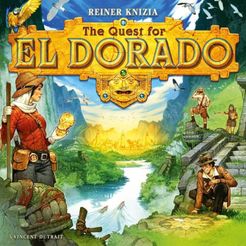 So sometimes, I have to play the second fiddle, and I think then looking, for example, The Quest for El Dorado, where I said, can I not bring deck building games to A? This is the letter E, to the wider public and takes the complexity out. And have something which is very natural. What do I want to do? I’m not going into depths or in a legacy game with My City. Can I not offer something in 20 minutes where people can experience this without having to go into that very deep set of rules which we had before this legacy games.
So, long answer again, but it’s multifaceted how to stay relevant and how to create new things. And I have to say that, I’m cursed by new ideas. So this is also important. An idea is a starting point, but then comes a long design process, and if you’re sure of ideas, then kind of, you are desperate, okay, I have to make this work into a game. It becomes forced. Whereas, I have a very nice evolution process here, because there’s so many ideas that get developed, and those who do not perform so well as I want, they fall back, and it’s always the best crowd which comes to the top, and they get developed onwards, so we’re never short. I mean, we are testing again in 2 hours. And I have so many things to test. I hope these people stay until midnight, but probably not. So, this is also to be able to choose what works, what doesn’t work.
AM: That was wonderful. Well, cool. Andrew and I have some quick fire questions for you. So we’ll give you a chance for some short answers as well, right? Andrew, why don’t you go ahead and start?
AH: So, I mean, trying to get an idea of you as a person as well as your games. Just thinking about things like, what’s your favorite cuisine?
RK: I… I think I don’t have fun. Maybe it’s, um… It’s pasta, spaghetti. That’s it. I’m a pasta, a pasta person, so, um, but, um, there’s, there’s not one direction. I mean, we live in the middle of Munich here, and there’s so many restaurants and the variety is also, is also great. So, of course, Bavarian food where I come from, home food is always nice as well.
AH: Wonderful. Uh, tea or coffee or some other form of drink?
RK: But I mentioned 23 years in England, so the answer is tea. Um, I’m trying to stay away from the inverted corner’s drugs, uh, because you get some coffee and caffeine and all this stuff, because you get used to it, and you just get a level, and it’s not better, but you just have to consume them. So, uh, I know when I really need to be fit, and when the evening is wrong, because I’m an early bird, and I really need to push, and I drink a little bit of coffee, and then, phew, because I’m not used to it, so it really has an effect.
AH: So you’ve lived in the states you live in the UK? Obviously, you’re originally from Germany. So breakfasts: full English, or the Continental, or the American pancake stack.
RK: Uh, no, no, not the full English breakfast. You know, When I usually get up, it’s 4 o’clock in the morning. But what I try to do is get in 2 or 3 hours of being efficient and when it’s quiet. So my breakfast comes usually around 8 o’clock. I’m not sure if that is according to science, but science on nutrition and eating is so confusing. You don’t know. So you need to listen to yourself. And that works for me because that’s my 1st break. And then it’s either a cereal, so it’s more the carbohydrates, or very often I could just put an egg. I’m not a cook, put an egg into the pan and put something with it and have a little omelette or something. And that’s my start to it. I know when I eat a lot, or if I eat sweet stuff, I fall into a coma. So that’s not good for a working concentration. So it’s very often a salad at lunchtime and lots of nibbling, lots of little things, lots of dark chocolate, lots of nuts. Full of antioxidants. Wonderful. An excellent healthy diet.
AH: So you obviously moved back to Germany, relatively recently, after the unfortunate Brexit vote, and I’m sorry about that. But since then, there’s definitely been a sort of a resurgence in the appreciation of your games. I think, within the hobby, at least, certainly starting with, sort of, The Quest for El Dorado, and Yellow and Yangtze, for instance, and you seem to be more and more popular than you even were back in the, sort of, late ’90s, early 2000s. Is that, in any way, linked to the move and returned to Germany? What does your base, do you think, have an impact on what you’re designing, or are there other reasons behind this, do you think?
RK: This is very difficult to say, and there are probably many different theories. I think it’s a lucky coincidence that you suddenly get onto a positive wave and things, right, and one thing adds to another one. But I think it also has to do with me now having found the long-term base in Munich back in Munich. I could develop a team and really get a team of colleagues around me who very professionally take over some of the very exciting tasks of showing games to publishers and contract management. and all these things. So, I have found colleagues which help me to concentrate on what I do best in that games.
RK: So, in this respect, I probably have a bit more time and have a bit more opportunity to retreat and think deeply about developments. I’ve also now achieved a place in day-to-day running, just running. Every quarter, I take a design retreat for 2 weeks. Just 100 miles down the road, somewhere very easy to reach, but away, for two weeks, nobody there, nothing to test, but lots of projects with me, and to deeply work on these projects, and I enjoy them. They energize me, and I’ve always looked forward to them because that’s really a very, very intense phase of designing. People say, well, you’ve been away for 2 weeks. Now you’re rested and come back. No, I’m exhausted when I come back. But this is, I think, another point of having the piece of thinking deeply about new designs. And probably the rise of crowdfunding and being able to give deluxe versions of our old classics from the 90s to revive them and so on. Because some of them are still very, I think, very up to date and very relevant. And so that has probably added to this aspect as well. So that’s my 20 cents.
AM: Can I interrupt? I want to tack on to that question for a moment. So you talked about your uh, your 2 week getaway. When you begin envisioning a design, how quickly does it go from purely mental to some form of actual tangible pen and paper, cardboard cutouts, paper? How quickly does it go from mental to actual manipulative components?
RK: Yeah, that’s a very important question, because if you go too quickly into prototyping, you don’t get proof of concept in a way. So I’m usually on the other side that I sometimes spend a bit too much on research, on thinking about it, getting already getting the initial graphics into place. But for me, so it comes a relatively late stage, and I know it can only be disappointing, because when I see a game through to the end in my head, so that I say, okay, now it’s ready to be prototyped, then, of course, it worked very well, and in my head, it plays perfectly, but in reality, you start fresh again, and you see what you, it’s all your experience.
RK: Nothing worse, because when it’s on the table and you play it, you see it for the 1st time. But what I have seen more and more is that I’m, I have an integrated, holistic process of designing. That means I would, you know, have an idea, I would read about the theme, I would research this theme, um, I would, or look for a theme depending where I start, yes, and look for a seaboard. So, things inspire it, cross virtualize themselves, because when I have a theme and read about it, it inspires me about mechanics, mechanisms.
RK: If I think about components, then I sit in front of the PC, and I would draft, how would the card look like? How would the board look like? I say, Okay, can’t put that in there, because it’s too big, or I don’t need too many spaces, it would be too small. So it is really growing as a whole. It’s not, I have the rules, and then we test the game, and when the game is finished tested, then I start making the product. No, it grows all together. That means also later in play testing, um, The graphics would, I mean, it’s not final graphics, it’s clipout and so on, but the graphics would grow every time, okay, this is too dark, we can’t differentiate, and that icon isn’t very good because it’s similar to this one. So, it grows when the game essentially then is tested, and I put it aside for two, 3 weeks to get rid of a distance, and have a final few tests, you say, Am I really happy with it? Then there is not too much to be done to make it into a final prototype, apart from, really, then polishing up the rules, and making the final components, and printing everything new, so that it’s fresh.
RK: But before we come back to your question very briefly, usually, my rules are already written up before the first play test. And again, writing up the rules, you see, well, you really need three paragraphs to solve this little thing. This is too complicated. So I also see how, because I believe in… simple rules, so that people can cross the game quickly, can get into the game quickly, but then I want the depths to develop through people’s places.
RK: So, again, a long answer, but sometimes I know it’s my weakness, I fall in love with the process, and then sometimes I say, okay, I’ve done all the nice graphics, and now I put it in my put it away. But then, it, it’s a process which satisfies me, satisfies me completely, because I can do this holistic work in the seed shape altogether. So just to do a quick and dirty, peaceful, try it. It’s probably more effective, but it’s not satisfactory to me. I’m a software engineer by trade. I’ve been doing that for about 25 years, and so the focus and goal of terseness, of being able to express a statement or a function in as few lines of code as possible while still maintaining readability, is… It’s a joy, the outcome.
AH: You spend a lot of time designing in your head to begin with. But obviously you’re fluent in German, you’re fluent in English, possibly more, I don’t actually know. What language do you design in your head in?
RK: Mostly it is English, and, uh, all the prototypes are in English, and my notes, I keep very detailed notes during play testing; also in English. Of course, it comes from the history in England, but it has also got the advantage that all my rules are written in English, because we have a worldwide network of publishers, and I can’t write the rules in every language, so the best language to communicate in is in English, and therefore, it is this holistic approach. So, then I have the right terminology, and I don’t need to translate it, and I see people get confused about this, so I need a different name. So it, even the language, so the rules in English grow during play testing.
And there’s another aspect. Forgive me for saying this, but the political correctness engendering in German, you cannot write proper rules anymore, because you have to put every gender, everything in there. It may be politically correct, but it is no joy to read. Yeah. Sorry, give me now I can get a shit storm, but that’s what it is, therefore, therefore, I stay with English, because in English, the player is a player. It can be male or female. In German, if you say Spieler, then it is only male, then we say Spieler or Spieler in, so people don’t say player anymore, say person. And so the person. And it’s not a person, it’s a player. Anyway, enough said.
AM: That’s a great answer. Let’s go ahead and do a couple of quick fire questions again. What is your favorite genre of music?
RK: That is, uh, an interesting question. I do not hear lots of music, but… It is certainly non vocal, so no voices there. It’s just instrumental. It is a classic instrumental. Sometimes I put it on when I were creative, that helps you relax and get into the mood. Any voice, any sentences, any statements, just distract me. So there are the classic, the classic ones, but this energy and drive, not the snow ones.
AM: I’m the same way, actually. When I’m writing code, I sometimes have to focus and I’ll either turn off music completely or try to go something that’s instrumental, usually electronic or whatever, because like, but if it’s got too hard a beat or too many vocals, I keep focusing on that.
AM: Okay, this one’s gonna be a hard one: the clatter of dice or the riffle of cards.
RK: From a field, the clutter of dice.
AM: Okay. That’s… the most simple answer. I love it. Okay. If you could have access to only one, which would you rather have, a handful of dice or a deck of cards?
RK: I feel in this case, I would have to go for the take of cards, because it’s more flexible. You can do many more things with cards.
AM: Excellent answer. Andrew.
AH: Yes, sir, thinking about Carlos, thinking about the types of things you incorporate into games. Like you mentioned earlier, that you’re sort of, you’re known also for games like, who was it you incorporate technology in? But technology is always changing. So are there any technologies that you haven’t yet sort of incorporated into a game or user? Is there anything you’d like to in the future?
RK: Oh, there are a lot of technologies. I would still like to incorporate, but they haven’t been invented yet, so it doesn’t matter until they come around and then I snatch them up and do them. So there’s 2 things. The technology needs to be there, but it also needs to be affordable. It needs to be safe. You need to be able to produce it in a manner that it can be put into a game. It needs to be robust, so you can’t experiment with things.
We experimented once, and I’m very grateful to Ravensburger. Brownsburg is the market leader, essentially, in Germany for games, and I’ve published more than 100 games with them over the many years. And so they are the classic family games. And we had a technology where we had conductive ink. And so, this was actually a company who developed it in England, not very far from where I lived, and so Ravensburger was there, they introduced me to it, and it essentially meant if I put a… finger on the battery, or is good, and if I put a finger somewhere else on the board, then a lamp will go up, because the current, the current goes through me. So, in the the board will also be conductive, and so you have the circuit for the flow of the current, and therefore, you get the light on, and this was something, a real challenge. That’s like this. How do you make a game out of it, yes?
So, um, so, it was clear to me that, of course, we don’t want the light, but we want a loudspeaker there, and the nice thing is, so, you can then touch different areas, and the different areas will be connected differently to the last figure, to the electronics, so the unit knows where you are, which is very nice. And then you always need to touch the battery. So you make a children’s game, you tell the parents, okay, your kid will have to do this, and then you put the battery in the current will go for the kid, very good. Yes. Oh, uh, but then, we disguised the bedroom and said, It’s not this, I know I want to touch my figure, and you can actually differentiate the figure by different, um, uh, resistances in the figure, yes?
So, you can see which figure is there. So you know on which space I am, because that’s the different parts of the conductive areas, and, you know, which figure there is, and why do I have to put my other finger on battery? And so, what we did is, we don’t have one little button, but several buttons, where you put it on with its imaginary button, because then you take a decision. What do I do with my figure? Do I fight, or do I run, or do I befriend, or do I give a gift? And so, suddenly, it becomes very natural. This is my figure, I’m here, and this is what I’m going to do. And suddenly, it all becomes very natural.
So, what I’m saying is, sometimes, a very primitive thing of touch here in touch here, and the night goes on, can be developed into a nice game. And so I’m always on the constant lookout, but of course, the publishers even more, to see what technologies we have, and then see what we do. I cannot do such technology games by myself. I need a publisher resist, because production is much more complicated. But these are the challenges I love. So that’s one example for that. And now, I’m on, guys, technicians, develop some more stuff that I can do more games.
AH: I love it. You know it’s interesting talking about these themes of children’s games, and of locations. What would be one of your favorite historical periods: Ancient Egypt, ancient Mesopotamia, ancient China, etc.. What would be one of your favorite historical themes?
 RK: I love history. Because history gives you an instant understanding where you are, what you’re wrong. If you see a pyramid, if you see a pharaoh, you know I’m in ancient Egypt, and you know the roles and so on. And quite a number of my classic games from the 90s are based on historic themes. You mentioned a few. So, and my absolute favorite period is ancient Egypt. They just did amazing things, but I mentioned my colleague, Zubrita, is our licensing manager. She speaks to the publishers and shows them the games and tries to play them in the different publishing. She has said, “you are not allowed to do any more Egypt games. We have too many, and you can’t differentiate them”, and I’m not allowed to make any more games about penguins, and so this is a restriction I get internally, but it’s good. It’s a new challenge. So, we’ll see. I love it.
AH: Is there a historic period that you haven’t yet covered that you are interested in? And actually in a similar question, are there any themes or topics that you just don’t have any interest in?
RK: Instagram, any seems, topics, historic periods where I wanted to make a game about, I would make it. I would do it, so I would have done it. So, of course, I’m constantly on the lookout and see what has not been overdone. And that’s one of the important things about BoardGameGeek, is, of course, giving us all the all the information wonderful, the source, to see, okay, there have been Renaissance in Italy, don’t touch it, it took 100s of games. How do you differentiate yourself? So it is the lookout for new themes, new themes can be historic, but something which has not been overdone. But this is still relevant and this can be recognized by people. So that’s always interesting.
RK: But it doesn’t always stop is a theme, of course. What do I not want to do I don’t want to make games which glorify bloodshed and violence and any of these. These things which we have, unfortunately, enough in the world, and we don’t need to emphasize it when we sit together with friends and play. There are many other themes. So then I will shy away, and then I will also oppose when a publisher wants to go this way. Either with the theme or with graphics, which is just too bloody. So board games, I mean, you know, chess is a war game, so where is the image? And then we have a short and taught no battle line, which is just about a fight where you put out card combinations about cornerstones. So, this is fine, because you can do it in a funny way that it’s got surf there, and they fight over the clans. This is a nice theme, and it’s not bloody, it’s funny, it’s satirical. That’s fine. So it’s also the way of presenting a certain theme or approach. Yeah, thank you.
AH: I appreciate that. Keeping it sort of historical, but, I guess, more recent history, your sort of gaming history. We have seen a lot over the last couple of years of revisiting some of your earlier designs, so that the VRA, the samurai that’s become handmade, Rheinlander is out on Kickstarter just at the moment, as we’re speaking. What’s it like going back to visit all these earlier designs? Is that an enjoyable? Is it revisiting children that you’ve not forgotten about, but not met? Are there any games that you feel like were hard done by and sort of need a, would like to revisit?
RK: Yeah, and as mentioned, you very rightly say that we have a renaissance of these more classic games, and it’s essentially mainly due to the possibilities we are crowdfunding. We have to Kickstart is one of the main ones. Because this allows the publisher to put extra things in to put nice components in, and I also would sit down and say, okay, this is one of the classics Camino blue on the back of the board. Can we offer a different board or an extra expansion variant and so on? So I’m very keen on leaving the poor game, the classic game as it is, but then we can put things on the side and offer some extras. That’s something which refreshes the game, and but it also, this new approach, I think, opens new players, opens the door for new players, it gets a new audience, because younger generations play very different games. They may not be aware of these classic games, and quite a number of them have actually stood with a proof of time, and you mentioned a few, and we have Euphrates and Tigris, the Tigris & Euphrates is coming out next year. So, I think in next few years this is very close to my heart, the game, and it I think it’s a very nice, good classic. And so, I’m very grateful that these opportunities arise.
Now, I only release a game. I mean, it’s, there are lots of games which don’t make it to the final, so they never see the light of day. And that’s fine. This is the evolution process which we mentioned. But I see some games from the 80s, from the 90s, where I say, that was a good game, that worked, but today, it has lost its reverence. Because it is too slow, it is a classical, the dynamics people want to do it. It’s just not what people want to play, and there are many other things, which I would say rather play these. And then I don’t need to force them and say, okay, take a second rate gap. Today’s 2nd rate game in today’s judgment, yes.
So, uh, I accept that some of the games, I made a long time ago, uh, are no longer really suitable on my first choice for today’s role. Therefore, I say, okay, fine, they have done their job. I’m very grateful for them, but I don’t need to force it and make them worse or gives them a bad ending. Yes, they had the good time, then I leave it with them. So, with this respect, I don’t have to put everything which has been out of print for years now, put it back into print. And if there is something, I mean, the classic games are quite in demand. So whenever we have something where I think, okay, this is good, this is something we can [rerelease].
We have Merchants of Andromeda, which recently came out, which was the Merchants of Amsterdam, which had this mechanical clock. We don’t have the mechanical clock now, because it was difficult to produce. It was a real… nice thing to look at, and it made people… give them attention to look at this, what is going on, with this Dutch auction going down, with surprise until you accept it. So, um, sometimes it needs to be worked a little bit, and when I think we can do it, I would, and if I think, no, this is not going.
The Last Paradise, for example, is one of these games, where I’ve taken it out once or twice over time, and always when we played it, I came to the conclusion. No, it had its time. I don’t want to force it anywhere. And so believe it, it’s fine. Yes, so, no regrets, and nothing, nothing. So this disrespect when you ask me, is there anything whichhes, so to speak? has an undeserved end, it should be revised, I would revive it. Yes. and but not everything has to be revived. Some things can be left in peace. I think that is an excellent way to end that particular topic. Not everything needs to be brought back.
AM: You should tell that to Hollywood, Reiner.
RK: And not everything needs an expansion.
AM: That’s right All right, a couple more quick fire questions. What is your favorite book? Could be of all time, could be a current book, your favorite book.
RK: My favorite book? Book. Book. Oh, this is… this is hard. Um. It is certainly not… I’m contradicting myself. You’re catching furious. So I said, it’s certainly not a piece of fiction, but in this context, I would actually say it’s in this game. And this game is a piece of fiction about players. I’m not giving you a spoiler, but it is something which is fantastic to read, a good description of characters, and the storyline is very nice, and it’s for gamers. That’s, I have a lot of business books which I really love, but I think people would not be able to relate to themselves. Even with industry. In this game, it’s an excellent book.
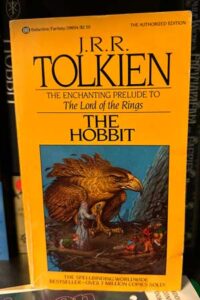 AM: All right, along the same topic, The Hobbit or Lord of the Rings.
RK: I have to say The Hobbit, because that goes in line with me, keeping things simple, and the storyline, and there’s a lot of tips in the hobbit, but it’s still more accessible. The Lord of Rings is overwhelms you. It invites you for big, gigantic storyline and game. And I like more the… reduced to the essentials, and The Hobbit is more reduced to the reception.
AM: Uh, yeah, I feel the same way. I was given the entire series, The Hobbit and Lord of the Rings when I was 10, maybe. And I read The Hobbit, and it was amazing, and I tried reading the Lord of the Rings, and I was scared. Right? Like I literally, I didn’t read the rest of the series for probably another 3 or 4 years after that. The Hobbit feels, uh, it feels like it’s it’s encapsulated. You don’t have to read anything more than The Hobbit, but with The Lord of the Rings, you kind of, you’re introduced to the entire world and, you know. I love it.
AM: Okay, so we’re coming close to time. We have one main question that we’d like to ask you, and then, depending on if we have time, we have a few other questions that we can also include. So, uh, you’ve been designing games, as we’ve talked about for over 40 years, uh, and we hope that we can continue to see many Rhiner Caninsia designs uh, for many years to come. The industry has changed over that time. Uh, and you have a decline in popularity, risen in popularity, and you as a designer have responded to those changes. What do you think your impact on the industry is going to be? What is your legacy going to be?
RK: Okay, um, my friend, I uh, decline, because that’s not for me to judge. It’s, I want to be humble enough to say, yes, I am very proud of what I’ve created in my legacy, but the judgment of what that does for now and eternity. It should not be up to me. So, um, I’ve mentioned a few things I’m proud of, but uh, let, let, let, otherwise I’m, I’m, I’m too arrogant if I now start talking and, and blowing my own trumpet.
 AM: That is well answered; I appreciate that. Well, let’s go ahead and let’s do a couple of wrap-up questions then. One of our writers is friends with someone in the Reiner Knizia Discord group. And apparently Bitewing games released an alien plushie as part of the the Cosmic Silos trilogy—EGO, SILOS, and ORBIT—that came with the alien. Does that alien have a name?
RK: No, I’m not aware that this has a name. Um, we have actually also, um, participated a little bit in the production of the, not in, not in the production effort, but we have taken a number of these as well, but without the aliens. So, we are actually handing them out to our business friends and business partners, and it’s nice, I hope they won’t use it as voodoo dolls, but so I don’t know, and I said, we sometimes put cookies in there, often put cookies in there because we use it a little bit more generic than the aliens, yeah.
RK: The name for the aliens, but I should say, well, one of my favorite, I should actually have said something else. You know, my favorite book, actually. I have to correct myself. My really favorite book is The Time Machine. Oh, yes.. That is fantastic. So, um, I corrected myself, I stand corrected, number one is the time machine. number 2 is I, I, forgive me, number 2 is, uh, I don’t have to do it. I have 2 favorite games. There we go.
AM: All right. We can go back in time and change your answer. No, we probably won’t do any editing. Okay. So, uh, one of the, uh, one of the hallmarks, in my opinion, of a, uh, of a Reiner Knizia game is the tension between what you want to do and what you were able to do either through, um, artificial limitations or components, you know, you don’t get the right card draws. What is it about that tension that really appeals to you as a game designer?
RK: You know, life is great if you have so many things to do, and not enough time. And because otherwise, if you’re bored, you don’t longer know what to do, this is not good. So, my life is great because there are too many games to design and too many other things to do, and essentially I want to find the same thing in a game. I don’t want to sit there and say, okay, I have nothing really to do. What’s my next move? Okay? This is boring. So, I want the game to be exciting, and that means I want to give you so many options, so many things to do, so few turns, and I want to do this, and he’s going to do this, and she is trying to do this, and I need to do this, and you sit there, you bite on your fingernails, and you watch what the others are doing, because they’re all after you, of course.
And so this is what I really want to build in there because this is what I say when I, when I, when I express relatively simple rules, yes, when we, we’ve just released through the desert again. So all you do is you take two of the canals and put them on the board. That’s all that happens. But they’re coming from everywhere, and they don’t take a look at holes away. you block you off the off the, um, of the OA, this. And this is… this is what I can create through the interaction of the players. And that is what gives the game the depth, even though the rules place two camels, are fairly simple. Yes, but what happens, Zenis, comes all through the players, and that’s what they love, and then you play with different players, they play differently, and the game will be different.
AM: You perfectly described one of the things that I both love and hate about some of your games. It’s that things would be so much better if everyone would just get out of my way. But they wouldn’t, actually, you know? No, okay, sorry. Oh, that just makes me laugh.
And given that I’m laughing, what makes a game fun for you? Now, to clarify, this could be you as a player, you’re playing someone else’s design, or if you are intentionally creating a game, you’re like, I want this to be fun as opposed to, you know, I’m going to stop. What makes a game fun for you?
RK: For me, a game is always interactions with other players. That means the fun is when I have the fun with other players. I would like to see, and that’s what I’m trying to create, is the game is a platform, where the players engage, and you have the fun by, and fun, is, as you say, can be very, very different things, exploring new things, laughing together. But it is essentially games are about fun, about entertainment. It’s a leisure time. It’s not something we have to do, and so it’s drawing yourself in and having an exciting, inspiring time with other players. That’s what the games are like.
AM: That is that is exactly me. Um, I know solo play is a very popular thing. You know, you can play on Board Game Arena, or you can play solo. I always like to say that apparently I just don’t like board games enough to want to play them by myself or to play them online. That’s not a knock on anyone who does those activities, but my focus is that I want to play games with people. The face to face is the important thing for me. So yeah, I resonate with that answer.
RK: Thank you. But you also see that these are different desires, different needs, people have. And I sometimes take my tablet out and play a little Italian. So play a game with an AI mode or just a solitaire thing. So not the parts are take, but something which you can play by yourself. And there are, and it’s a nice 10 minutes entertainment, but it’s a different need. It’s a different satisfaction. It’s like, when you do crosswords, when it’s, it’s also satisfying, yes, but it doesn’t mean it replaces my game.
AM: Agreed. Yeah, it’s the focus right? If I want face-to-face interaction, I’ll play a board game at the table, but for me, like crosswords, that’s a mental acuity. That’s my main focus is I want to like exercise my brain. I want to, uh, you know, challenge myself. My family has a text message thread that’s been going on for about 3 years where we post our Wordle scores. So I love it.
Andrew, you want to pick up anything? We got time for maybe one more question.
AH: Yeah, if that’s right, we’re approaching Christmas when we’re recording this. What does Reiner Knizia want under the Christmas tree this year?
RK: I have a very clear agreement with all the people around me, specifically with my wife, no presents. Because what I hold hearty can say, I have everything I could wish for, for everything I could buy with money. I’m healthy. I have a wonderful wife. I have an environment which is very positive. There is nothing I need, and therefore, let’s not force something as a present. So nothing under the Christmas tree, just the gratitude of things are perfect, and I don’t need a present. My present won’t make it better.
Do they, do they listen to your, your boyfriend and friends, they actually listen to, to that for a statement? I find, when I say I’m very happy, there’s nothing I want or need. I just get ignored. And sometimes, when we invite people and say, Don’t bring a present, they just can’t do it, because they think it’s impolite. They bring something, as long as they bring something to eat some cookies or something, it’s fine. I’ll eat them to the testers and that’s okay.
But, you know, there’s so many presents. I don’t need games as presents. I have I mean, whatever I want, I buy. This is the point, and it just forced something, and then it mingles here, the vase of the aunt has to be undusted every time she comes in. so this is even the opposite for. No, it’s I have no wishes for Christmas. If I had any wishes, I would fulfill them. So it’s this is a wonderful wonderful life and I’m very well aware of it and very grateful for it. Universe is good to me.
AM: Uh, I think with that, we’re gonna end the recording. Thank you very much Reiner Knizia, thank you. My name is Andy Matthews. We have been interviewing Reiner Knizia. I’m with Dr. Andrew Holmes, and you will be able to find this on YouTube shortly. Thank you again so much for your time and I really appreciate being able to talk to you today.
RK: Well, thank you for your invitation. It was a pleasure. It is a pleasure. Thank you.