

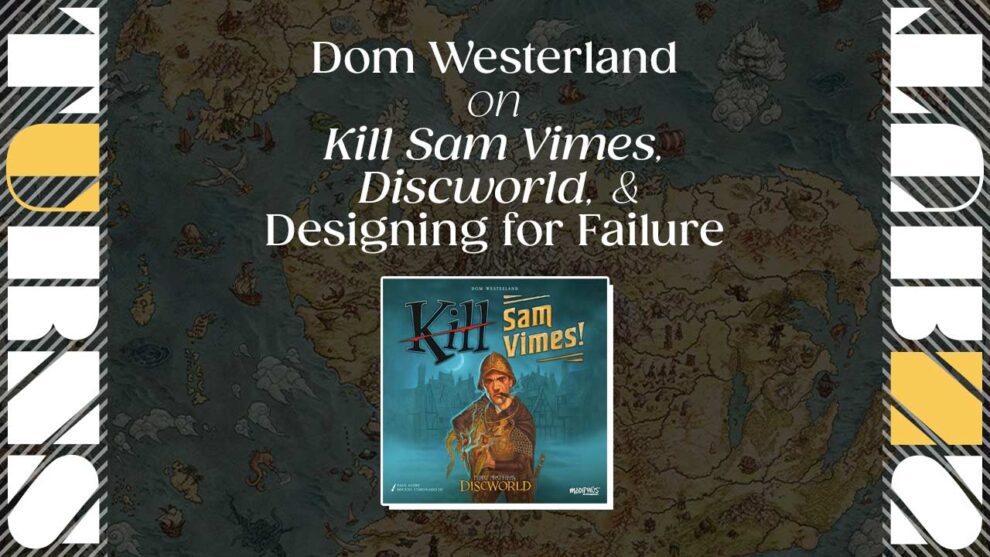

There may be easier assignments for an assassin than trying to kill Sam Vimes.
In Kill Sam Vimes, the upcoming Discworld board game from Modiphius Entertainment, players control aspiring assassins attempting to do exactly that. Of course, anyone familiar with Terry Pratchett’s famously stubborn Commander of the City Watch probably knows how well that is going to go.
Designer Dom Westerland has spent years working on games at Modiphius, including licensed properties such as Fallout, but Kill Sam Vimes presented a very different challenge: creating a relatively light, chaotic game that could capture some of the personality of Discworld while remaining approachable to players who may never have picked up one of Pratchett’s novels.
We spoke with Westerland about his relationship with Discworld, designing around spectacular failure, why commercial realities sometimes shape game mechanics, terrifying prototype versions of Sam Vimes, and the Discworld novel he would most like to tackle next.
This interview has been lightly edited for clarity and readability.
Entering Discworld
MM: Before we talk about the game, what is your personal history with Terry Pratchett and Discworld? Were you already a fan when the opportunity to design Kill Sam Vimes came along, and is there a particular book or character that means the most to you?
DW: I had dabbled a bit in Discworld prior to working on the game, but I was mostly brought onto the project because I was the least familiar with the source material on the team.
I have read five, I think, of the books: three Witches books, Guards! Guards!, and Monstrous Regiment, so certainly nowhere near all the canon.
I’ll take a sideways shot at the last part of the question. The characters that mean the most to me in regard to Discworld are the fans themselves.
Personally, I am not a mega fan of the property as much as some people in the office are. See the team on the RPG for that! But I have spent some time around the fandom via cosplay, and these people are just the best. They are so passionate about this world, and even to a layperson like myself, it is truly infectious.
When starting to work on Kill Sam Vimes, more than anything I wanted to do this game right by them.
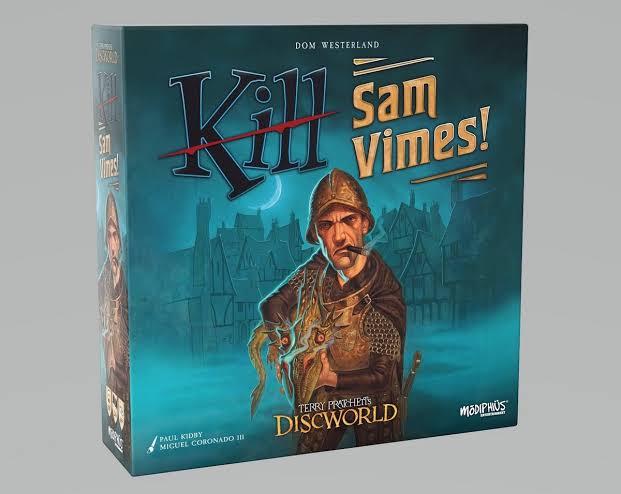
MM: Of all the characters and stories you could build a Discworld game around, how did you arrive at the idea of a bunch of Assassins’ Guild apprentices trying, and inevitably failing, to kill Sam Vimes? Was that premise there from the very beginning?
We threw around a few ideas. It was a group process of people throwing ideas into a hat, seeing what we liked, and then pitching them to the top brass at Modiphius to see which ones they liked the most.
The Assassins’ Guild idea that became Kill Sam Vimes was always in the mix.
My favorite one that didn’t see the light of day was based at Unseen University during lunchtime and involved using magic to ensure your wizard got the best picks of the buffet.
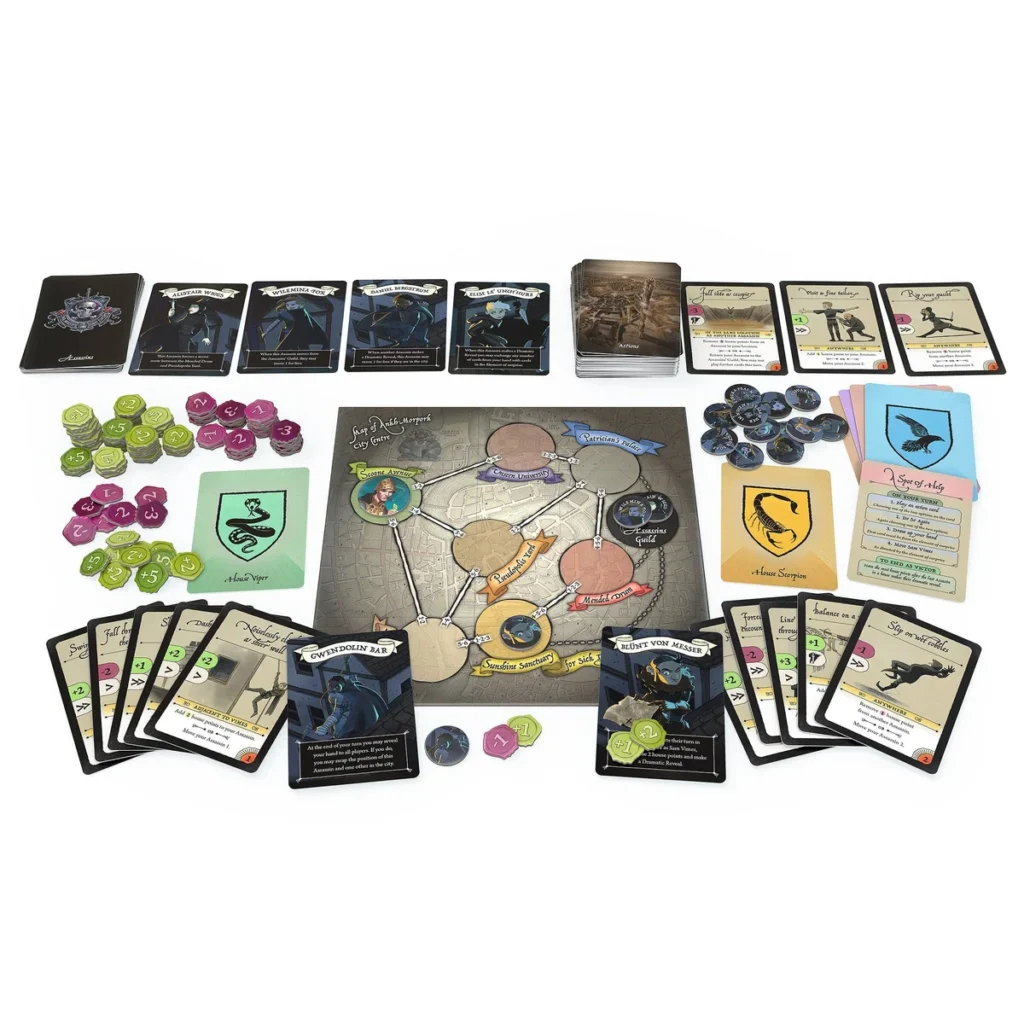
Kill Sam Vimes became the pick in the end because, as I remember it, there was a push for the game to have a board of some description. A miniature map of Ankh-Morpork felt like the most natural inclusion for this, hence the one included with the final product.
Designing Around Failure
MM: One of my favorite things about the premise is that everyone already knows they’re not actually going to kill Vimes. The objective is essentially to fail better than everyone else. How do you design a competitive game where failure itself needs to feel satisfying and funny?
DW: I think it comes down to keeping the humor separate from the mechanics.
You can have your funnies embedded in the overarching concept for the game, like assassins using Sam Vimes as a training exercise for how they would theoretically kill him, but then it should sit out of the design process until the very end, when you come to add flavor onto the game pieces via art, text, or both.
The other part of keeping losing fun is giving folks another chance to jump back into the game if the first attempt goes south. In Kill Sam Vimes, players generally have multiple assassins they can throw at Vimes, so if they don’t succeed the first time around, they can have another go.
I also think having some “stab your neighbor in the back” mechanics helps take the sour edge off losing.
You just lost your favorite assassin? Well, that player is going to be the target of your ire for the rest of the game!
MM: Pratchett’s humor is obviously a huge part of Discworld, but simply putting quotes and references on cards wouldn’t necessarily make a game feel like Discworld. How did you try to express Pratchett’s humor and satire through the actual mechanisms of the game?
DW: Kill Sam Vimes is pretty mechanically light on purpose, so there wasn’t a ton of mechanical space to inject that Discworld spice into the game system itself. That is part of the reason the aesthetics on the cards do a lot of the heavy lifting.
The mechanical aspect that does bring that Discworld feel, I believe, is the multiplayer “do your friends” experience of the game.
It leads to a lighthearted kerfuffle, with each player calling someone else out, vendettas being made, and deals being broken.

Cards, Assassins, and Commercial Design
MM: The game uses multi-use action cards. What attracted you to that system, and what kinds of decisions were you hoping players would wrestle with when deciding how to use a card?
DW: There is a brutally simple answer for this one.
Multi-use action cards were picked because they allowed us to squash more information into a smaller box.
Sometimes, as designers and developers in commercial games, you need to look at a game as a product first. We needed the game to fit into a box that would neatly sit on a shelf in a bookstore, and multi-use cards allowed us to do that.
Regarding player decision points with the cards, we wanted a small amount of decision-making. I say small because the game is meant to be fairly speedy.
When the player is looking at each card: Which of the two actions do I use it for? When I get a new card, do I want to take one for the abilities on the card, or do I want to choose one based on how much it will ruin the plans of other people at the table?

MM: Each player controls a different House of assassins. How asymmetric are those Houses, and how did you approach giving them distinct personalities or strategies without creating a nightmare to balance?
DW: The Houses themselves are mostly player aids, and they don’t have a major impact on gameplay beyond being somewhere to stash your points.
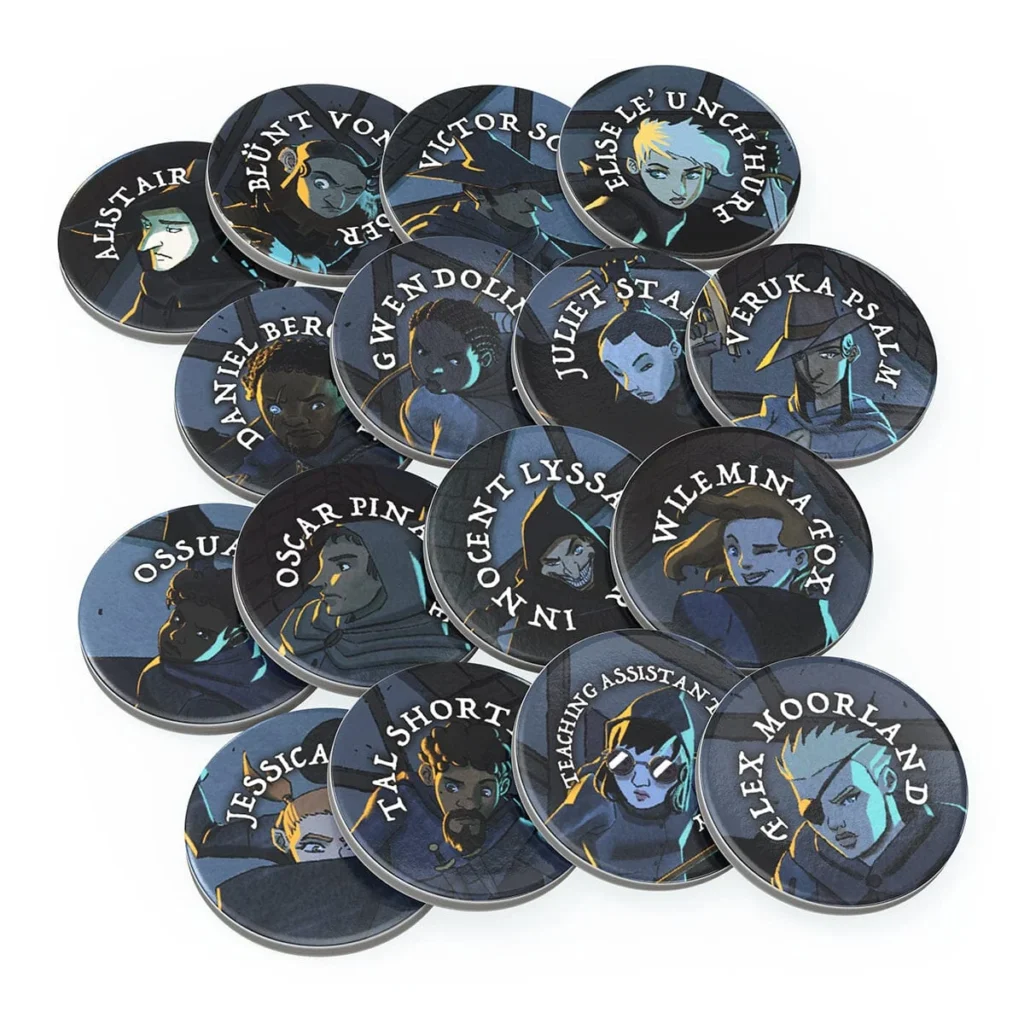
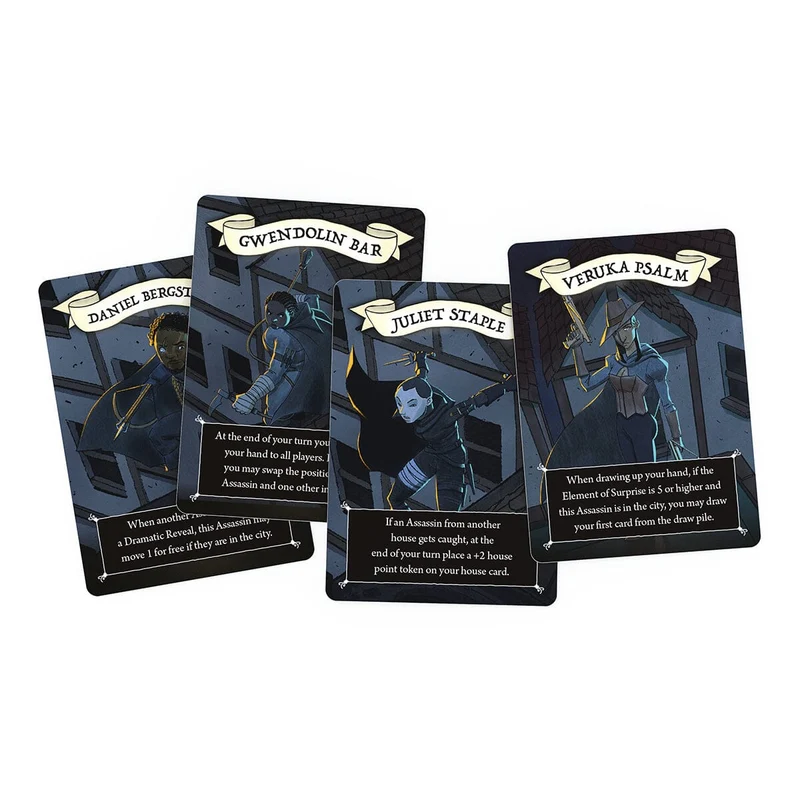
The individual Assassins are where we asked what the characters should feel and play like.
Balance is a mutable term across the different games I have worked on. It is always going to be there, but the importance of utter, complete fairness will shift from project to project.
With Kill Sam Vimes, creating a fun and enjoyable experience sat above every single player character being perfectly balanced in a traditional sense.
For the main group of Assassins, we leaned into tropes to give us the traits each one has. Some will know secret routes around the board, whereas others will have tricksy uses for Action Cards that only they possess.

Building the Prototype
MM: What did the very first prototype of Kill Sam Vimes look like? Is there any major mechanism from that version that survived all the way to the finished game, or did it transform completely during development?
DW: The prototypes were made out of bits of card and paper, along with tokens borrowed from other games we had in the office.
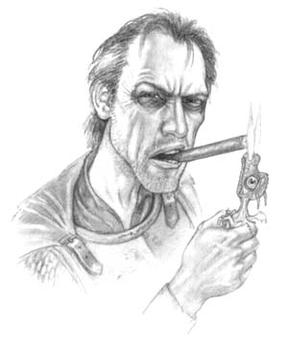
The original token for Sam Vimes was from the Doom board game we had lying around, which somehow made him all the more intimidating.
This bodged-together version of Kill Sam Vimes is likely to be the version that sticks in my head visually over the version you see in stores, purely because of the amount of time we spent with it.
Mechanically, the game stayed pretty similar from start to end. Its whole design and development process was quite short because it is a fairly simple game.
How Sam Vimes moves around the board was the one thing I can remember that did change. To begin with, I think there was a die involved before we noticed we could include that information on the Action Cards and therefore free some space up in the box.
Designing in Someone Else’s World
MM:You’ve spent years working on licensed games at Modiphius, particularly within universes like Fallout. What have those projects taught you about the difference between designing a good game and designing a good game that also needs to authentically represent someone else’s world?
DW: I think a good game has to be a good game regardless of whether there is an IP attached to it or not.
Funnily enough, I have worked mostly on other IPs rather than a company’s own ideas. Such is the nature of the industry.
What this means for me is trying to do a good job on something regardless of the world the game is in. I tend to take a workmanlike approach to the games I make. My father was a carpenter, and I think I have gained a similarly brass-tacks approach to creating.
It needs to hold together, and it needs to be easy to use.
I do think third-party IPs introduce another wrinkle into the process. Everyone is a fan of something. There is so much stuff out there that you cannot possibly, as a worker, take in all of that stuff to become as much of a fan as the people who really love it.
This means you have a duty to ensure that even if you don’t know or like an IP you are working on, somebody will. You have to do a good job for those people who love the thing more than you do.
MM: You’ve also worked extensively with playtesting, errata, and development. Has being the person who sees how games break after they meet thousands of players changed the way you approach designing your own game from the beginning?
DW: Gosh, I don’t think it has changed the making of a game much for me.
What it has done is make me take notice of the after-release support and care of a game. I am talking about errata, FAQs, and the like.
It would be great if we could get everything right the first time around, but the teams behind games are just human. We’ll miss stuff.
If the game calls for it, there is an amount of interaction with the player base once they get it in their hands. The workers on the game then get all types of feedback on all their hard work, too, so that is always a pleasant boost to a workday.
Designing for Fans and Newcomers
MM: Did you find yourself designing primarily for people who already know Vimes, Vetinari, the Assassins’ Guild, and Ankh-Morpork, or was accessibility for someone who has never read a Discworld novel equally important? How do you serve both audiences without overwhelming one or underserving the other?
DW: I think it comes back to what I mentioned earlier about keeping your mechanics separate from your deep lore.
Discworld fans will enjoy playing in the world they enjoy, but people who haven’t even touched a Discworld book will get a kick out of screwing with their friends or the antics that the Assassins get up to on the Action Cards.
MM: The game supports up to six players, which can dramatically change the amount of interaction and chaos around the table. Does Kill Sam Vimes feel meaningfully different at two or three players compared with a full six-player game?
DW: The main difference as player counts change is going to be the amount of stuff going on.
Sam Vimes will move more with more players. Your score will go up and down more.
Also, a lower player count leads to fewer Assassins per player, so you’ll have fewer attempts to “kill” Sam Vimes.
This means that the game is definitely more madcap with more players, which is where I think it works best.
Returning to the Disc
MM: Dangerous question: if Modiphius handed you the keys to Discworld again and told you to design any game you wanted, with no restrictions on character or setting, what corner of the Disc would you want to tackle next?
DW: Easy question. Give me Monstrous Regiment.
For the time, it is a pretty good take on gender and the issues that crop up with it. If Sir Terry was still around, his work on Monstrous Regiment makes me think he would be a pretty solid ally to the trans community.
As a trans genderqueer butch in the tabletop industry, I am so keen to see us present stories that speak of both our experiences and the experiences of others, such as binary trans women, in the community.
Monstrous Regiment is as close as you can get in a big-name IP to one of those stories.
What Dom Plays
MM: Finally, outside of Kill Sam Vimes, what kinds of games do you personally love playing, and are there any designers or specific games that have had an especially strong influence on the way you approach design?
DW: It has shifted over time.
I used to be a big competitive tabletop player. I likely still would be, but I have a pretty discerning taste in games, so I await the next hyper-competitive miniatures game to come along that’ll interest me.
Other than that, I am a sucker for the big guns like Magic: The Gathering and Dungeons & Dragons. I am so fortunate to have great groups I play with, and nothing excites me more in gaming than crafting a deck or a character over time and getting it just right.
Mark Rosewater from Wizards of the Coast is a big influence on how I design due to the extensive talks he has given online, along with his inherent enthusiasm for his work.
I should also call out Evie Moriarty, the lead designer at Modiphius. I always learn new things from her that make me go, “Uh, neat.”


