
The year 2025 marks the 40th anniversary of Dr Reiner Knizia’s career as a board game designer – his first published game, Complica, was released in a magazine in 1985 (although he’d self-published games before then as well).
Since then, Knizia has designed and published over 800 games and expansions, many of which are critically acclaimed. Put simply, Reiner Knizia is the landscape on which all other modern designers build their houses.
To celebrate Knizia’s career and back catalogue, Meeple Mountain are taking things back to basics to consider the ABC of Reiner Knizia: one game for each of the 26 letters of the alphabet.
This time: The Letter ‘Z’.
Z – Zoo Vadis (2023)
About a year into researching and writing Meeple Mountain’s Reiner Knizia Alphabet I took a break.
I’d reached the letter ‘O’ and wasn’t happy with how things were progressing. What had originally been intended as a single article with each letter afforded around 200 words, was starting to look like it wasn’t going to work. There was too much to write about, too many interesting diversions and tidbits. I could do it, everything was the right size but the overall result wasn’t especially satisfying. Too surface level, when the whole point of the alphabet was to dive deeper into Knizia’s career than most typical lists allow. There are dozens of Knizia lists that feature games like Tigris & Euphrates, Ra and Modern Art, but I’d decided on using the alphabet as a structure to look beyond them. Sure, the alphabet has covered the ‘greats’, but it’s also examined games like Orongo, Qin and Carcassonne: The Castle. Hidden gems.
I stopped and asked myself quo vadis? – where goest thou or where are you going? What did I want the alphabet project to be? What goals did I have in mind, what did I want readers to learn and experience? What feelings did I anticipate when I reached the end and looked back? I had to look back to work out where I wanted to go with the alphabet.
At around this time the freshly Kickstarted Zoo Vadis began arriving on backer’s doorsteps, providing both a critically acclaimed game with which to end the alphabet and quite possibly the most Knizian representative of the designer’s career.
Which is curious for a game regarded by many as an unusual Knizian.
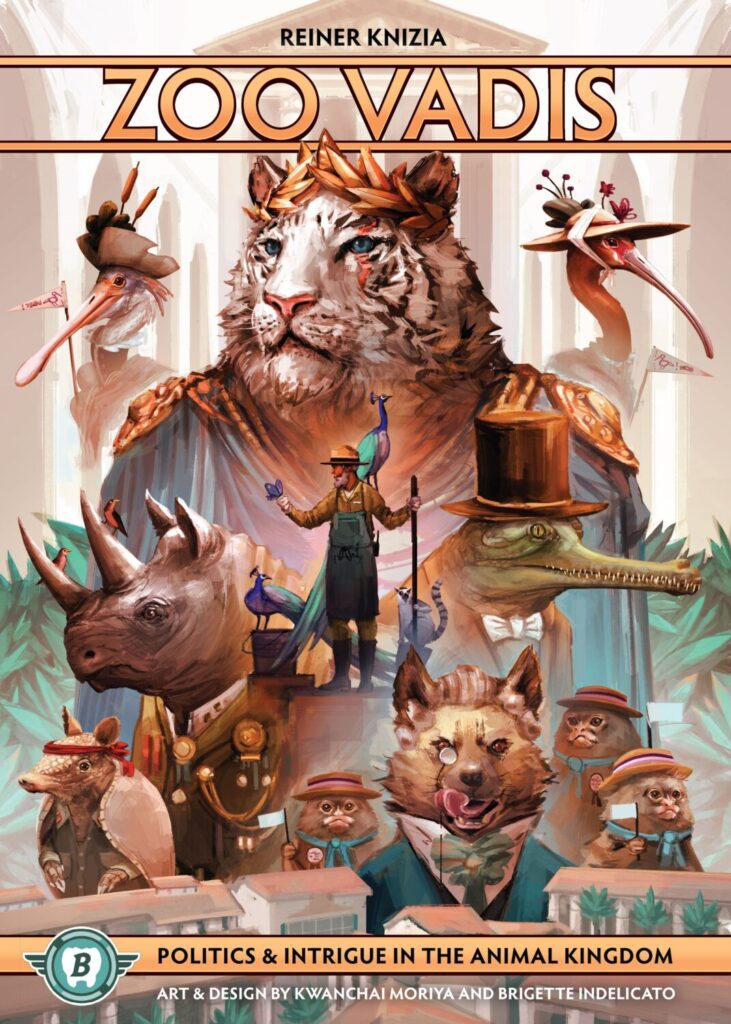

Zoo Vadis is a game of animal negotiations. As animals running the zoo, your goal is to reach the star exhibit and become the zoo’s mascot. The way you do this is by moving your animal figures across the zoo from one exhibit to the next, but you can only leave an enclosure if you have the majority vote there. A hyena sharing an enclosure with a tiger and a marmoset would need the approval of at least one of them to be allowed to progress. This is where the negotiations come in, with players able to offer points, promises and powers to swing the deals in their direction.
It’s a game built around those negotiations, and when it comes to Knizia’s back catalogue there aren’t many other negotiation games. In fact, the BoardGameGeek database lists only three other tabletop games, all from 1992 and 1993: Ascot, Das letzte Paradies (‘The Last Paradise’) and Quo Vadis?, which was the original iteration of Zoo Vadis set in the Roman Senate. (There are also five others listed if you narrow his games down by ‘Category’ instead of ‘Mechanic’ – BoardGameGeek is never the clearest of places! – but two of them don’t involve actual negotiation, one is a Monopoly spin-off, one is a Live Action Role Playing Game and one is the book New Tactical Games with Dice and Cards which includes a couple of negotiation variants to some of main games. Despite not being listed as featuring negotiation, Knizia’s book Blazing Aces! also contains the Pit-esque Stampede.)
In summary, Knizia has very few negotiation designs, all of which (role-playing and Monopoly aside) were from the first decade of his published career. Of the two original ‘boxed’ designs (published in boxes with components, rather than in a book or Spielbox magazine), Das letzte Paradies only had one German edition and has been out of print ever since, whilst Quo Vadis? received three editions, released in 1992, 1999 and 2005. Not unsuccessful, clearly, but not a game that set the world alight either.
As the 2010s drew to a close, few had even heard of Quo Vadis?, and fewer still made the effort to seek out secondhand copies for themselves. Whilst some liked the minimal Roman aesthetic of the originals, the words ‘dry’ and ‘beige’ were used aplenty to describe it. When I first started planning this alphabet it was in the running to be my ‘Q’ (a title that was eventually shared by both Qin and The Quest for El Dorado. Who knew that ‘Q’ was such a strong letter!).
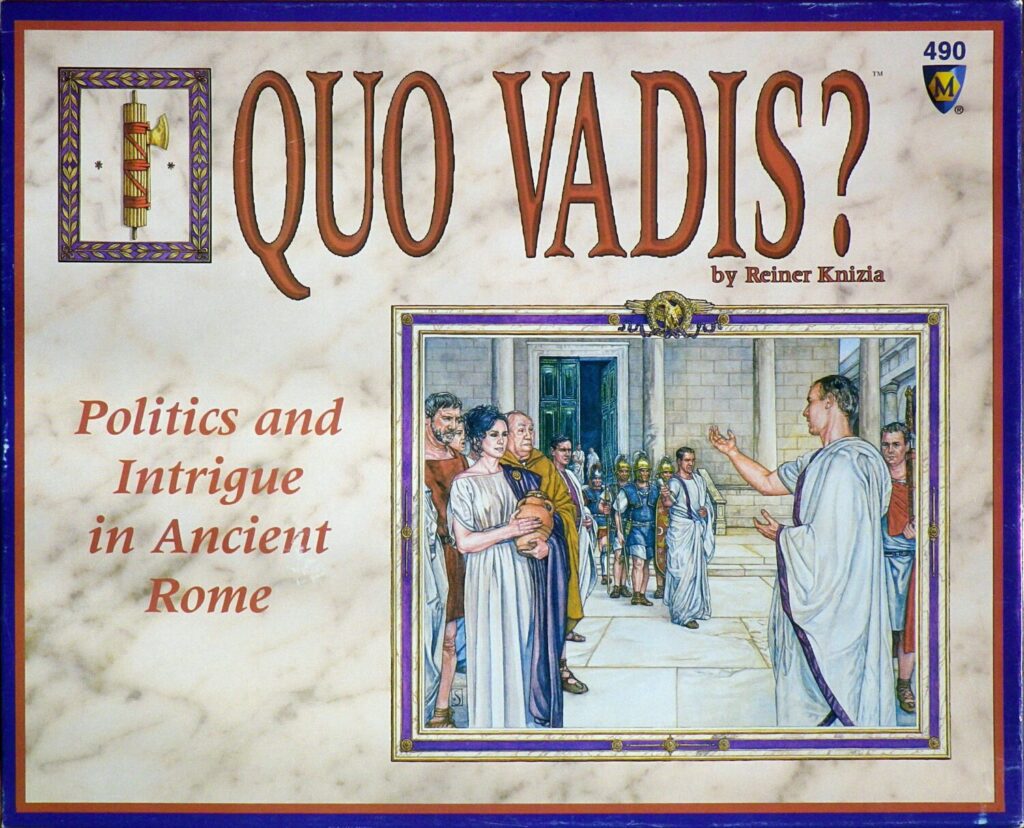
Quo Vadis? was a ‘hidden gem’ indeed, a diamond that needed digging out of the rough, a glint of gold in the pit of a yellowed molar. Happily, a couple of dentists were well placed to discover such a precious filling. Nick Murray and Kyle Spackman even named their publishing company after a common type of dental x-ray: Bitewing Games.
“I kept hearing hobbyist gamers revere Quo Vadis? when discussions of “underrated games” or “hidden gems” or “games you wish would be reprinted” came up,” says Murray in the Zoo Vadis rulebook, “so I tracked down an old copy and instantly fell in love with this cult-classic negotiation game.” Murray was already a fan of Knizia’s design style. In his publisher diary he talks about how his first play met all expectations but that its dull appearance and variant rules from different editions created barriers for newcomers.
Bitewing had worked with Knizia for their first Kickstarter campaign to publish the Criminal Capers Trilogy (Hot Lead, Pumafiosi and Soda Smugglers). In a move that has now become part of their process, Murray documented his SWOT analysis (Strengths, Weaknesses, Opportunities and Threats) to assess Knizia’s initial Criminal Capers prototypes.
Interested in bringing Quo Vadis? to a modern audience, Murray applied the same approach. “When I reached out to Reiner regarding Quo Vadis, I had a vision for what the game could become,” Murray wrote when announcing the game, “I dug through over 30 years of data and presented my analysis to Reiner including several development goals for the game. Then off he went with his decades-old design to give it new life—like a phoenix reborn from the flames.”
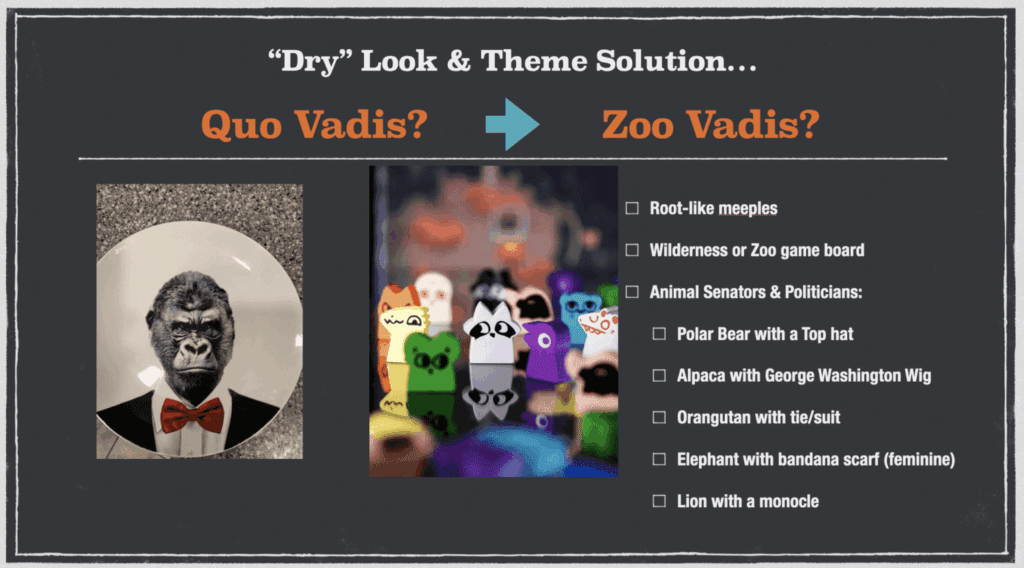
The analysis identified three main areas for improvement: presentation, player count range and the need for more to negotiate with. For the presentation, Murray took inspiration from the anthropomorphic animals of Root and other games, as well as a gorilla plate he and his wife had on their wedding registry. “I really wanted to squash the idea of this game looking dry or dull,” he told Paul McLeod of Smash Cuts, “so the concept of spotlighting different animals on each of the screens (much like our dinner plates) with massive and vibrant art really appealed to me.” With the talents of illustrator Kwanchai Moriya and graphic designer Brigette Indelicato, Murray got what he wanted.
Meanwhile, based on some initial suggestions from Murray, Knizia explored adding player powers and neutral pieces to the game (inspired by the neutral pieces in Renature). The fact that the player powers can’t be used on yourself and can’t be traded away increased the negotiation in the game, whilst the neutral pieces could be used to further yourself or block others. The refinements weren’t a quick or easy process, but Knizia was happy with the results. “The player powers make the game more dynamic and even more dramatic,” he told Murray when presenting the new rules, “the [neutral figures] also introduce a nice play option: you may move a [neutral] figure instead of an own figure to obstruct other players.”
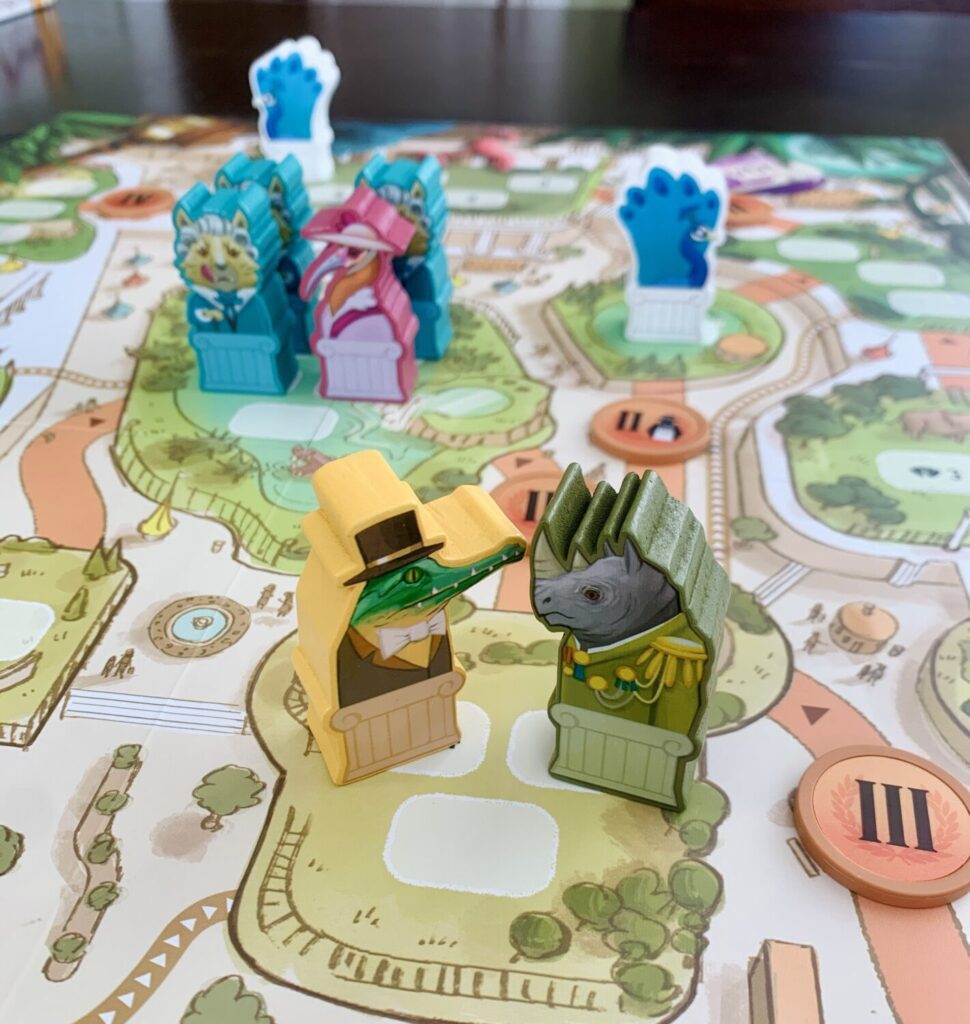
The result is a game that honours, modernises and improves upon its predecessor, without feeling forced. “All of the additions here – including asymmetrical powers and neutral peacocks – come across as natural extensions from the heart of the design,” says Charlie Theel of Player Elimination, “even the ludicrous setting of animals squabbling over internal hierarchy somehow works.”
Zoo Vadis charmed the critics on its release in 2023:
- “Zoo Vadis has moments of transcendence. A player moves a piece up an enclosure and the whole table feels that turn as pregnant with the promise of what that player intends to do next. That is pure magic.” said Meeple Mountain’s own Andrew Lynch in his review of Zoo Vadis.
- “It’s terrific, it’s fun, it’s funny, it’s simple, it’s unique,” said Quentin ‘Quinns’ Smith of Shut Up and Sit Down.
- “As board games grow ever more complicated, this serves as an essential reminder that many of our greatest exemplars are lean and unburdened. Zoo Vadis updates an overlooked Knizia that might have otherwise been lost beneath the avalanche. It’s exceptional.” said Dan Thurot of Space Biff.
- “The elegance here is astounding. This is one of Knizia’s most interesting designs. It’s fantastic to see such a first-rate design receive an unusually fitting product that is modern yet precisely tapered.” said Theel.
Importantly, however, it’s a game that requires the right approach and playstyle. “I like the game a lot,” said Tom Vasel of The Dice Tower, “but I think half of gamingdom would not.” (Author’s Note: The Dr Seuss nature of this quote is, sadly, an artificial product of trimming a few words between the two statements. Come on, Tom, all your reviews should be in lively rhyme!)
Vasel’s co-hosts on the review demonstrated this mixed reception. Whilst Vasel gave it 8 out of 10, and Mike Dilisio and Chris Yi both scored it 9, Joey Evans absolutely loathed it, finding the pure negotiation lacking. “I think it’s barely a game for me,” he said, scoring it a 4, “It’s a big, big miss for me and it’s one that I probably wouldn’t play and [would] actively avoid.”
So why is Zoo Vadis ‘the most Knizian representative of the designer’s career’? And why is it sometimes regarded as an outlier in his oeuvre?
As we’ve seen, Zoo Vadis, like Quo Vadis?, is a pure negotiation game, a mechanic rarely used by Knizia. There aren’t tiles to lay, auctions to bid on, dice and cards to press your luck with, contests to bet on, abstract pieces to place. It’s not cooperative and isn’t a tight two-player experience. As Quinns says, there’s something unique about it.
But it also bucks against the stereotypical views of what a ‘Knizian game’ involves. It’s not dry, it’s not abstract, it’s not so precisely balanced to make it sterile and there’s no indication of a PhD in mathematics. These misconceptions continue to permeate the hobby at every level. “If you had told me Reiner Knizia designed this, I would never have guessed it,” said Vasel of Zoo Vadis, “He’s mathematical, and this is not very mathy at all; it’s all negotiation. This is not like other Reiner Knizia games. Fact, end of discussion.”
“I have to disagree,” said Thurot, arguing that Zoo Vadis “inhabits a similar headspace to many of [Knizia’s] most enduring contributions, largely thanks to its absolute economy of play.” Thurot goes on to compare the elements of Zoo Vadis with other Knizia mainstays, including Tigris & Euphrates, High Society and Modern Art. Dilisio similarly thinks Zoo Vadis bears the hallmarks of Knizia: “The rules don’t get in the way and the game is more about what’s happening with the players around the table than what’s happening on the table.”
It stems from what Knizia considers makes a game fun. “For me, a game is always the interaction with other players,” Knizia told Meeple Mountain in an interview that will be published later this month, “That means the fun is when I have the fun with other players… what I’m trying to create is the game as a platform where the players engage.” Zoo Vadis is the epitome of that ambition. Simple rules, elegant gameplay, high player interaction and a depth that can be explored over multiple games – in terms of the game itself, Zoo Vadis is Knizian through and through.
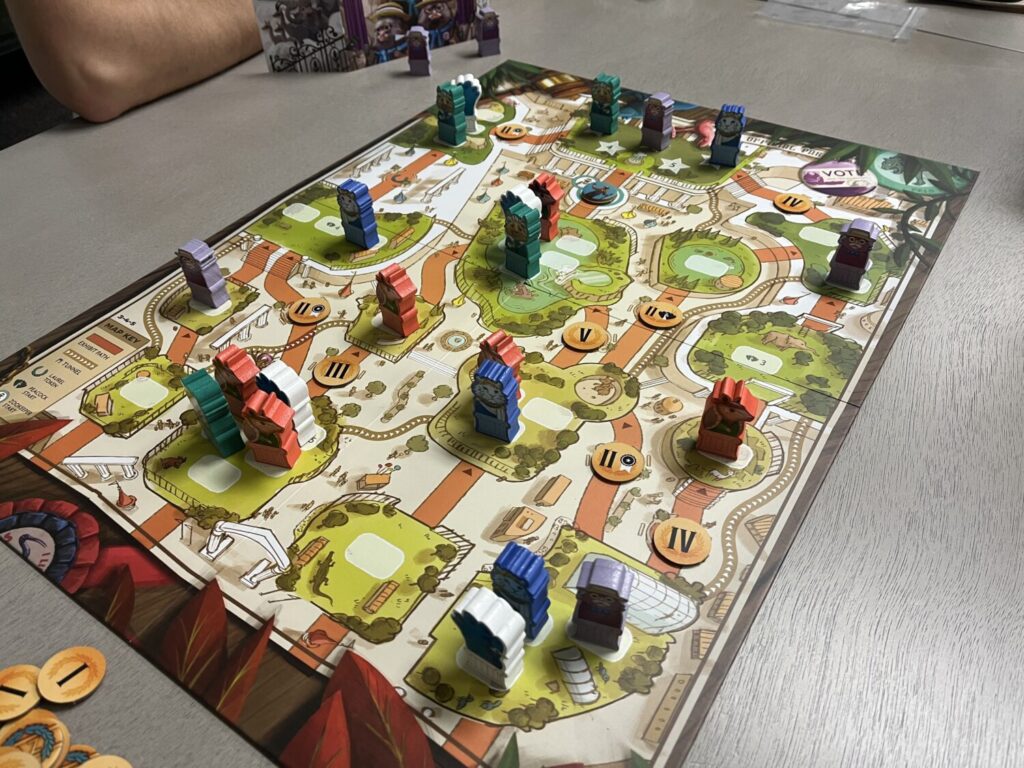
But the game is also the perfect representation of Knizia’s 40-year career. It spans most of that time and mirrors his own career trajectory: popular in the nineties and early 2000s, falling from favour from the mid-naughties, returning stronger than ever in the late 2010s and 2020s.
It’s a game that still embodies its origins (the zoo board retains the Roman architecture of the original, laurels remain the symbol for points) and remains subtly thematic (see Ender’s review of Quo and Theel’s review of Zoo for discussions on theme). But it’s tweaked and tuned, quietly expanded for the 21st century audience.
Zoo Vadis also represents the recent trend of refreshing Knizia’s heyday hits. “We have a renaissance of these more classic games, and it’s essentially mainly due to the possibilities via crowdfunding,” Knizia told us. “This allows the publisher to put extra things in, to put nice components in… I’m very keen on leaving the core game, the classic game as it is, but then we can put things on the side and offer some extras which refreshes the game. This new approach, I think opens the door for new players; it gets a new audience.” Zoo Vadis is the success story that enabled the development of evolutions such as Merchants of Andromeda, Silos and Hanami, and smart new editions of Ra, Through the Desert, Tigris & Euphrates and Rheinländer.
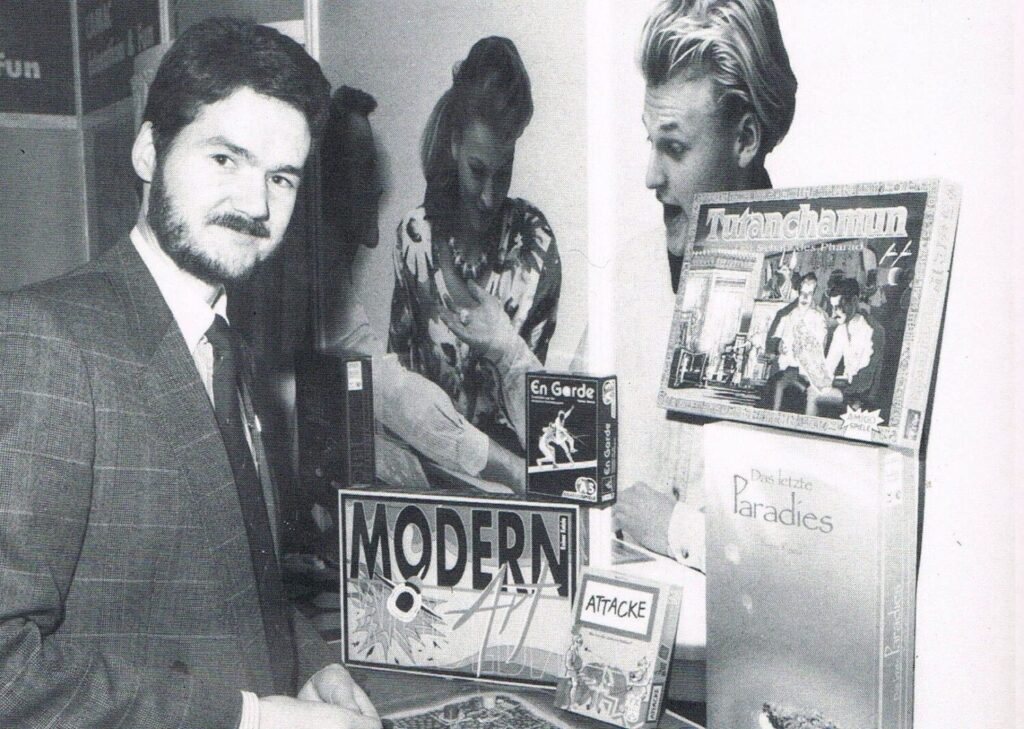
Not every older Knizia game, however, is a ‘hidden gem’ that should be rediscovered. “I see some games from the 80s, from the 90s, where I say, ‘That was a good game, that worked, but today it has lost its relevance’,” said Knizia during our discussion. Quo Vadis? was a game that needed the right attention and has proved hugely successful, but that doesn’t mean that you’ll be seeing refreshed versions of any of its negotiation stablemates from the early nineties. “The Last Paradise is one of these games where I’ve taken it out once or twice over time, and always when we played it, I came to the conclusion that no, it had its time… Not everything has to be revived, some things can be left in peace.”
Zoo Vadis launched on Kickstarter shortly after I started putting pixel to page on the Reiner Knizia Alphabet. In writing this article, I discovered it was first announced a couple of weeks before I began planning and researching. Much has changed in the intervening years, and Knizia’s popularity has only grown, along with the number of his published designs. For me, whilst The Quest for El Dorado and Yellow & Yangtze represent the early ripples of his return, it’s Zoo Vadis that is the moment when the Knizian resurgence crests.
It seems fitting that more than three years after I began, it’s Zoo Vadis that ends the alphabet.
Gazing at the ‘Z’ Zone
We may be dazzled by the wizard’s Zoo Vadis, but Knizia’s ‘Z’ list isn’t zero-sum. Gaze into the ‘Z’ zone with us:
Zen Master – A variant of Relationship Tightrope, which we covered under the Letters ‘R’ and ‘O’ (for Odd Socks), Zen Master sees players trying to play cards that are neither the highest nor the lowest played that hand. Also published as Yin Yang and Fifty Fifty, the main difference between this 2010 release and its 1999 predecessor is that you don’t have to play all your cards in a round, providing a little more choice as you try to balance the tokens you receive for playing the highest and lowest cards in a hand.
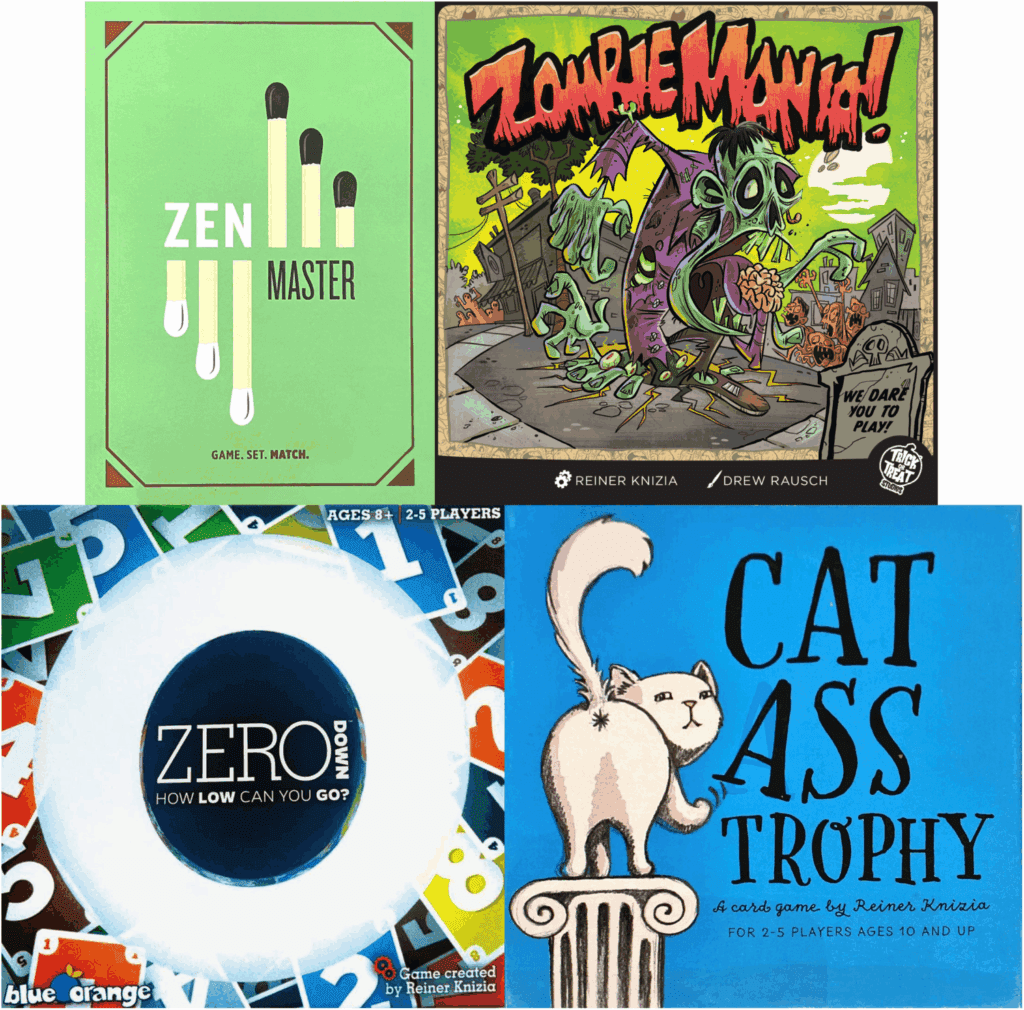
Zero Down – Originally released in 1998, this card-swapping game sees players trying to have the lowest score in the hand when a round ends. Making it harder to judge, a round only ends after the second knock of the table, meaning you want to swap cards to get a lower score in your hand but also want to try and catch your opponents out by ending the round when they aren’t ready. It’s seen multiple editions and names over the years, with perhaps our favourite being Cat Ass Trophy, released in 2021 and containing some excellent feline card art.
Zombie Mania – A simple push your luck dice game from 2014 which was rereleased in 2022 with some lovely weighty plastic zombie pieces. You’re trying to clear your property of zombies by rolling pairs of symbols, and can even send them to settle on the property of other players. It didn’t win any awards and doesn’t push any boundaries, but as a quick dice-rolling game it’s not too bad, even if the 2022 edition seems way larger than it needs to be.
Zombiegeddon – We’ve covered this zombie-themed game earlier in the alphabet with the Letter ‘J’ and its sibling game Jäger und Sammler. Released in 2009, Zombiegeddon has players collecting tiles from the board as they explore and gather supplies to survive a zombie apocalypse. An unusually violent game from the doctor, at least in terms of its appearance (the actual gameplay is very abstracted), and the grimy artwork sadly makes it hard to distinguish between tile types.
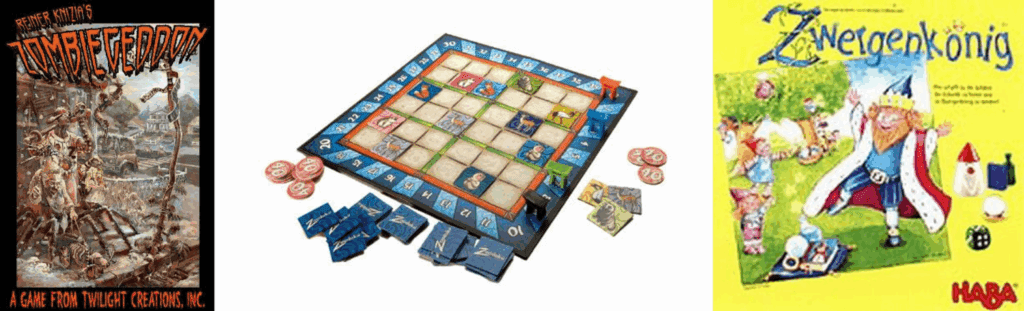
Zoodoku – Knizia has released at least 10 Sudoku-based games, most of which were released in the mid-naughties when Sudoku’s popularity outside of Japan soared. Zoodoku is a children’s introduction to the puzzle, playable by kids as young as 6. Instead of placing numbers in a grid, the game involves placing animal tiles, with the animals depicted native to Japan.
Zwergenkönig – One of the games with the youngest target audience that we’ve covered, 2002’s Zwergenkönig is a simple roll and move affair with players navigating a labyrinth and trying to find treasures, whilst avoiding goblins hiding in trees. The rotating disk below the board ensures the goblins move around regularly and the whole production is chunky and cute, as you might expect from a HABA game.
–
We have zoomed to the zenith of the A to Z and a state of (kni)‘Zia’ zen has been reached! Are we zesty zealots zapping from zilch to zillions in our ‘Z’ quest? Did our fizzing ‘Z’ razzmatazz leave you abuzz and in a tizzy with amazement? Or is our bedazzle more of a fizzle, our whizz through ‘Z’ weightless and zephyr-like? What ‘Z’ would you have zeroed in on? Zip a comment below with your ‘Z’ zone of choice and be amazed by the rest of the Reiner Knizia Alphabet here!