
(Last updated July 2026.)
Let’s get the obvious question out of the way: yes, it’s a miniatures game, and yes, that phrase alone is enough to send some board gamers running for the hills. I get it. I was one of you. The idea of assembling tiny plastic limbs with tinier plastic glue, then learning a ruleset that looks like it was fully written for people who already know what a “beam attack” is, felt like I was trying to translate the Necronomicon or something.
Marvel: Crisis Protocol is Atomic Mass Games’ skirmish game built around Marvel’s absurdly deep bench of heroes and villains. “Skirmish” is doing real work in that sentence: you’re not commanding armies or pushing platoons around a table. You’re fielding a handful of named, iconic characters and throwing them at each other across a comic-book landscape. This means the game is about how Juggernaut specifically behaves in a fight as an unstoppable wrecking ball, not how many identical soldiers you can cram into a formation. If you’ve ever wanted Hulk to pick up a dumpster and throw it through a building, this is the game built for that exact impulse.

Here’s the game, stripped all the way down. You build a roster of characters ahead of time, pick a smaller squad from that roster to actually bring to a given match, and then you and your opponent alternate activating one character at a time. Usually, your actions are some mix of moving, attacking, or shaking off bad conditions, though some superpowers cost an action too. Once everyone’s gone, the round ends and points get scored. You’re not usually trying to wipe out your opponent’s whole team, though it happens from time to time; you’re trying to control specific objectives on the map long enough to rack up points before they do. Every attack in the game rolls a handful of eight-sided dice, checks the result against your opponent’s defense, and if you’ve out-rolled them, your opponent’s about to have a bad day. Do enough damage, they’ll “daze” and flip to their injured side. Deal enough damage on their injured side, and they get KO’d and removed from the game.

Building that roster isn’t a free-for-all. Every character carries a threat rating (basically a cost, running from small two-threat pieces up to nine-threat heavy hitters), and each mission sets a threat cap for how much you’re allowed to bring. Most squads end up around four or five characters as a result. You’ll also want to pay attention to affiliations: loose thematic teams like the Avengers or Brotherhood of Mutants, most of which are led by a specific character whose leadership grants a passive ability the whole squad benefits from. You don’t have to build strictly within one affiliation, but sticking close to one usually means your leadership and your teammates’ abilities are actually working together instead of just coexisting. As long as the majority of models you put on the table are affiliated with each other, you’re in the clear to splash others. Want Hulk to join up with the Guardians of the Galaxy for a while? Go for it. Want to live in a world where Magneto made a deal with Baron Zemo to help the Brotherhood? Absolutely, you got it. Beyond your characters, your roster will also include a set of tactics cards (one-off effects you can play mid-game for a burst of value) and a set of crisis cards, which set the actual objectives you’re fighting over each match. More on those in a bit.

The resource underneath all of it is power. You earn it mostly by dealing damage and by taking it (yes, getting hit is often good for you, which is a small act of design genius), and you spend it to fuel your character’s flashier abilities. It’s also the resource most rule changes end up touching in some way. Buff or nerf a character, adjust a leadership, tweak how objectives pay out. Power is usually somewhere in the blast radius.
And then there’s the thing that sets MCP apart from every other minis game on a shelf: terrain. The board becomes more than a landscape to play in; it’s a giant weapons rack. Characters throw cars, lampposts, and each other into buildings hard enough to level them. Rhino rips a garbage truck off the ground and hurls it at your face. Spider-Man uses one of your opponents as a projectile to launch into their own team. It’s the single most “yes, this is a superhero game” thing about the whole experience, and it’s the reason I’d point a board gamer here before I’d point them at almost any other minis system: the theme isn’t just painted onto the mechanics, it is the mechanics.
What the Game Looks Like Right Now (July 2026)
As of right now, the objectives you’re fighting over come in two flavors: secures and extracts, twelve of each in the current rotation, with five of your choice going into your roster. Most secures are the traditional king-of-the-hill style, contested just by standing on them, but five are pay-to-flip, meaning you have to spend power just to take control, which gives a team with a strong power economy a real edge on those missions. Extracts work similarly: most are the traditional kind, physical tokens a character runs out, grabs, and carries around until they’re knocked out or have it stolen. However, four are source extracts, a newer wrinkle where the token resets to its starting point every round instead of staying with whoever grabbed it. That second type is new enough that it’s actively reshaping how people build lists. Grab-and-run tactics that used to win games don’t work the same way against a source extract.


The overall pace of matches has shifted too. For a good stretch of the last couple of years, games trended fast, with plenty of matches wrapping up by round three. AMG has been deliberately pumping the brakes on that. Objectives score slower now, and a wave of character updates landing next month is buffing health pools across a big chunk of the roster, meaning your favorite characters should stick around the table longer before getting dazed or KO’d. None of this happens in a vacuum, either: pay-to-flip secures and source extracts both put more strain on your power economy than the missions they replaced, since you’re now paying to interact with objectives that used to be free, and teams that were already stretched thin on generating power are having a rougher time of it right now.
Where to Actually Start
(Starter set info current as of July 2026.)
Okay, you’re sold on the theme, you get the loop, you understand why a garbage truck to the face is objectively hilarious. Where do you actually put your money?
If you want the full experience, terrain, rulebook, everything, in one box, the Earth’s Mightiest Core Set is still your default pick at $149.99 MSRP. It comes with thirteen miniatures split across heroes and villains, a full set of city terrain to build your battlefield, and enough crisis cards and tactics cards to actually learn the game rather than just look at it. If you’re setting up to teach a friend from scratch with nothing else on hand, this is still the answer.

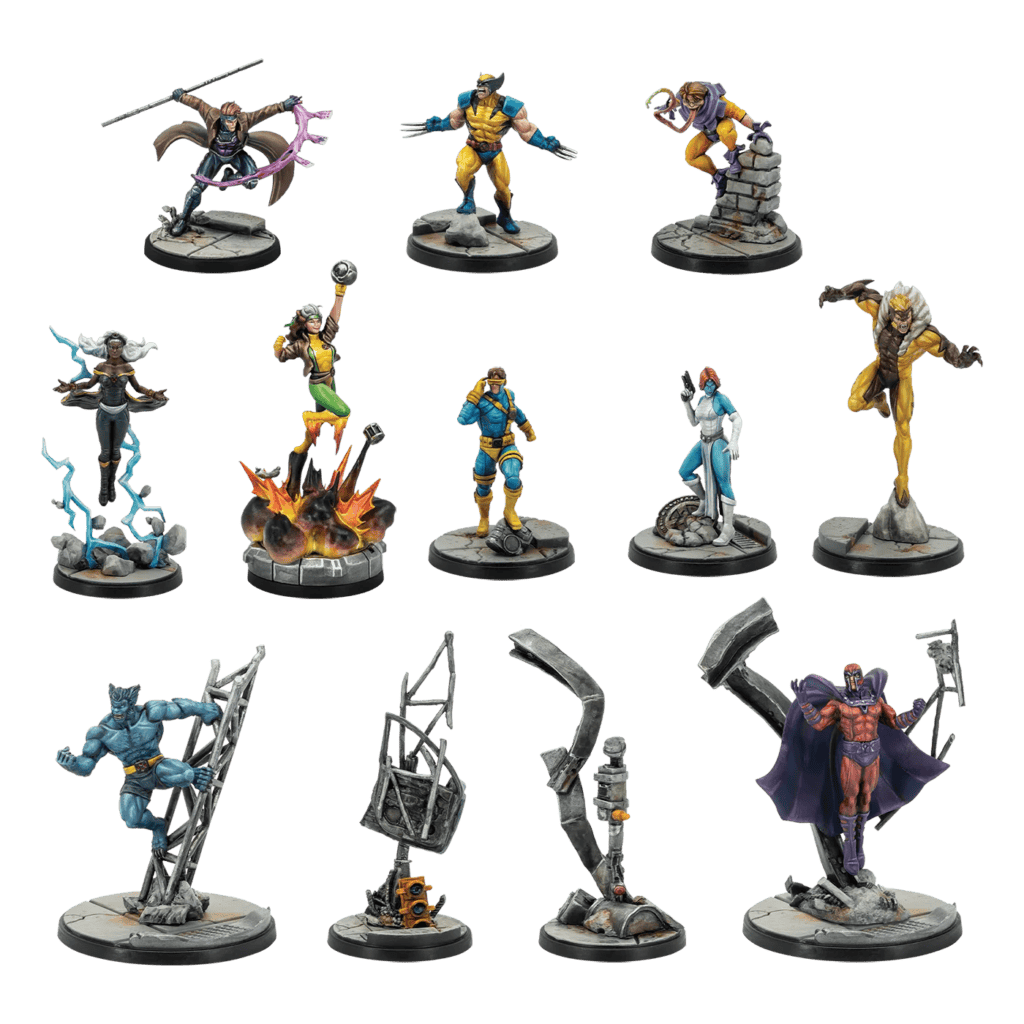
But if you’re playing at a store that already has terrain lying around, or teaming up with a friend who’s already got a table built out, you don’t need to pay for another set of dumpsters and lampposts. This is where the single-player starter sets earn their keep. The X-Men Starter Set is the evergreen pick here: ten mutants, a full legal roster right out of the box, plus tactics cards, dice, and range tools, all for under $100. It’s built specifically to solve the roster-building problem the core set doesn’t, since a core set’s thirteen models don’t cleanly assemble into one legal ten-character roster the way a starter set’s do.
AMG also has two more starter sets on the way this year: an Asgardian set and a Guardians of the Galaxy set, both built the same way: a full roster’s worth of a specific team dropped into one box. If either of those affiliations calls to you thematically, keep an eye out for them.
One starter set you might see mentioned elsewhere, Spider-Foes, isn’t included here on purpose. It looks to be sold out through official channels as of this writing, and AMG hasn’t said whether it’s getting reprinted or retired for good. If you can find it, though, it will give you the same full roster experience as the other starters mentioned above.
Once you’ve got minis in hand, the fastest way to find your people is your friendly local game store. Ask if they run Marvel: Crisis Protocol nights or a Learn to Play event. Every single person I’ve met through this game has been generous with their time and genuinely excited to get a new player up to speed, which is not something I can say for every competitive tabletop scene I’ve dipped a toe into.

Once your collection outgrows what fits in your head, and it will, check out Jarvis Protocol. It’s free, works as a web app or a download, and has every character and card in the game, so you can build and save full rosters without laying out your entire collection on the table just to remember what Cyclops’s card actually says. And if you’re curious how any of this plays out at a competitive level, or you want to find an event near you, Longshanks tracks tournament results and upcoming events across the scene. Poke around recent results, and you’ll get a much faster read on the current meta than any article, including this one, can give you.
Now go build something ridiculous and throw it at someone. Until next time, heroes!