

Aeon’s End: The New Age – Andrew Lynch
Indie Board & Card Games took their foot off the gas just a little with The New Age, by which I mean it isn’t nearly as punishing as War Eternal. The New Age introduced Aeon’s End’s campaign system, which would become de rigueur for their future releases, and those of us who’ve played Aeon’s End before will know that that’s a mixed blessing. The constant injection of new cards and powers is great, but the writing…well. Nobody plays Aeon’s End for the quality of the writing. You win some and you lose some. If you play Aeon’s End enough, you’ll lose quite a bit, in fact.
Ease of entry?
★★★★☆ – The odd bump or two
Would I play it again?
★★★★☆ – Would like to play it again
Read more articles from Andrew Lynch.
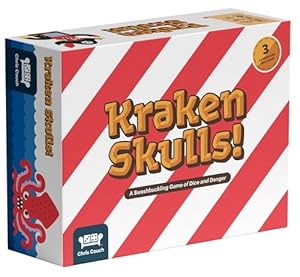
Kraken Skulls! – Kevin Brantley
Kraken Skulls! puts 2–5 players at the helm of a pirate ship, chasing the most fame to become the king (or queen!) of the pirates.
Players bounce between a random selection of dice mini-games (via cards) laid out in a circle, mixed with open-water cards that house the dreadful Kraken. Everyone secretly rolls their own die to determine which direction they’ll move. If multiple pirates land on the same card, they roll off in a mini-game specific to that location. If they land on the Kraken card, they work together to defeat the beast. Players are also trying to secure treasure, which can be exchanged to increase their dice pools for future bouts.
The premise sounds fun at first glance, but the idea of dice-rolling mini-games with a pirate flair immediately made me think of Party Pirate Pandas, which is a great game. And while there are some fun concepts here, the whole thing left me a bit underwhelmed.
Dice combat is resolved simultaneously, which helps keep things moving, but overall it still felt a bit long—not in pure playtime, but in how long it takes to build up your dice pool and actually get an edge. If treasure isn’t hitting the table regularly or combat isn’t happening often, it can be a slow burn up front.
As a family filler, though, I think this fares best with kids. The rules are simple enough, the components are fun and colorful, and—come on—who doesn’t love rolling dice? It just didn’t stick for me, but that may be because I’ve played too many dice chuckers and I’m simply the wrong audience.
Still, there are enough mini-games in the box (plus small expansions) to keep the variety high and the dice rolls flying.
Ease of entry?
★★★★☆ – The odd bump or two
Would I play it again?:
★★☆☆☆ – Would play again but would rather play something else
Read more articles from Kevin Brantley.

War of the Ring: The Card Game – Fire and Swords – Andrew Lynch
War of the Ring: The Card Game has been unjustly relegated to the old news section of board gaming, if you ask me. It employs a unique card economy and deck flow system that makes it unlike any other game I’ve played, and it manages to capture the essence of Tolkien’s masterwork without breaking the bank. Is it for everyone? No, but it’s for just enough people that two expansions have been released. The second, Fire and Swords, adds some new locations and some new decks, but its primary draw is an ocean of new game modes, including a bonkers two-player game that takes in the entire scope of The Lord of the Rings. War of the Ring: The Card Game is a great game, and Fire and Swords only makes it better.
Ease of entry?
★★★★☆ – The odd bump or two
Would I play it again?
★★★★☆ – Would like to play it again
Read more articles from Andrew Lynch.
Lords of Vegas – K. David Ladage
I have played many games where the theme and the mechanics flow together well, where each action taken by a player reinforces the theme bringing joy to all, even the players who are not doing so well by way of score. I have also played games where the theme was obviously an afterthought and publishing the game as an abstract would have been the better choice. Games, as we all know, run the gamut.
I would have to search my memory hard to find a game where the theme and the mechanics come together better than they do in Lords of Vegas. In this game, you are building up the Las Vegas Strip by gathering property (which starts off as parking lots) and building casinos. As casinos touch each other, if they are the same brand, they can become larger casinos worth more points. But that does not mean only one player is in charge! Dice in the casino spaces represent your stake, as there can only be one boss.
Money is earned, points are gained, and the available property dwindles down. We played with the UP expansion, so we were able to add additional floors to the casinos to earn more points when property was getting scarce. The whole thing was a blast! You have everything from renovations which will change the band—a move that could be aggressive or defensive, depending on what the board state is. You can shake things up and attempt to take over a casino you are a minor player in—in a perfectly thematic tone, this is a roll of all the dice in that casino. If you want, you can even gamble in someone else’s casino. {chef’s kiss}
This is a game I think I truly need to add to my collection.
Ease of entry?
★★★★★ – No sweat
Would I play it again?
★★★★★ – Will definitely play it again
Read more articles from K. David Ladage.
The Guest – Justin Bell
To kick off a recent game night, I set up a six-player game of The Guest, a hidden role game in the vein of dozens of different games ranging from Nemesis to Blood on the Clocktower to Battlestar Galactica: The Board Game to Werewolf to…well, the list is massive. This means that a couple players are “guests” (aliens, murderers, etc.) while the non-infected human crew of a ship has to stay on their toes to ensure that they suss out the baddies before it’s too late.
Except that The Guest might be the worst game of the year. If not for our experience playing The Pirate Republic: Africa Gambit earlier this year, The Guest would be the worst game I’ve played this year. It gets almost everything about the format wrong. Cards regularly redistribute which player is playing which role. Voting cards surface randomly during play, and this is the way to eject players off the ship…which means a player’s game will be over just a few turns into a game. In our game, my nine-year-old got voted off the ship on the game’s second turn, which led to him running off in a huff while not realizing that he was the lucky one by dying early. (And he wasn’t even a guest!)
There’s a massive first-player problem, tied to the role of the Commander…each time a vote takes place, the Commander goes first, meaning that in our game, the sixth player never got to lead a turn because voting cards were continuously revealed. Commanders break voting ties, which is a problem when the game comes down to a one-on-one vote between a remaining guest and a remaining human. (Yep, that happened in our game too.) Avoid this at all costs.
Ease of entry?
★★★★★ – No sweat
Would I play it again?
☆☆☆☆☆ – No chance
Read more articles from Justin Bell.