You know that old chestnut about the stars and wet paint, right? Tell a man there are a million stars in the sky and he’ll believe you, tell a man the paint on a bench is wet and he’ll have to touch it to know for sure. Or maybe the Eddie Izzard bit about the scale of murder? You murder one person, you go to jail. You kill six or seven people, we put you in a padded room with a window and observe you. You kill millions of people, we don’t know how to process that. “You must get up very early!”
The attendance numbers for Spiel are a bit like that. 230,000 attendees, 1,000 exhibitors, 15 football fields of space, it’s all so large that it’s rendered abstract. “Boy, that sure does sound like a lot” is about as close as you can get to a cogent response. If you happen to work in event planning, your response is likely something approaching the Wilhelm Scream. It is a lot, I assure you. The city of Essen is stretched to its limits; try finding a seat for dinner on that Saturday night. Messe Essen, home to Spiel, is itself at capacity. For the first time, this year saw nary an inch of unutilized conference space.
 I’ve been attending Spiel since 2021, which means I’ve seen it grow by considerable margins with each year that I’ve attended. By and large, these changes are not tangible. I couldn’t tell you where the 5% of extra space this year was, and I suspect most people couldn’t. The only change to really resonate was made last year, when Spiel expanded into Hall 8.
That area was previously a sort of holding pen prior to the 10:00 am doors, and it has proven to be a godsend for the show as a whole, or at least for those of us who regularly walk the floor. Anecdotally, this felt like the least crowded year since the COVID-hampered anomaly that was 2021. The show was again sold out, so we know there weren’t fewer people. My guess is that the German families who make up an appreciable percentage of Spiel’s attendees stick to Halls 7 and 8, full as they are with family games and publishers specific to the German market. That leaves the rest of us with a little more breathing room.
This hasn’t worked to everyone’s favor. When asked how the show was going on Sunday, one worker out in the relatively Siberian Hall 2—put a pin in that—said, “It’s been slow today. We have four hours left and it’s, you know, it’s basically empty.” The upside of families mostly sticking to Halls 7 and 8 is that they’re out of the way; the downside is that they aren’t impulse-buying the games they would walk by if they ventured further into the complex.
Still, it doesn’t sound like many exhibitors had a bad show. Every publisher I talked to did as well, or even better, than they’d hoped. Mighty Boards was well represented in shopping bags all around the festival, both by Kennerspiel winner Rebirth and new release For the Gods! The queue for Queen Alice at the Combo Games booth went hundreds of people deep and lasted for hours; I couldn’t believe it when they still had copies left Saturday morning. Feuerland had a massive hit on their hands with Greenwood, though unfortunately for Germany’s hottest Euro publisher, the groundswell of enthusiasm was so sudden—it blew up on BGG only a few days before the fair—that they weren’t in a position to capitalize on all the interest. Lord knows if they’d had more copies, they would have sold them.
The Biggest Mackiest Daddy of all 2026 Spiel releases, at least in terms of pure box size, was CGE’s Kingdom Come Deliverance. I’m not sure how anyone got it home, let alone carried it around the fair all day. I’m not sure many people did. You usually see the big releases all over as you go from place to place, serving as little indicators of the paths people have taken throughout the day, but for how long the line at the CGE booth was every morning, there weren’t many people lugging that massive box. I imagine that particular purchase was made and then either run back to the car or the hotel or was taken immediately to shipping. From what I can see, those who hefted that box will be happy they did; I spoke to one longtime member of board game media who said Kingdom Come Deliverance is probably his single favorite game of all time.
The high-profile releases are a benchmark of the Spiel experience, and the dopamine rush of getting your hands on a copy of The Game, whatever your The Game may be, is enormous. Between my position at Meeple Mountain and my job as the manager of a board game store, I’m long-divorced from that particular thrill. I can either get the game for free or, more often, for about half price. I don’t always want to be patient, but it almost always makes sense for me to be so.
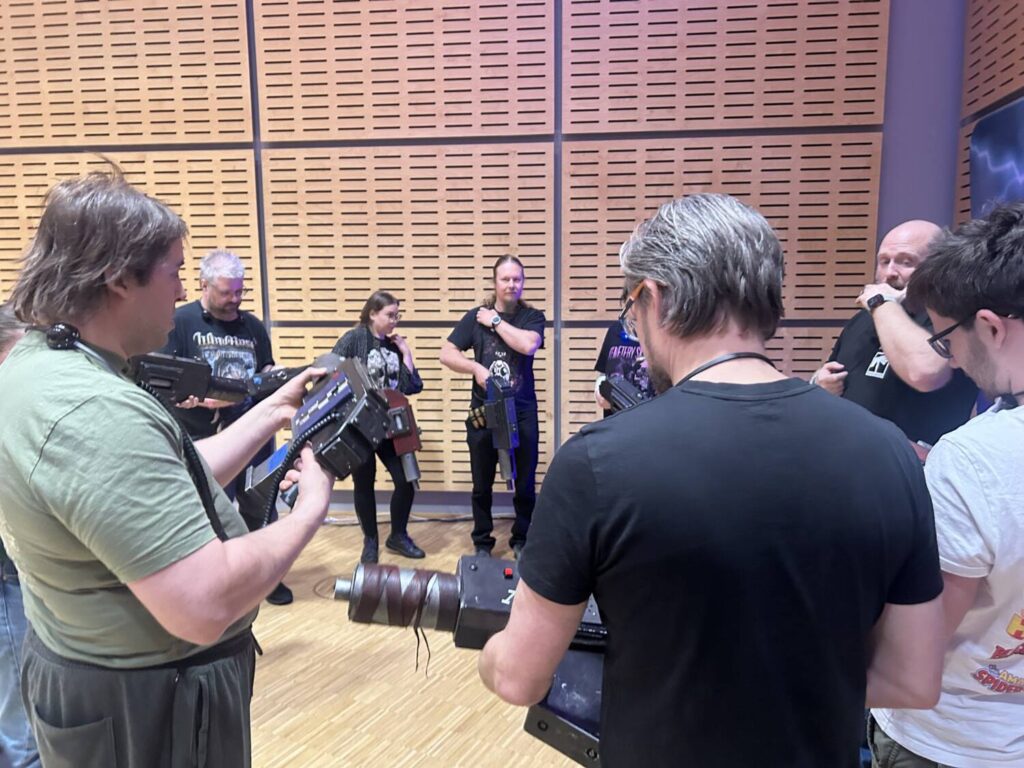
As a peruser of wares, then, as a consumer of product, Spiel for me is much more about the niche and the unusual, the games that I’m not going to trip across in the ACD catalogue three months from now. These are often games that have no marketing to speak of, outside the marketing cost that is the booth. I was stopped dead in my tracks by the backdrop for the modest corner booth occupied by Beyond Words Games, a Ralph Steadman-esque fantasia of monsters and hallways and angles gone awry. “Their” game, and I only put that in quotation marks because “their” here is Italian artist and designer and publisher all-in-one Gerardo Maria Priore, is an inductive reasoning game in the same vein as Zendo, called The Stranger Forgeries of Mr. S.C.Rheber. I had already bought more than I intended that day—we’ll get to that in a moment—but I couldn’t walk away without picking up a copy of this gorgeous and eclectic production.
 For the last several years, the only money I’d spent on games was for the old—Germany is awash with second hand copies of what Americans would consider rare games, and for cheap—or the exceedingly rare. Much of my modest discretionary budget would go towards copies of small print-run Japanese trick-takers. The ones I could manage to snag a copy of, anyway. The great limiting factor for the last half decade has been that the smaller Japanese publishers wouldn’t have many copies. They’d run out of things before you had a chance to buy everything.
No longer is that the case. Capitalism has worked its magic. Such is the demand for trick-takers, so obviously wide-open is the gaping maw of our collective desire, that publishers have reacted in the only sensible way: they make more. I eagerly snapped up copies of every Japanese trick-taker I came across on Thursday morning, assuming I had mere hours left in which to do so. Imagine my surprise and embarrassment when every single one of those booths had copies left on Sunday afternoon. I’ll have to learn prioritization and self-control for next year, I guess. Bummer.
Outside of my own poor fiduciary impulse control, there’s no downside to that. And, in fact, for people in my position, people who come to Essen every year, provided this trend continues, it also means there’s less need to spend big bucks on imported games during the rest of the year, since many of the hottest trick-takers were readily available at Essen booths for about 20% less than I’d paid for them on American import sites. This is how we learn.
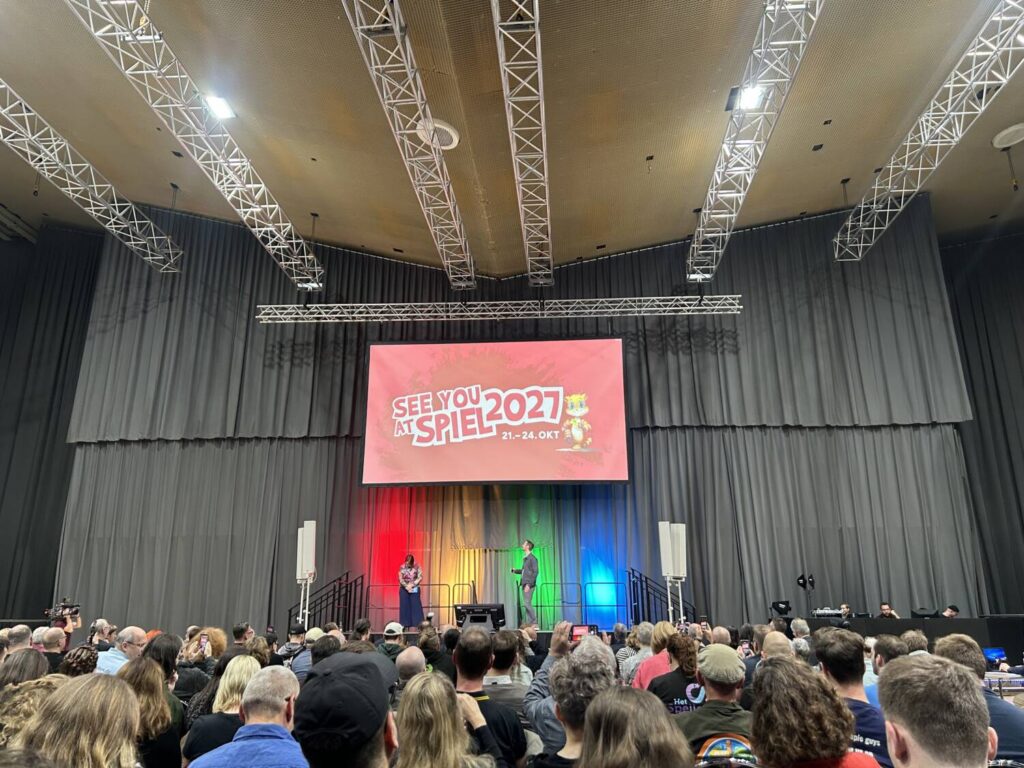
In general, East Asian publishers were very well-represented this year. If the attendees of Spiel remain monolithic in their pallor, at least the publishers continue to grow more diverse. The difference between 2023 and 2026 was significant. During the pre-show press conference on Wednesday, the organizers of Spiel noted that five of the seven continents were represented, with the exceptions of Antarctica, where board games are not produced, and Africa, which “was not available.” I still can’t quite parse what that means, even adjusting for the speaker using their second or third language. Probably that no African publishers applied for a booth? It was the sort of statement that makes my ear itch. There’s probably a there there.
The four days hummed along, with everything working like clockwork. Messe Essen’s efforts cannot be understated. This is an impossible show, and they make it more or less effortless. The odd overflowing trash bin can be forgiven in light of the absurd quantities of people and trash generated, to say nothing of the fact that the trash cans don’t stay overflowing for long. Food options were plentiful and efficacious, security was effective without interfering, and everything within the building worked just as it’s supposed to. That’s impressive as hell.
The publishers and vendors themselves have also certainly stepped up their game. I think 2026 might have been the death of the small booth. By that I mean even the smallest booths were full booths. In 2021 and 2023, the far back halls had “booths” that were little more than a narrow standing banner and a table, freely floating in an open hangar. These were the places where you’d find the DIY efforts, the people taking a swing with little worry of connecting. There was a time when the “Siberian” Halls truly did feel different from the others, much more makeshift. That doesn’t exist in the same way now. Whether or not that’s a good thing, I’m not sure. If the barrier for entry into Spiel keeps rising, that’s going to leave people out.
This year saw a major push for the inclusion of TCGs. Hall 5 was largely given over to Flesh & Blood, Magic, Pokémon, and others. There were significant queues for used card vendors, and booths occupied by nothing more than vending machines with booster packs. I have mixed feelings about all of this, but it was clearly successful. My doubts are not born out of a sense of separatism or a belief that TCGs and the people who play them are Different from board gamers. The rabid and blind consumerism that undergirds both industries was on evident display throughout the convention and in my own bags, so far be it from me to throw stones.
There is a relationship between the perils of our current age, the explosion in nostalgic properties, the use of IP to overcrank the monetization value of a brand, and the reliance of TCGs on the gambling loop to drive profits that does not sit well with me. TCGs, in short, have come to embody for me the darkest parts of our somewhat separate hobby, and to further integrate the two makes me very nervous.
The space claimed by TCGs seems to have mostly been at the expense of used booths, of which there were significantly fewer. The last five years, I couldn’t swing a dead cat without hitting a copy of Elfenland, which I was finally ready to buy this year, but it was nowhere to be seen. Fortunately, my favorite used booth, out in the corner of Hall 2, was still there, and I engaged in my now annual tradition of bringing them the name of some early-2000s Euro I’d like to play. They write it down, go back to their magical warehouse that night to dig up a copy, and I come pick it up the next day. It’s always a pleasure, and it’s a small extra bit of effort on their part that is both entirely unnecessary and makes Spiel a wonderful place to be. For all the mindless commerce, for all the crowds, for all the potential of such an environment being a pressure cooker, it’s full of people who love what they do and care about sharing the joy they find in it with others. It’s hard to beat that.
 Bis bald, Essen.