
Disclosure: Meeple Mountain received a free copy of this product in exchange for an honest, unbiased review. This review is not intended to be an endorsement.

The Whole Hog
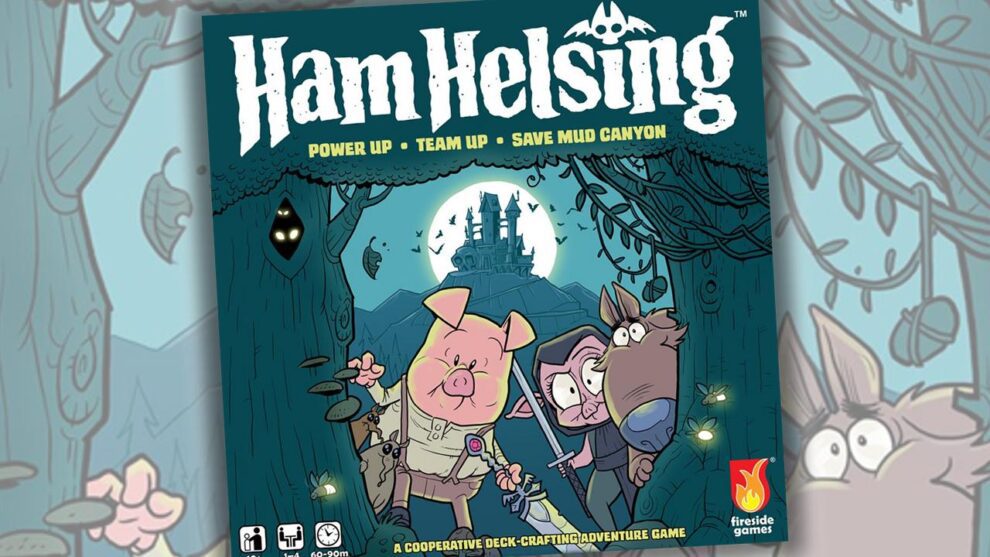
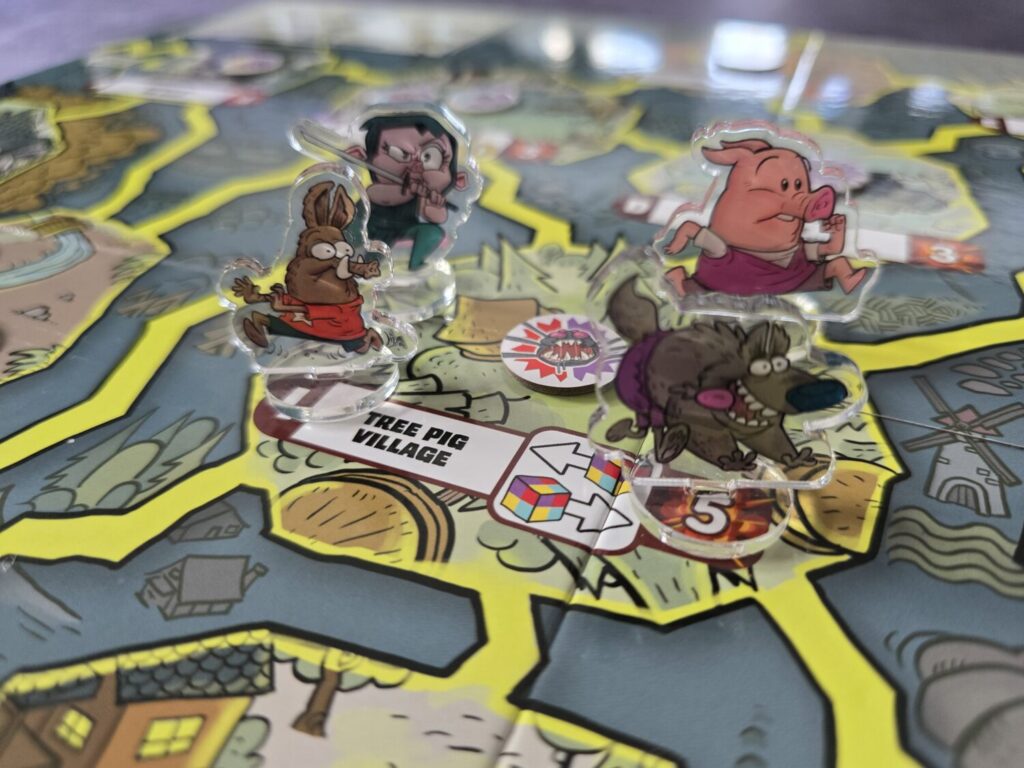
Ham. Ronin. Malcolm. And a werewolf with zoomies named Lobos. These are the heroes in the world of Ham Helsing. Based on the bestselling graphic novels by Rich Moyer, the art in this game immediately grabs your attention and pulls at your heartstrings.
I was first introduced to Ham Helsing way back at GAMA (Games and Manufacturers Association) Expo earlier this year. Typically, cartoon-style or family-friendly art doesn’t draw me in, but something about those lovable animals kept me from walking past the Fireside Games booth.
I haven’t read (or even heard of) the graphic novels, but a few plays put this game into the same bucket as other book-based titles that convinced me to read the source material, including Harrow County, Mind MGMT, and Corps of Discovery.
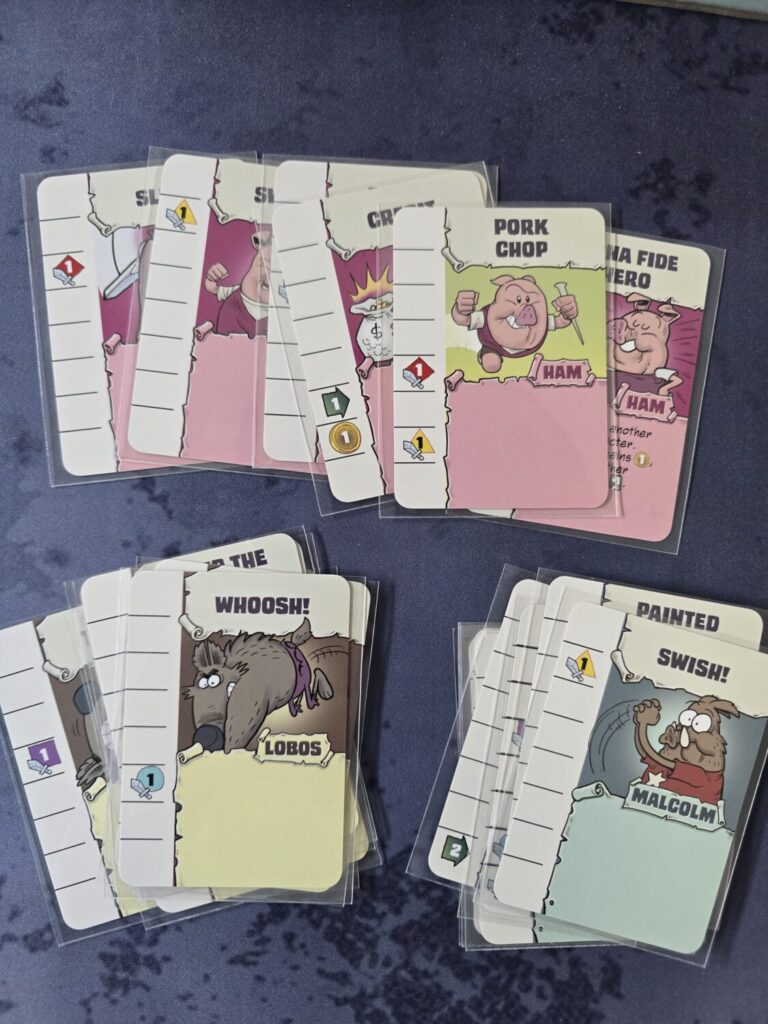
The biggest draw here is the card-crafting system, a mechanic I want more of in the gaming world. Card crafting takes existing cards and makes them more powerful, a parallel twist on deck-building. You may recognize this system from titles like Mystic Vale, Edge of Darkness, Canvas, and Dead Reckoning. The system is cleverly implemented by adding translucent cards into sleeves, often layering symbols or powers until you’ve built a fat stack of juiced-up cards.

Wrap all that in a slew of pig puns, and you’re in for a uniquely charming experience.
How the Sausage Gets Made
Ham Helsing is a cooperative game played over five rounds, where players must defeat one of four villains before they reach Mud Canyon. What seems like a simple task becomes complicated by the spawning of spider minions across the board. If they’re not handled, they can create a bigger mess for the group.
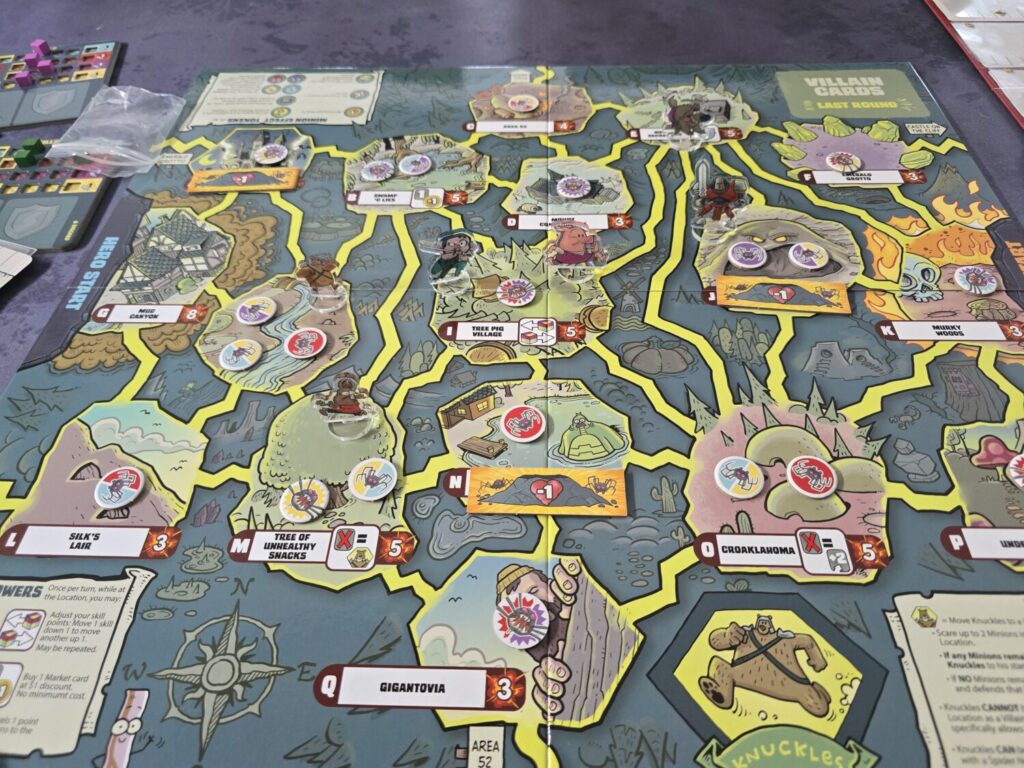
Each player starts with an asymmetric deck and a unique power. In any order, players play cards that earn money, move, attack specific colored minions, heal, or summon the help of Knuckles, the lovable bear who removes minions with his mighty roar. Defeating minions earns gold and skill bumps, which, when maxed out, grant a free attack of a specific color. Minions come in specific colors (and some are multicolored!), and colors must match to defeat them. Players can also attack the boss if they share a space. Defeating the boss wins the game, but the villain also takes actions by rolling dice that block, deal damage, or trigger powers that slow the heroes down.
After each player’s turn, additional minions spawn, and certain spaces can be lost if they become overcrowded.
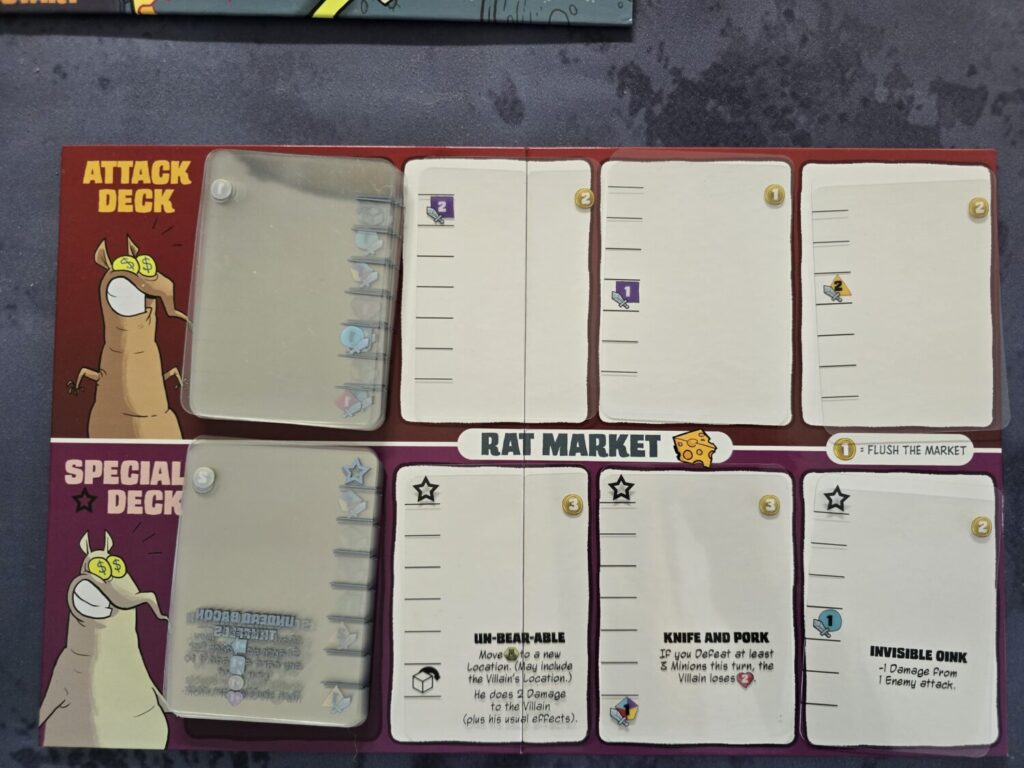
Once everyone has taken a turn, players buy new transparent cards from the market to upgrade their decks. These cards slot into the base sleeves, adding more action symbols and augmenting the heroes’ abilities to take down the big bad.
Defeat the villain, and the heroes are victorious. Take too long, and the villain destroys Mud Canyon, resulting in defeat.
Bringing Home the Bacon
This wasn’t a game that was necessarily on my radar, but it may be one of the best cooperative games to release this year. Peel back the layers, and you’ll see that each player really only gets five turns the entire game, which makes action efficiency the core puzzle.
I had a blast beefing up my cards from the market, especially when my base attack suddenly teleported allies across the map or provided bonus healing. Though all players have asymmetric characters, it felt beneficial to lean heavily into one attack color to create “specialization.” And because turn order never changes, strategic planning becomes crucial so the right heroes are positioned at the right time. As much as I wanted to build certain upgrades for myself, we often made collective decisions about where effects would be most impactful.
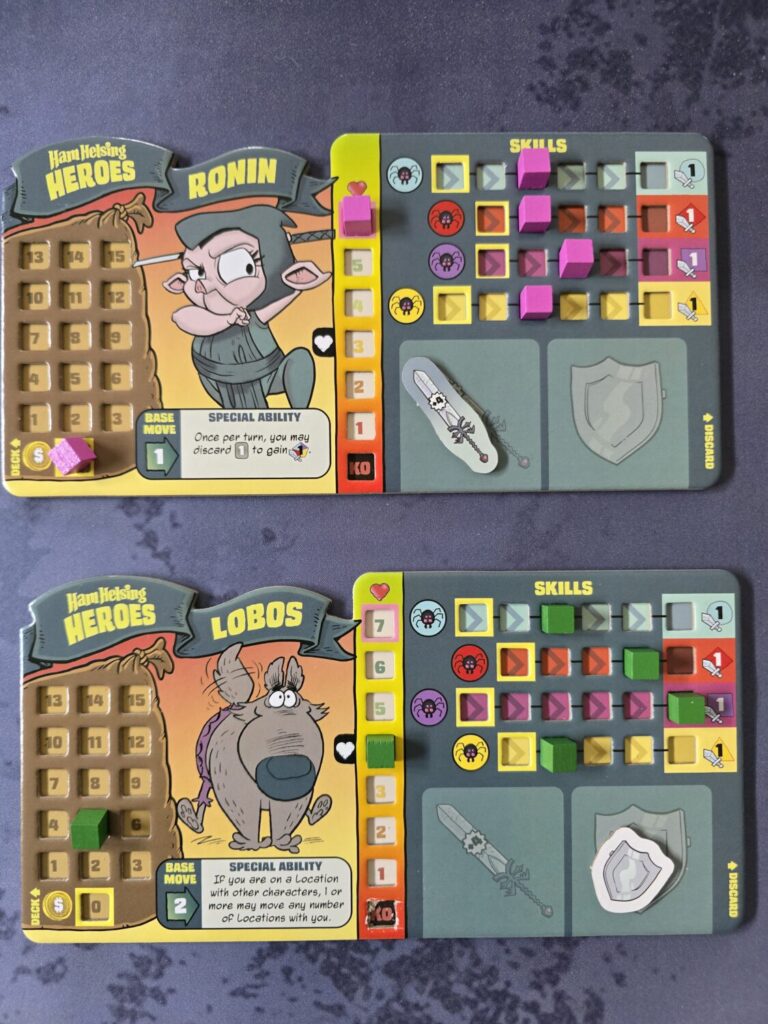
Ham Helsing presents a healthy challenge that hits the sweet spot: enough stress, but not unwinnable. Similar titles like Eldritch Horror or Cthulhu: Death May Die offer the same team-up-against-a-baddie vibe, but those games often have a punishing failure rate that becomes part of their masochistic appeal. That isn’t present here. The box also includes four villains with varying difficulty, some disrupting players and others punching them directly in the face.
The first half of the game feels unwinnable, but after a couple of rounds of heavy shopping, things start to swing. In one play, a teammate who had been dealing one or two damage per turn suddenly strung together a combolicious moment and hit the villain for 20 damage in a single swing. Folks, there is immense fun in building your own broken combos. And since you only see about a third of the upgrade cards in any given session, the synergy stays fresh even after playing through all the villains.
The card-crafting is the most fun angle of the game. Because upgrades go straight into your hand, you get the immediate satisfaction of unleashing your new, souped-up powers on spider baddies. One row of upgrades gives symbols, and the other row gives powers, making the buying decision tough with so many goodies and usually only enough money for one or two purchases per round.
It does take a game or two for the strategy to click. It seems daunting when minions spawn all over the board, constantly, but they’re mostly there to distract and slow you down. Wipe them out too fast without attacking (there are plenty of ways to remove minions without combat), and you won’t have enough to farm for money and skill bumps. I compare it to DOTA or League of Legends: if you’re not farming creeps, you fall behind in levels and gear.
Ham Helsing also doesn’t overstay its welcome, landing anywhere between 45 and 90 minutes. It’s a fairly accessible cooperative game, though not exactly non-gamer-friendly. While the actions are straightforward, there are numerous micro-systems and stacking effects to track, making it easy to forget a thing or two.
Ham Helsing delivers fast turns, big combos, and that satisfying cooperative cohesion where every decision matters. It’s funny, inventive, and way more strategic than it first appears. If the game is this fun, I can only imagine what chaos awaits me in the comics—and what made a hen named Hen go full supervillain.
Ham Helsing details
- Designer: Justin De Witt
- Artists: Rich Moyer
- Publishers: Fireside Games
- Release Date: 2025
- Player count : 1 - 4
- Age range : 10+
- Time range : 60 - 90 minutes
- Mechanism(s): Cooperative Game, Deck, Bag, and Pool Building, Dice Rolling, Die Icon Resolution, Events, Layering, Market, Solo / Solitaire Game, Variable Player Powers
- BGG Geek Rating: 7.19 - converted to Meeple Mountain scale: 3.5.
- More articles about Ham Helsing.