
Disclosure: Meeple Mountain received a free copy of this product in exchange for an honest, unbiased review. This review is not intended to be an endorsement.

“So, normal trick-taking rules, must follow, there’s a single trump. But THIS time,…”
Trick-taking games are becoming very difficult to review, because an ocean of new trick-takers get released every week. (If you had told me the “best” part of the tariff backlash is that more companies are producing more cheap-to-make card games with a trick-taking element, I might have retired from games right on the spot. I like trick-taking, but I don’t need it to survive.)
The hardest part of the trick-taking deluge is that you have to both learn each game as if it is new, and you have to try to leverage your years of playing other trick-taking games to account for how to win tricks, or avoid them, or win some to set up losing all the rest, etc. The first sentence of this article is uttered at almost every game night I host now, because I picked up about 20 different trick-taking games at Gen Con or through the mail!
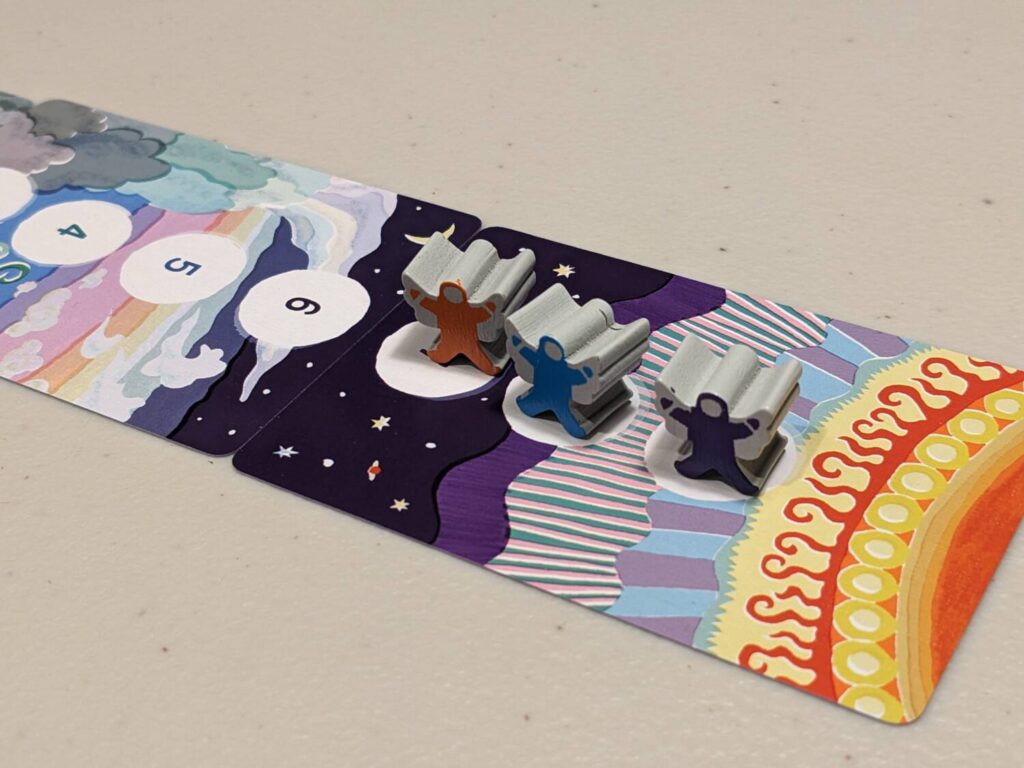
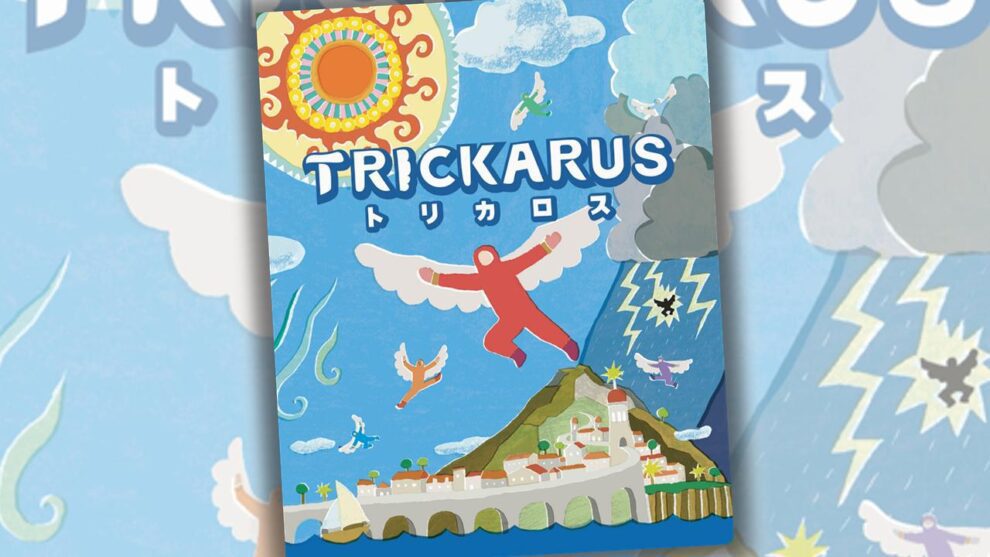
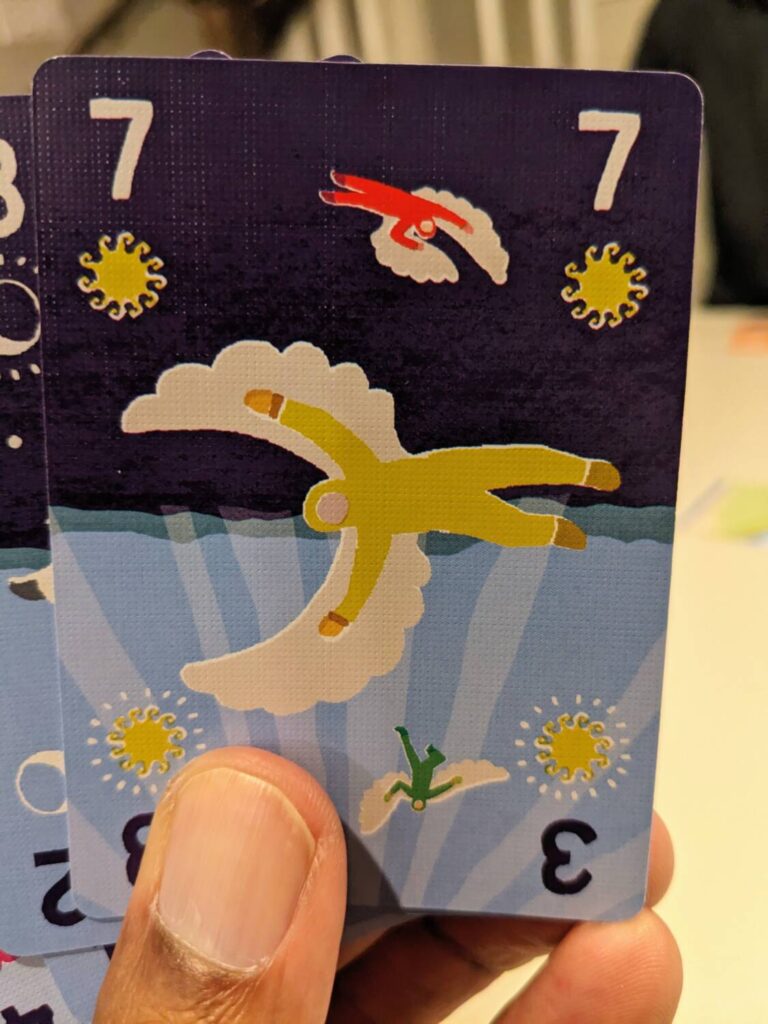
Trickarus (originally released in 2024, but now published by Smirk & Dagger Games in the US) is a must-follow trick-taking game. There’s a trump suit. But THIS time, there is a mechanic where players have cards that have a day half, and a night half. Usually, the total of the values on each card—across four suits: suns, rain, clouds, and moons—total to 10. That means your 9 sun on the day half of the card is a 1 sun on the night/moon side of the card.
The lead player leads with something, then other players must play a card of the same suit from their hand if they can. If not, they can throw off any card they would like. But if anyone plays a 5 into the trick, everyone rotates their cards already on the table and in their hand, which immediately changes the angle of how that trick will play.
This is important, because in Trickarus, there’s a score track that runs from zero to nine. Each spot on the track can only be occupied by one player’s token. When any player’s token sails past nine into the sun (the tokens are Icarus tokens, so, you know), that token is reset just beneath the game’s low-score holder. Once any player has flown into the sun, whoever is in the lead when all cards have been played is the winner.
Trickarus is fast, and the subtle strategy behind trying to win just enough to be high on the score track but not too high is often quite interesting, particularly over the last 3-4 tricks of the game. It’s more of a strategy game at three players; at four or five players, it’s a bit of a chaos engine, one that doesn’t give me good vibes as anything more than a game of chance. (And that’s before you get a bad deal for the likely only round of a high player count game. At three players, both of those plays went for two rounds, leading to a lot of interesting jousting.)
An advanced variant is also included, but I didn’t try that for this review; I wanted to see the game a few times in its base form. The base game of Trickarus is unique enough to warrant inclusion in a collection that is rich with other trick-taking games. The production here is great, with lovely art credited to three artists (Dandi, Tomoaki Mizuno, and Wakana Mizuno), and a hefty poker chip used to signal the game’s current trump suit.
Trickarus is also available on Board Game Arena, so give the game a look there to confirm if the play format is right for you!
Trickarus details
- Designer: Bajir Cannon
- Artists: Dandi, Tomoaki Mizuno, Wakana Mizuno
- Publishers: Bucaneiros Jogos, Learn Bridge Online, Smirk & Dagger Games, Tonbi Games
- Release Date: 2024
- Player count : 2 - 5
- Age range : 8+
- Time range : 20 - 40 minutes
- Mechanism(s): Cooperative Game, Track Movement, Trick-taking
- BGG Geek Rating: 7.06472 - converted to Meeple Mountain scale: 3.5.
- More articles about Trickarus.