
Disclosure: Meeple Mountain received a free copy of this product in exchange for an honest, unbiased review. This review is not intended to be an endorsement.

My relationship with Lost Ruins of Arnak (2020, Czech Games Edition) is generally positive. I’ve always enjoyed myself during my 20-ish plays—all of the base game, both in person and via plays on Board Game Arena—but I’ve never left the table howling at the moon. I’ve always thought of the system fondly, but I’ve never been the one to push the game to the table. I think of it as one of the most reliably solid medium-weight games in the hobby.
Luckily, I know a number of people who don’t just enjoy the system…they adore it. Two people in my gaming circles own the base game and every expansion, while also chasing down every promo item, deluxified set of components, and externally-sponsored artwork piece ever made for the games. One of those guys is the person who I referenced in my interview with designers Min & Elwen, a guy who has logged more than 150 plays on BGA.
So, it was very easy to get the new expansion, Twisted Paths, to the table with my network. For this review, I did two plays, because the main new goodie in the box is a double-sided board with slightly different mechanics depending on the side chosen. I integrated this expansion only with the base game, so for those looking for thoughts on how Twisted Paths plays with expansions like Expedition Leaders or The Missing Expedition, just know that I didn’t try it with any extras.
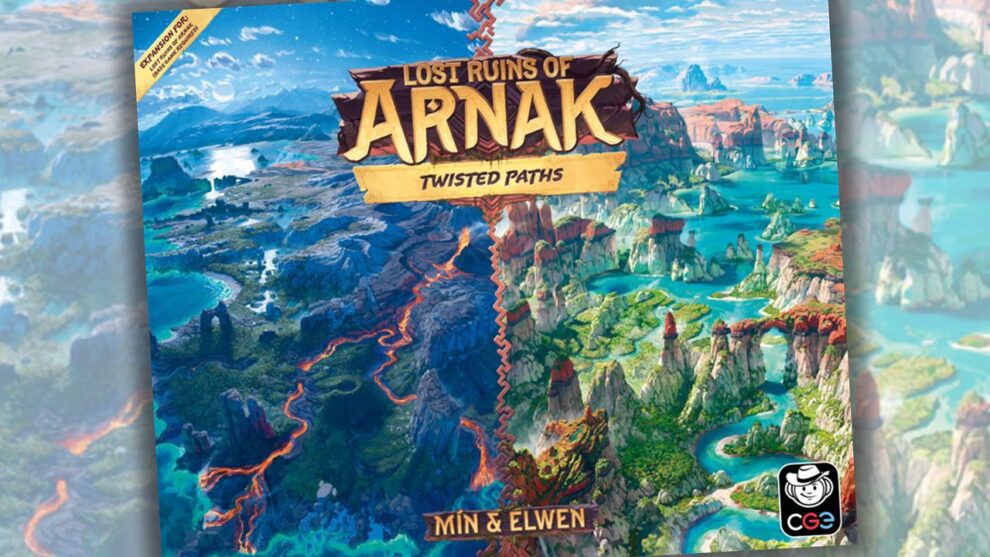
While Twisted Paths does have a few additional site tiles, guardians, and assistant tiles, the reality is that you will buy this expansion for the new, double-sided board that provides options for players who want to add different research tracks to shake up play. The new board has two sides: the Owl Temple and the Spider Temple. For this review, I did one play on each of the new boards to get a feel for what changes are offered by the new boards.
The Owl Temple
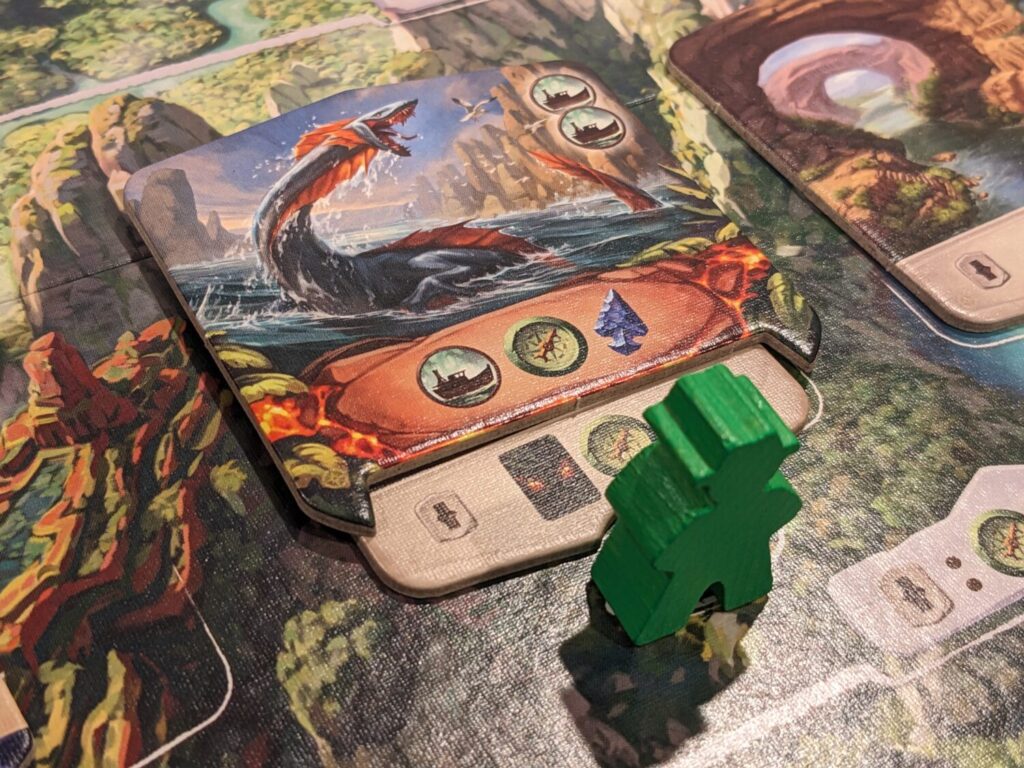
The new manual’s description of the Owl Temple is brief: “the Owl Temple tends to offer more plentiful scoring opportunities.” In our play, our scores were actually pretty similar to what the base game offers, if not a little lower, with a winning score in the mid-70s and other players close behind. (I find that top-tier Arnak players in my network can usually surpass those scores, so your mileage may vary here.)
The non-research portions of the board, where five starting sites still reside at the bottom of the board, and new level I/II sites are added during play, feels mostly the same. The only change comes in the form of an additional tier between the costs for level I sites (three compass/exploration tokens) and level II sites (six compass tokens): now, there’s a middle tier that players can trigger for a cost of three compass tokens and two coins.
I actually love this addition, because I sometimes found myself with a nice pool of resources but not enough to reach a level II site with six compass tokens. Also, one of the sites in this new tier can be reached for a travel cost of two boots…as a result, all of us who spent time building up our pile of Fear cards found ways to burn those to visit that location in each of the final four rounds of that play.
But, this is Lost Ruins of Arnak, and in my experience, Arnak is a research game. That means gathering resources to go up the track on the right side of the board is the best way to score points, and the Owl Temple is no exception. Here, the new track offers new temple tiles that appear in sets of 1-, 5-, and 10-point values and are scattered around spaces on the new track. Moving up the track still costs resources, but temple tiles are now available on almost every space on the track for a separate cost, and can be acquired by taking the research action.
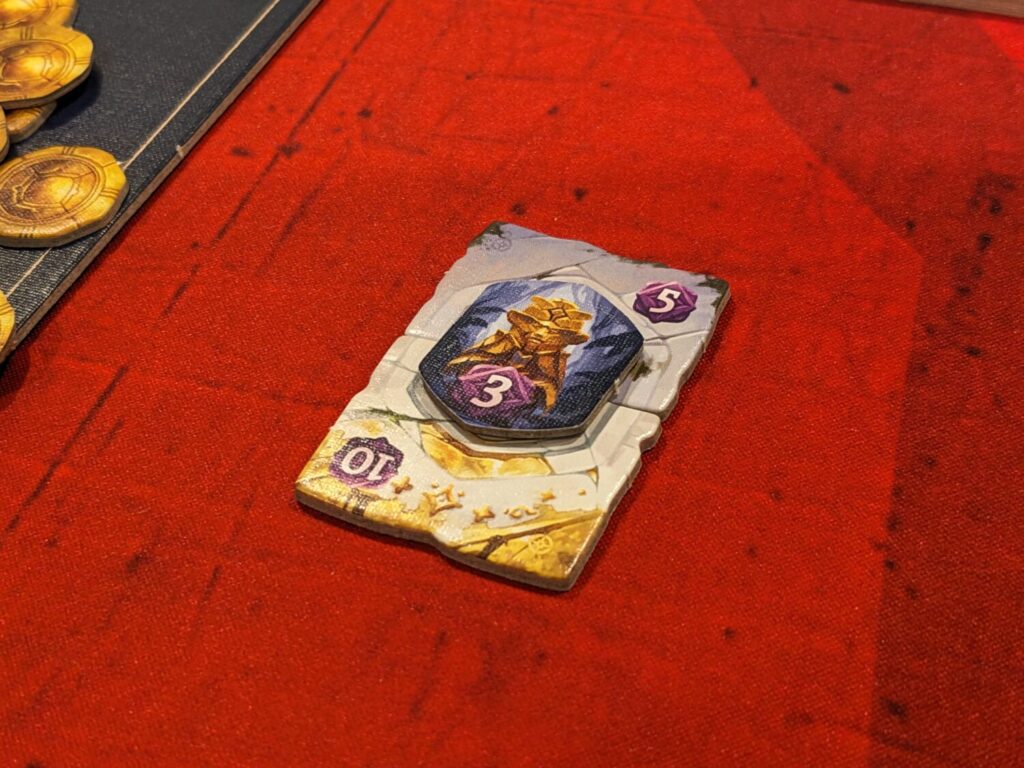
The tiles are small puzzle pieces; when a player gains a second temple tile, they are combined to create new holding slots for idol tokens. In this way, players are incentivized to both acquire these new temple tiles but also to get a number of idol tokens…because now, these new temple tile combos can keep idol tokens from blocking the 1-2-3-4 point scoring spaces on each player’s personal mats, while also triggering the normal free action bonuses when spent.
This addition is not a wow moment, but it is a subtle change from how the base game plays. It is welcome, but it’s not the reason to run out and buy this expansion.
The best change on the Owl Temple research track comes in the form of secret passages. Scattered along each edge of the track, there are about a half-dozen spaces that can be accessed by a player with their magnifying glass token. By paying the cost at an open secret passageway, a player can permanently bury their magnifying glass in one of these spaces to get a one-time reward.
That reward is minor, because the bigger thing here is that this action unlocks a player’s lantern token, new to this expansion. Once unlocked, the lantern begins play at the start of the research track and then has to be boosted up the track as usual…but the rewards for the lantern token are better than the ones granted by the magnifying glass. In some ways, it feels like burying the magnifying glass as early as possible is a good thing, to take advantage of the better bonuses granted by the lantern early on.
Only one player took advantage of this in our play, though. That left the entire experience a bit muted—the Owl Temple and the other minor changes to the main board made the whole game feel like a normal game of Arnak. Our scores weren’t any different than if we had played the base game, there are no new Item or Artifact cards, the new guardians are defeated the normal way, etc. I guess I prefer the Owl Temple over the Bird Temple from the base game, but thinking purely as a consumer, I’m not sure I would run out and buy Twisted Paths based only on this new board.
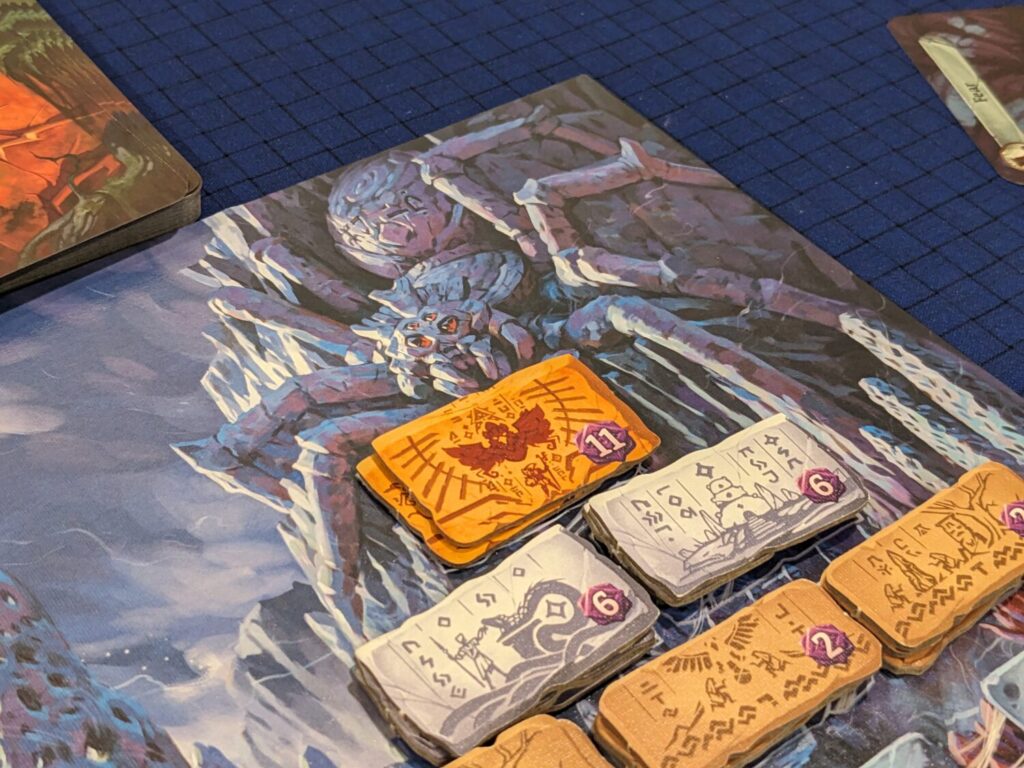
The Spider Temple
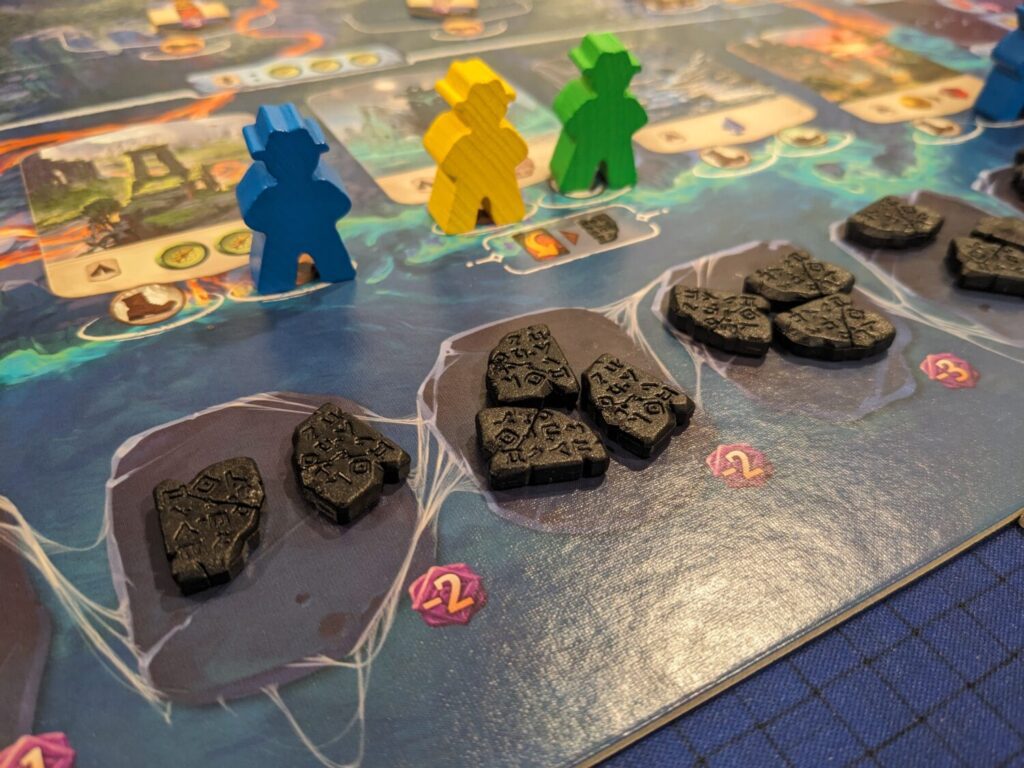
A few nights later, I grabbed a different group to try Twisted Paths on the Spider Temple side of the map. The main change here: dark tablet tokens, which can be found as bonuses on various parts of the board. These tablets are used on the Spider Temple’s research track to trigger one of the five altar spaces scattered throughout the track.
Each altar can hold one artifact card for the entire game, so racing to get to those spaces first to seed a space with a preferred card is a fun twist to how the track plays. Once an artifact is placed, players can take another research action to place one of their dark tablet tiles below the altar to trigger the artifact’s power, up to three times during the game.
Of course, this comes with a cost. As players collectively take more dark tablets from a supply located at the bottom of the board, the amount of negative points each played dark tablet is worth increases. That could mean as many as negative five points per tablet, if enough of these tablets have been acquired by other players by the end of the game.
In our play, this led to scores so low that it was comedy by the end. (The rulebook warns of this as well, so this is the expectation going in!) The winning player, who got seven dark tablets onto the board, lost a whopping 28 points during the game! Clearly, this leads to an interesting subplot around the strategy of this track, because the person who has the most dark tablets next to each altar receives a very small area majority bonus (2-4 points). Finding ways to use the altars sporadically, but strategically, will be a fun angle for Arnak superfans to explore.
That said, the Spider Temple doesn’t really change the overall way Lost Ruins of Arnak plays out. We actually wondered if it made more strategic sense to just go after a normal approach to this version of the game but not interact with dark tokens at all, using actions to defeat guardians or collect resources to fly up the research track like you might in a normal game.
Superfans Only
Lost Ruins of Arnak: Twisted Paths was a mixed bag for me, and in part, I’m sure this is because I attempted the new maps with only the base game’s rules and components. (I do not own the two Arnak expansions.) The rulebook gives me the sense that this will work better with some of the extra goodies included in Expedition Leaders and The Missing Expedition, so I would skip Twisted Paths unless you already possess one or both of the previous major expansions.
As someone who appreciates the base game but doesn’t play it often, I thought the new research tracks did just enough to shake up how the base game plays. I’m not sure I would run out and buy this if you are in the same boat, particularly because Arnak is still a research track game and not necessarily a “beat the bad guys” game (defeating guardians) nor is it a robust-enough deck-builder to surpass some of the other games like this in my collection. One of the guys in my review crew likes both Lost Ruins of Arnak and Dune: Imperium, but gets Dune: Imperium to the table more often because it is a better all-around game for his tastes…and I think I agree with him.
For Arnak superfans, Twisted Paths is a must. And there are new additions to solo play for those who like to take on their research track activities alone. I will try this again with friends who have the other expansions to see how the differences shake up the gameplay!
Lost Ruins of Arnak: Twisted Paths details
- Designer: Elwen, Mín
- Artists: Jakub Politzer, Jiří Kůs, Ondřej Hrdina
- Publishers: Cranio Creations, Czech Games Edition, Gém Klub Kft., HeidelBÄR Games, Rebel Sp. z o.o.
- Release Date: 2025
- Player count : 1 - 4
- Age range : 12+
- Time range : 30 - 120 minutes
- Mechanism(s): Deck Construction, Deck, Bag, and Pool Building, Open Drafting, Solo / Solitaire Game, Worker Placement
- BGG Geek Rating: 8.7786 - converted to Meeple Mountain scale: 4.5.
- More articles about Lost Ruins of Arnak: Twisted Paths.