
Disclosure: Meeple Mountain received a free copy of this product in exchange for an honest, unbiased review. This review is not intended to be an endorsement.
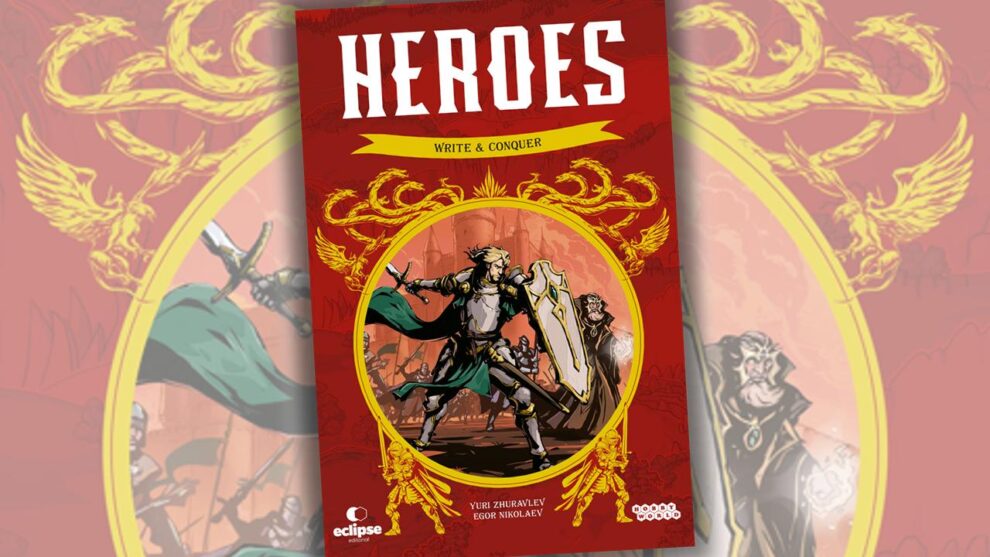
I had a quick meeting with the team at Hobby World at Gen Con earlier this year, during which one of their games caught my eye—Heroes: Write & Conquer, a game that looked a lot like a “blank-and-write” (roll, flip, etc.) with a fantasy setting, but everyone had their own unique faction board.
Count me in. Anything I can try that shakes up the formula for these games is a win for me, so Hobby World sent me home with a copy of Heroes: Write & Conquer a few months later. After getting it to the table, I have some thoughts. The wildest thing about this game is how wide a range of reactions it elicited from players.
16 Blocks
Heroes: Write & Conquer is a draw-and-write game for 2-4 players. The first hint that the game is pushing for interaction comes with that player count: it CANNOT be played solo, unlike most of the games I have tried in this category.
So if interaction is what the game is going for, the design should have that built in, right? Over the course of 16 rounds, the active player dictates which four of the game’s five actions will be taken that round: gather wood, gather iron, gather gold, build structures and recruit soldiers, or move on the game’s 27-site map. Save for the movement action, all players take all actions at the same time, which should lead to almost no downtime. (We’ll come back to this.)
The cool thing about that map is that all players share the same space. So, while players must track their current location on that map, they are often hoping to run into an opponent’s faction in the same space, because that triggers a combat round and the chance of battle spoils for the winner.
While movement is done in secret, each player’s movement phase starts when they announce their current location and ends when they announce their destination point. When players begin a turn on neighboring spaces, there’s a chance that they will decide to move into the same region. It’s a bit of a guessing game. And even when players reveal their new location, they can actually agree not to fight, so peaceful interactions are an available option.
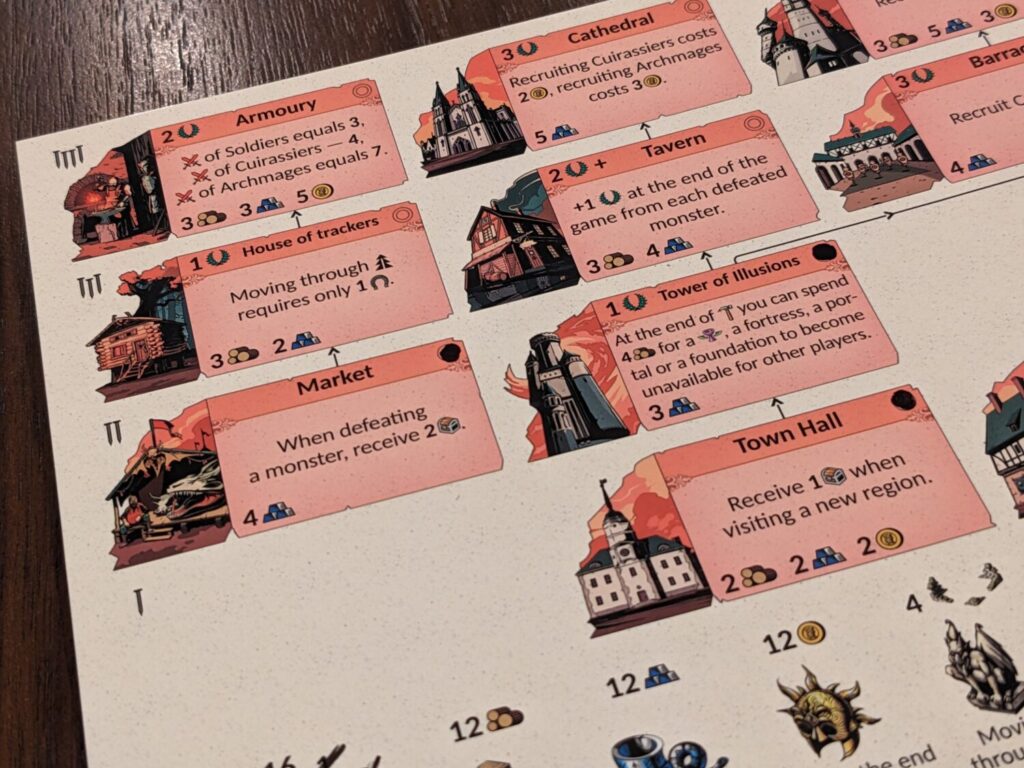
The actions are driven by the active player, who chooses not only the four actions that will trigger in the round, but the order. This order is important because it dictates the power of each action. So, if the order I select is wood, build, move, and gold, all players at the table will get one wood (a power-one gather wood action), then build a structure from a large roster of buildings at or below level two on their mat (a power-two action), then use three action points to move their faction somewhere on the map (a power-three action that is limited by terrain types that must be navigated), then gain four gold.
Just this simple puzzle got everyone excited. Mathing out the best way to gather the things you need to build (and later recruit military units) or the best way to move one’s faction while hosing everyone else who has to spend more movement points to move through difficult terrain was a fun puzzle. Each space on the map also includes collectible resources, artifacts, and “foundations” that can be built upon for bonus points. This incentivizes players to move because resources cannot be gathered by the same player from the same space twice during any single play.
Heroes: Write & Conquer becomes a very simple system, one that rewards points for gathering certain quantities of resources, fighting NPCs (non-playable characters) that are freely spawned at the bottom of a player’s mat, and building higher-level structures. All that was fun. But then a couple of holes opened up during my plays.
“How Long Did It Take?”
Heroes: Write & Conquer says it takes about an hour to play. That number was wildly inconsistent, and it came with a strange twist: across only one of my turns (across my first two plays, so across 32 turns) did a player even encounter another player and trigger a combat sequence.
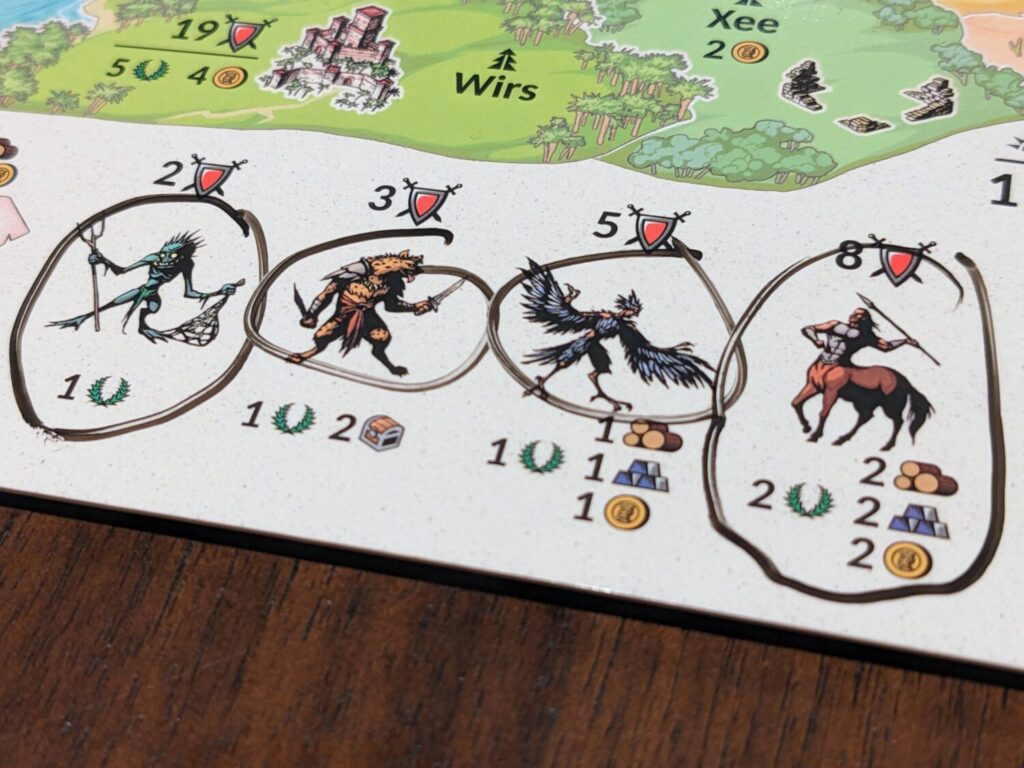
I did my first play of the game with my nine-year-old son. He picked up the rules very quickly, and by turn four or five, we were humming. That play took about 40 minutes, but my son and I never ran into each other. We mostly spent time hoarding resources, building up our armies, and taking out minor monsters that are available to cross off the bottom of a player’s mat by spending the appropriate amounts of military units.
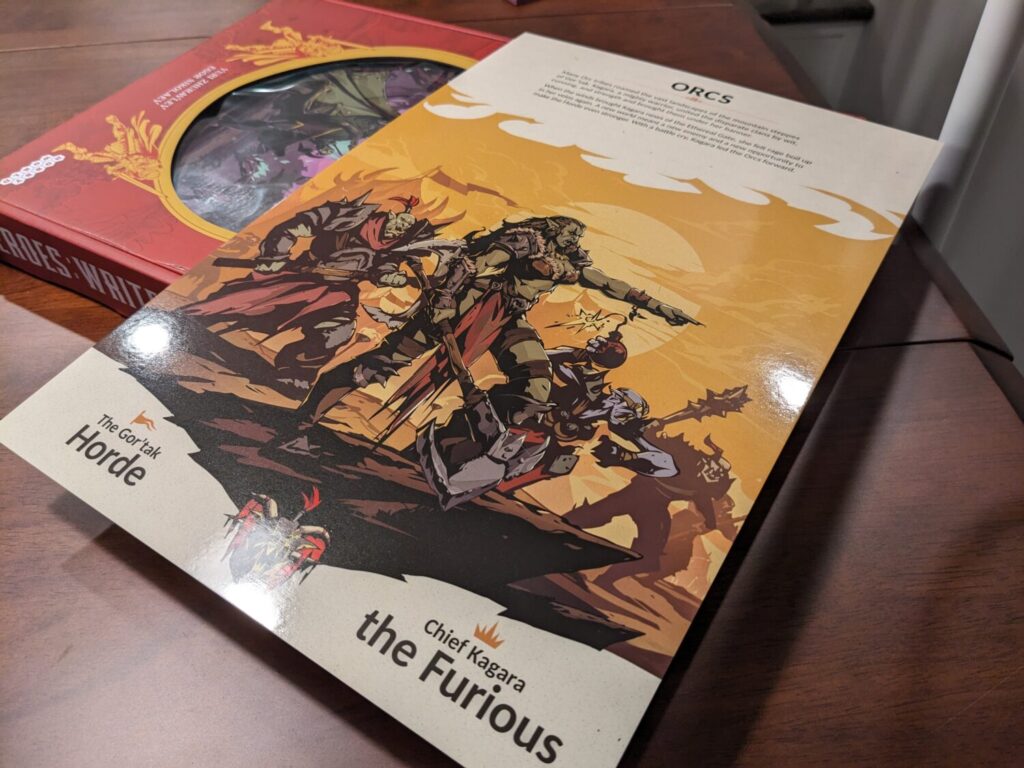
So, it wasn’t thrilling, but it wasn’t bad either. Later that same day, I tabled Heroes: Write & Conquer with my review crew for a four-player game using the four basic factions: Orcs, Gnomes, Humans, and the Undead. On that game’s second turn, the Orcs and the Gnomes moved into the same space, had a combat round that ended in a tie. And that was the final combat of the night.
In part, that’s because our game ran almost unbelievably long: through just eight rounds, that play took a little more than an hour, meaning we were another hour away from wrapping up the game. I looked at the clock and realized that the game we were doing behind Heroes: Write & Conquer that night—SETI: Space Agencies—was going to take another 3+ hours, so we paused our play of Heroes right then and there.
In a game featuring essentially simultaneous play, I couldn’t believe how long everything was taking. I was sure everyone hated Heroes: Write & Conquer…and boy, was I wrong.
“I won’t lie: I love this game,” one of the review crew guys noted.
“Me too!” said another. “I was kind of ‘heads-down’ the whole time, but I liked what it was trying to do.”
These players didn’t mind that they were embarking on a draw/roll/flip-and-write adventure that might take two hours or more…they just wanted to run around, grab stuff, and kill monsters.
That got me thinking: who is this game for?

Bring Better Markers…and Patience
Heroes: Write & Conquer left me in a tricky place.
I love what it is going for. One player (a man who happens to write for this website) called Heroes: Write & Conquer “a 4X game on a Denny’s menu”, and meant that as a compliment. The rules are simple, the included player aid answers a lot of questions, and there’s at least a hint of the thrill that comes with mystery—or, maybe it’s the mystery that surrounds the potential to run into another gang of orcs in the forest, stumbling into a battle that I hadn’t seen coming.
Each player’s faction sheet is exceptionally scoped to include everything a player needs. There’s a resource tracker, a big map, a host of buildings, a scorepad, and a round tracker all packed into a sheet that’s a little taller than a standard sheet of US letter-sized, dry-erase plastic. It’s efficient, and the overall package is so efficient that I think the box is somehow too large for what’s included (four markers, six faction boards, four player aids, and a rulebook).
As a production, Heroes: Write & Conquer is a winner. As a game, it was hit or miss. While I do think of myself as a player who plays fast, I still think this game will be too long for most players, especially with a full complement of four. I loved the concept that players have to keep moving around the map to get more stuff. However, there is a very good chance that you’ll spend most of the time not fighting, despite this being a game where you build armies, take out NPCs, fight fortresses on the map, and gain combat advantages through certain buildings.
Sure, you’re thinking…the game is called “Write & Conquer”, not “Fight & Conquer”, so I get that some players will be totally fine without the combat. But I think more combat would have made for a more interesting experience. I do appreciate that there are six factions included here, because every faction has different buildings, and in one case, different resources. (Orcs can collect rage. Of course they can.)
Heroes: Write & Conquer is certainly tidy. Give this a look if you are a patient soul looking for a family-weight blank-and-write game that leans hard into its fantasy theme. If you invest, just know that the included markers are pretty weak…by my third play, the markers were singing their swan song.