Disclosure: Meeple Mountain received a free copy of this product in exchange for an honest, unbiased review. This review is not intended to be an endorsement.
As someone who finds the wanton violence, corruption, and who-cares-i-ttude that’s baked into American life truly repugnant, the sheer unadulterated fantasy of a fair contest or battle is intoxicating. An oasis in a desert. Game designers and publishers seem to agree—there are so many darn area control beat-em-ups. I’ve played so many, because, when they’re done well (the razor-sharp edge of Inis or the skull bludgeon-y Shogun) you get to have a rare experience—a test of will, bravery, and risk.

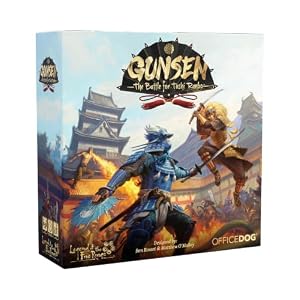
Gunsen: The Battle for Toshi Ranbo’s main problem is that it is sleight. It comes in a big box, it supports up to six players, it has faction asymmetry, tons of card powers, cool pieces, and a compelling premise. But each of these things, while initially compelling, reveal themselves to be paper-thin, and nothing becomes greater than the sum of its parts.
King o’ the mill
The way you win Gunsen is by being the first to accomplish 7 objectives. There are more than 7 available, and all of them, with one exception (holding the center) are permanent once you accomplish them. Most of the objectives are resource management things: build two buildings, play 3 tactics cards, occupy 2 shrines, use your 3 special action slots, etc. If you win a fight, that’s a goal, and you can do that twice. If you capture the center area, you get a goal and a bonus goal for occupying it, which as I mentioned above, you can lose.
If you’re noticing something already, you’ve probably played too many area control games (like me). For now, just note that in a single turn, if you win a fight with someone for the center, you score 3/7 goals immediately.
Powers and actions
Gunsen has a fun-ish action system where on your turn, you draft a card from the market, and tuck it in a matching column on your player board, activating the actions in that column from the top of your card down. It’s pretty basic stuff. You get resources, add troops, build buildings, play cards. You can also use the card you draft to activate a special action that recruits you a special hero, or lets you play a card in a column it doesn’t typically get to go.

There’s nothing here you haven’t seen before in an area control game. There’s Kemet-like movement where you can zip around the board and there’s some “teleporter” locations that further help you go after someone. Everyone has a power curve that ramps up as the game progresses, allowing for bigger and bigger moves.
Combat is semi-deterministic, where you compare three statistics: swords, armor, and blood drops. Your swords are equal to your troop involvement plus any cards. The defender rolls some dice, chooses some to keep, and then the attacker does the same. The die faces give you more swords and the aforementioned other symbols. Each blood kills a troop, each armor blocks a kill. The loser gets teleported back to their home base, and the winner gets a goal.
A beatdown without a cause
If I had to summarize my feelings about the game, I’d just say that it made me feel–perfunctory? Can that be a feeling? Each of the goals and objectives are trivial to accomplish, almost by design, as if the eurogame style contract fulfillment fairy had sprinkled dust all over everything. Because most of the goals do not draw players into conflict with one another, it feels like an exercise in box-checking. In a 5-player game, the whole thing can be over in 4-5 rounds, which doesn’t feel like much time at all to beat up your friends, and the typical culmination is somebody striking the center.
Give me juice, or rough edges, something to latch on to, something to get angry or upset about!

I wish I had more to say about the game. Nothing about the asymmetric faction design convinces me that anything meaningful has been done with this particular trope. Like many games that choose this feature, some of the powers are just strictly more useful than others (looking at you, green faction that gets to break the card column rule). There’s not much texture and flavor in the setting, which is feudal Japan with spells.
Maybe there’s an audience for this, but I’m not quite sure who it would be. The game is unsatisfying for area control-heads, and has a bit too much going on for someone looking for a casual experience. Mostly, it’s an assemblage of other games, reflecting none of their greatness.
Gunsen: The Battle for Toshi Ranbo details
- Designer: Ben Rosset, Matthew O'Malley
- Artists: Agri Karuniawan, Alayna Lemmer-Danner, Amelie Hutt, Andreia Ugrai, Andrey Pervukhin, Anna Christenson, Arif Wijaya, Asep Ariyanto, Billy Christian, Borja Pindado Arribas, Calvin Chua, Caravan Studio, Carlos Palma Cruchaga, Chris Ostrowski, Conceptopolis, Damien Mammoliti, Darren Tan, David Ardila, David Horne, Diego Gisbert Llorens, Eli Ring, Fajareka Setiawan, Felipe Gaona, Filip Storch, Francisco Miyara, Graey Erb, Guillaume Ducos, Imad Awan, Isuardi Therianto, Joshua Cairós, Kevin Zamir Goeke, Le Vuong, Leanna Crossan, Maerel Hibadita, Marius Bota, Mauro dal Bo, Nele Diel, Oscar Römer, Pavel Kolomeyets, Polar Engine, Robin Wouters, Sergio Camarena, Shawn Ignatius Tan, ShenFei, Stanislav Dikolenko, Tomas Muir, Tony Foti, Wen Juinn
- Publishers: Crowd Games, Office Dog, Rebel Sp. z o.o.
- Release Date: 2026
- Player count : 2 - 6
- Age range : 14+
- Time range : 45 - 90 minutes
- Mechanism(s): Dice Rolling, Die Icon Resolution, Hexagon Grid, Open Drafting, Race, Variable Player Powers, Variable Set-up
- BGG Geek Rating: 7.91021 - converted to Meeple Mountain scale: 4.0.
- More articles about Gunsen: The Battle for Toshi Ranbo.