
Disclosure: Meeple Mountain received a free copy of this product in exchange for an honest, unbiased review. This review is not intended to be an endorsement.

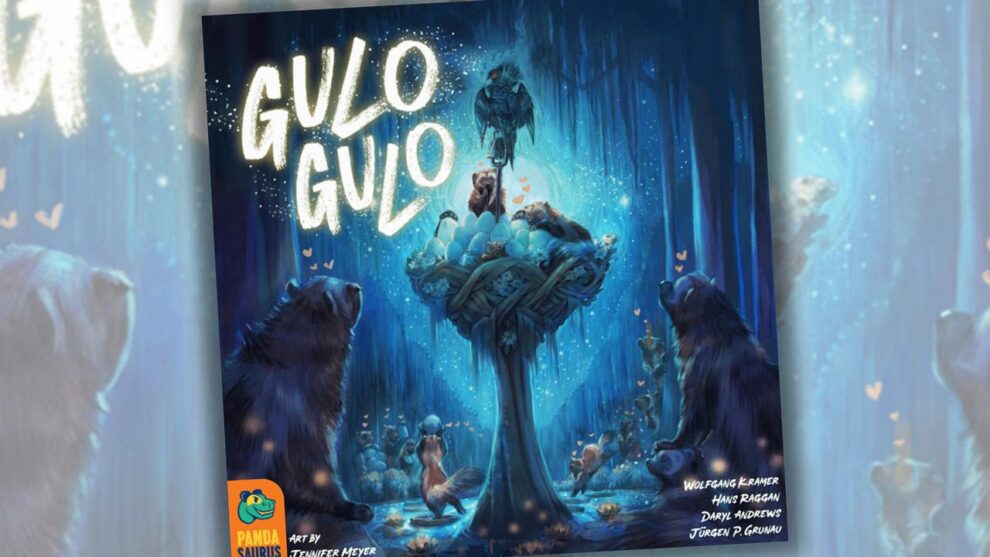
In Gulo Gulo, players compete to rescue a young gulo—a wolverine—from the evil swamp vulture. I say “evil,” but that’s unfair. The wolverine pup was trying to steal one of the bird’s eggs, after all. Is the vulture really evil, or simply a participant in larger systems that force us into binary rolesl? If the game were from the vulture’s perspective, would the gulos not be the evil ones? You could reframe Gulo Gulo as a tower defense game in which the vulture fends off a hoard of ravenous gulos and not have to change any of the facts on the ground. Games really can teach us things, if we have the heart to listen.
Philosophical implications of this exercise and its framing aside, Gulo Gulo is Candy Land with dexterity elements. To move to a new space, you pull a matching egg out of the nest, a wooden bowl full of the colorful ovoid ova. This wouldn’t be much of a challenge at all were it not for the tall and precarious stick that pokes out above the nest, its weighted end causing it to weave and wobble and constantly threaten to fall over. If the stick does fall or if you cause any eggs to fall out and hit the table, you move back to the previous spot that matches the color of egg you were going for. The first player to find the nest tile is the winner.
This is low-impact stuff, to be sure, but there’s an inkling of strategy in choosing what color egg to pilfer, based both on your board position and the arrangement of eggs in the bowl. Sure, that tan egg would move me way up the track, but it seems load-bearing, doesn’t it? Maybe a blue egg would be better. When you’re playing with a five or six year old, that’s just enough thinking to trick them into problem solving.
Another nice thing about Gulo Gulo, which separates it from just about every other dexterity game on the market, is that it self-balances for age. Older players have bigger fingers and a harder time grabbing the egg they want. Younger players are more likely to make poor choices, but they’re also better suited to picking up the exact egg they’re looking for, with fewer chances of pushing other eggs out of the bowl. Dexterity games often appeal to children more than other types of games, but they also struggle with dexterity. It’s nice to play a game that works to their advantage.
The only thing that really matters with a game like this is whether or not kids like it, and I can tell you for a fact that they do. Each time I’ve played Gulo Gulo, the youngest at the table have had a tremendous time. As for the adults? The kids having a tremendous time is enough.
Gulo Gulo details
- Designer: Daryl Andrews, Hans Raggan, Jürgen P. Grunau, Wolfgang Kramer
- Artists: Jennifer L. Meyer, Victor Boden
- Publishers: Competo / Marektoy, Pandasaurus Games, Rio Grande Games, Zoch Verlag
- Release Date: 2003
- Player count : 2 - 6
- Age range : 5+
- Time range : 15 - 20 minutes
- Mechanism(s): Modular Board, Physical Removal
- BGG Geek Rating: 6.83405 - converted to Meeple Mountain scale: 3.5.
- More articles about Gulo Gulo.