
Disclosure: Meeple Mountain received a free copy of this product in exchange for an honest, unbiased review. This review is not intended to be an endorsement.
I’ve never fully jived with resource management and conversion as a gameplay mechanism. Some of my favorite games are heavy on resource management—Beyond the Sun, Barrage, and Brass leap to mind—but I tend to shy away from such designs. No Agricola or New Bedford or Gaia Project for me, thank you so much for asking. With rare exception, I find the practice tedious. The need to do X so I can do Y so I can do Z is not pleasurable for me.
Despite that, I found myself drawn to Friedemann Friese’s Formidable Farm, a game whose box might as well carry a sticker crying out, “Oops!, All Resources!” You start the game with a deck of cards, each containing a resource conversion equation (spend one Sheep to gain two Tomatoes and a Wheat, as an easy example), and you win by being the first player to empty both your deck and your hand. This is Efficiency: The Game, and ain’t no mistake.
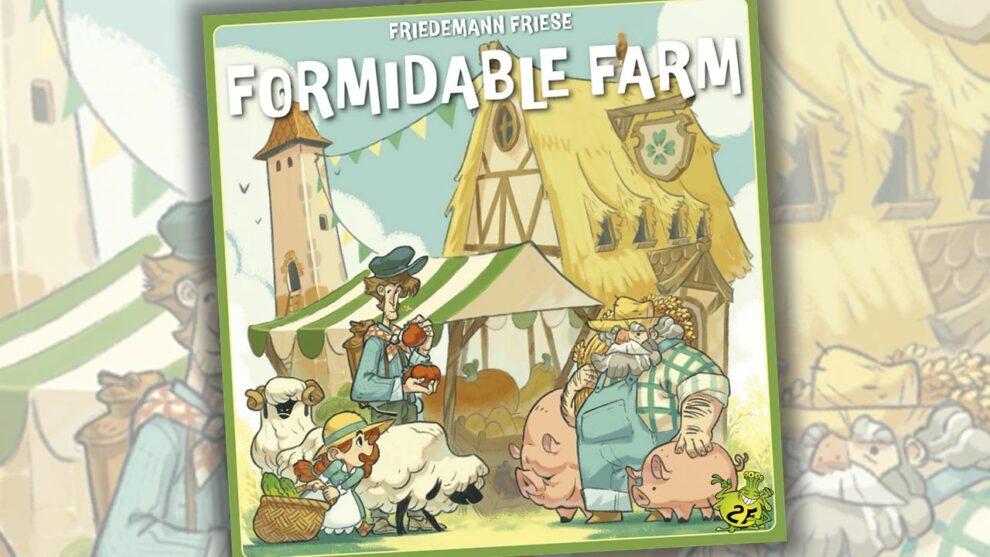
So why, then, do I find myself rather fond of this game? I can’t be sure. The art certainly helps. Sylvain Leroy manages to imbue simple drawings of wheat and tomatoes and pickles with personality. The farmers who populate this market and the coins that decorate the back of every box are wonderful, suggesting a world and an ambiance with relatively little material. You look at the drawing on the cover and you can hear the market’s theme music.
There’s also something refreshing about Formidable Farm’s approach, a lack of pretension in the directness with which it says, “Hey, manage your resources!” You spend about thirty or forty minutes trying to chain combos of cards at a rate of no more than three per turn and then you’re done. In and out, fairly quick.
The directness is novel, and so too is the card economy. You don’t draw cards in this game unless you fulfill a card that allows you to do so. This helps break the loop, to ensure that players are not constantly generating more and more resources until the end of the game. You need to spend resources to gain cards every now and then. You’re subsistence farmers, I guess.
That does mean the game doesn’t have a big arc, which may lose some people. You aren’t building an engine to later rev, or seeding crops for subsequent harvest. It’s a a tactical affair, a constant churn of cards and materials. You gather just enough to make it through to the next round. Any turn when you can manage to play three cards is a good one.
My primary motivation in picking up Formidable Farm was trust. I figured that a designer who’s spent the last 25 years cranking out idiosyncratic design after idiosyncratic design wouldn’t stop now. That trust was rewarded. Formidable Farm is a charming, quick, unusual game, both welcoming in its aesthetic and complexity and punishing in its practice.