
Disclosure: Meeple Mountain received a free copy of this product in exchange for an honest, unbiased review. This review is not intended to be an endorsement.
Five years ago, I reviewed the original Fantasy Realms with its expansion The Cursed Hoard. It was during my early years of committing to review writing, and if I’m going to be metaphorical for a moment, that feels like waking up and my feet just touching the ground compared to where I am today, two hundred reviews later.
What I wasn’t expecting, besides still writing reviews, was Fantasy Realms becoming a staple of the WizKids line. The original version performed well enough to spawn Marvel: Remix, Star Trek: Missions, and even a deluxe remake of the original. Each version has its own spin, for better or for worse, and the new Greek Legends feels more like a refinement of the original than something wildly experimental.
The Pantheon Expands
The core gameplay loop of Fantasy Realms: Greek Legends hasn’t changed much from the original. You still start with seven cards in your hand and draw from either a common deck or the discard pile. After drawing, you must discard one card from your hand face up. When ten cards accumulate in the discard pile, the game concludes and scoring begins.
The idea here is that each card scores differently and combos often interact with one another. The game is about optimizing your hand and ending at the right moment, with the major challenge being that there are roughly 80 cards in the deck and time isn’t on your side. Cronos is busy, you see.
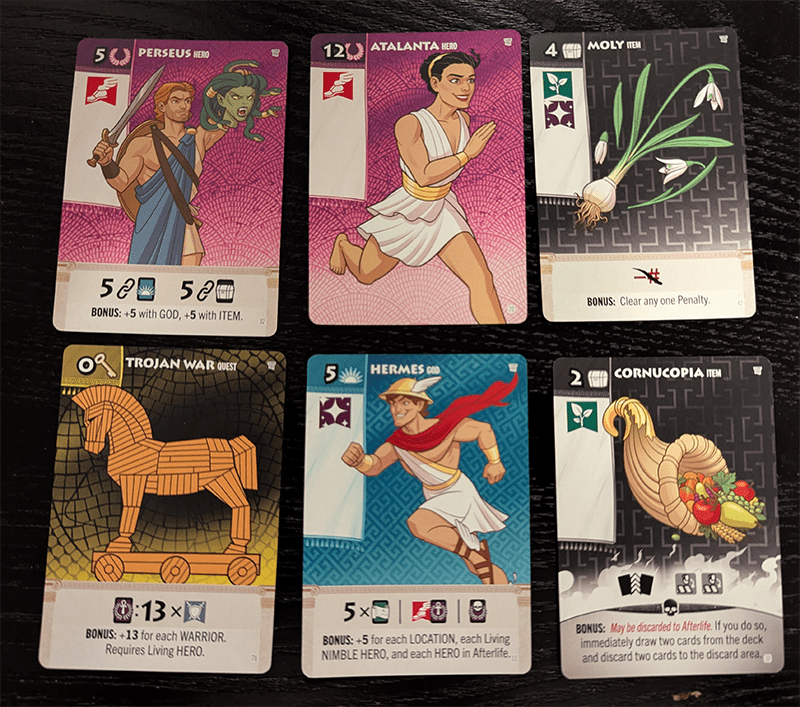
It’s certainly not hard to explain, yet there are a few interesting changes compared to the original. Make no mistake, this is still quite a random game where luck runs this castle and your scoring opportunities depend on the draw. However, the most noticeable new addition is the Afterlife mechanic. Certain cards, clearly labeled with red italic text, read “May be discarded to Afterlife.”
Instead of discarding a card from your hand to the central pile, you can place it in your personal Afterlife pile. At the end of the game, your Afterlife cards still count toward your score, allowing you to exceed the seven-card limit. However, each Afterlife penalty card scores negative ten points, so make sure Afterlife cards score above ten. To capitalize on this, many cards utilize the Afterlife either as an additional bonus or penalty.
The Oracle Speaks
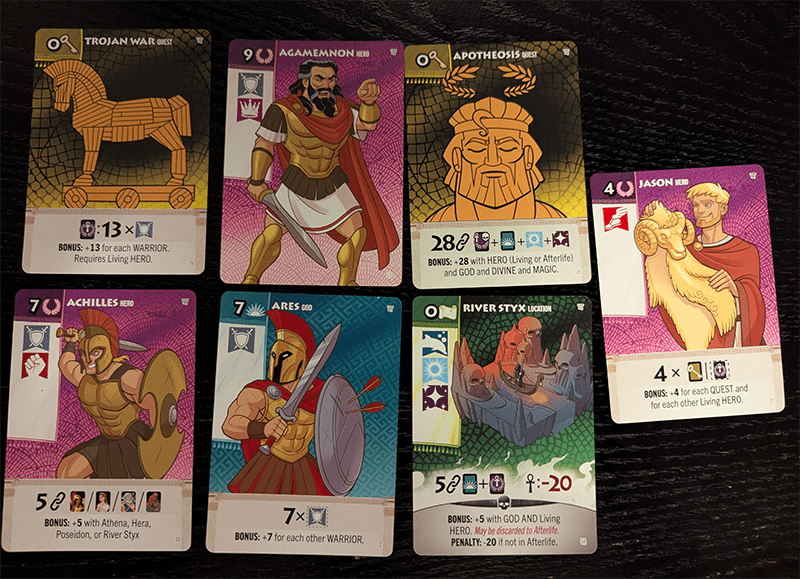
Another interesting design decision is making the suits much more consistent, as opposed to the cornucopia of scoring options in previous titles. Monsters send Heroes to the Afterlife unless a certain condition is met. Many Heroes and Gods synergize with one another. Quests function like objectives, scoring zero points if their conditions aren’t met. Locations often shift the theme of your hand, and so forth.
The consequences of these ideas are certainly felt in this new version. It’s much easier to get into, as understanding scoring opportunities doesn’t feel like navigating through a minotaur’s labyrinth. Players can also leverage the difficulty that they enforce upon themselves. Easy combos exist if you want them yet score less. Ambitious high-scoring combos require the stars to align. This lets new players and veterans compete together without anyone feeling lost. The experienced players usually win, sure, but only because they know which risks pay off.
This attempt to streamline the game does have a questionable outcome. While Fantasy Realms loves to sit on that “filler” category throne, this new version feels quicker than a race with Hermes. Because the complexity of the scoring is reduced significantly, it doesn’t require a PHD to judge your hand’s scoring capabilities once you understand all the nuts and bolts. It doesn’t help that the game has made penalties far less significant this time around, meaning players would know when to end the game. Fantasy Realms: Greek Legends is far more interested in being a sprint rather than a marathon.
Divine Scoring
The streamlined design brings a welcome bonus: scoring is actually manageable now. Veterans of earlier Fantasy Realms entries know the pain of tallying points and the process is just as pleasant as ancient Greek torture devices. Greek Legends sidesteps this entirely. You might not even need the companion app.
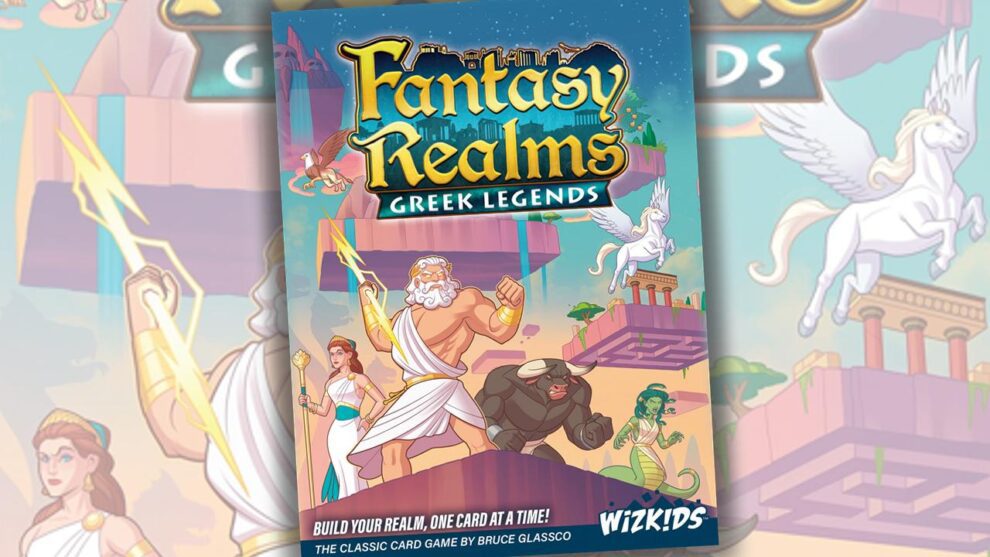
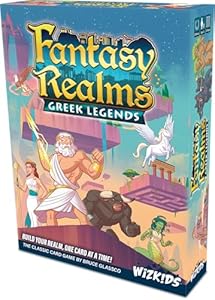
And the main reason for this is the graphic design itself. Daniel Solis is behind this one, and he’s a legend in his own right. The artwork is fantastic, with each item and character having a strong personality and silhouette. Each suit, like Heroes and Monsters, has a particular color scheme with a pattern, and understanding potential combos becomes digestible thanks to superb iconography and card frame layout.
I must also mention that the theme is quite well-researched here. Even someone like myself with passing knowledge of Greek mythology can appreciate the combos, bonuses, and penalties making references to these great stories. For example, Hector scores a bonus if paired with Ares, Apollo, or Artemis, mirroring his allies in the Trojan War. The Trojan Horse requires at least two heroes and the “Clever” hero tag to score its bonus. If you’re a huge fan of the mythology, Fantasy Realms: Greek Legends is going to paint a smile on your face.
Fantasy Realms: Greek Legends is a competent refinement that smooths out the rougher edges without revolutionizing the formula. It’s the version I’d recommend to newcomers, thanks to its approachable design and stellar presentation. If you bounced off Fantasy Realms before, this won’t convert you. But if you’re after a quick, mythologically rich card game, this polished iteration earns its spot as a solid option.
Fantasy Realms: Greek Legends details
- Designer: Bruce Glassco
- Artists: Darren Calvert
- Publishers: Looping Games, Strohmann Games, WizKids (I)
- Release Date: 2025
- Player count : 2 - 6
- Age range : 12+
- Time range : 20 minutes
- Mechanism(s):
- BGG Geek Rating: 7.50588 - converted to Meeple Mountain scale: 4.0.
- More articles about Fantasy Realms: Greek Legends.