
Disclosure: Meeple Mountain received a free copy of this product in exchange for an honest, unbiased review. This review is not intended to be an endorsement.
I enjoyed my time with Corps of Discovery Duo, Joy Cormier and Sen-Foong Lim’s two-player version of Corps of Discovery. Or, at least, I would have told you I enjoyed it. I certainly had a nice time playing this cooperative deduction game for two. But when it came time to write this review, I found I didn’t have much positive to say at all.
It feels unfair, but it also feels right. Prior to writing about Corps, I had been having an excellent day, so I know I wasn’t moody. I even re-read this draft after taking a nice walk. I gave myself a little treat. I hydrated. I took a nap. When I returned, I found that I couldn’t argue with anything I’d written. Corps of Discovery Duo did not work for me in any meaningful sense.
As Lewis, Clark, Sacagawea, or York, two players have to work together to map their way west. In practical terms, this is done by playing cards with one of ten different items on them out onto the table, following both public and hidden rules for each item while doing so.
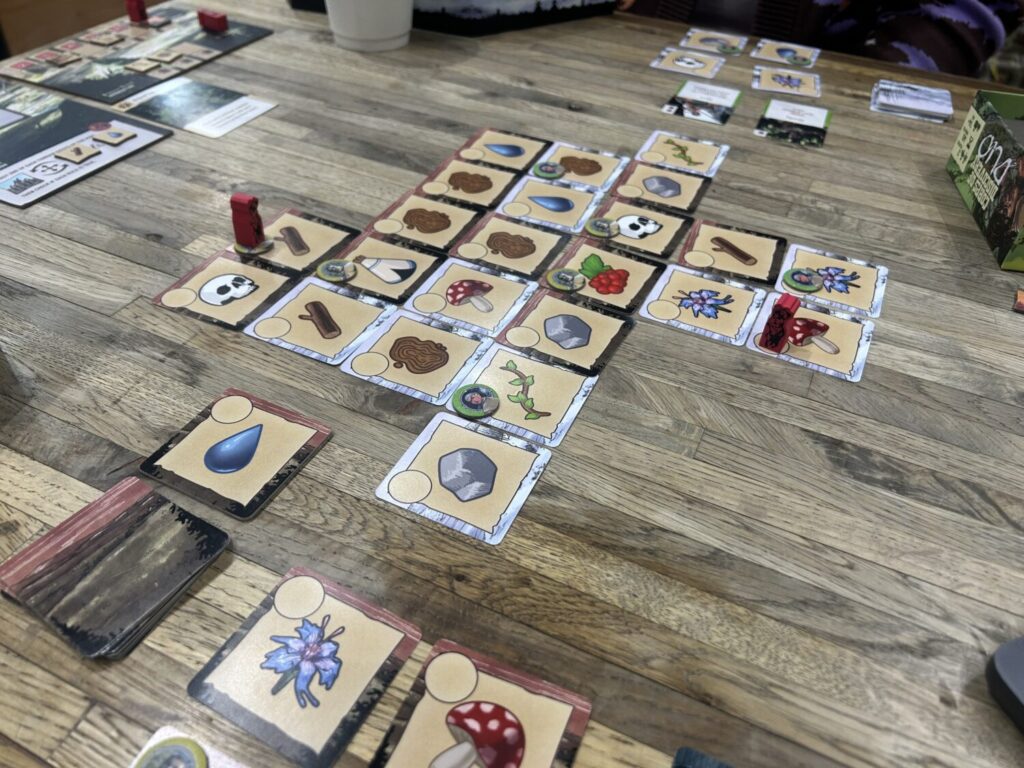
Here we hit our first bump. Why are we arranging items? Why aren’t the cards different types of terrain? Why were artists Owen Gieni and Matthew Roberts instructed to draw berries and skulls and mushrooms when, given the cartographic theme, mountains and lakes and valleys would make significantly more sense? It’s a small thing, but it came up in all of my games, so maybe it isn’t that small of a thing. It’s especially odd because it’s such an easy tweak. If you’re going to make the cards items, have us organize our pack. That’s less fun than making a map, but it’s also a more realistic task. I’d play a game about two coworkers who are incredibly anal about how everything gets put away.
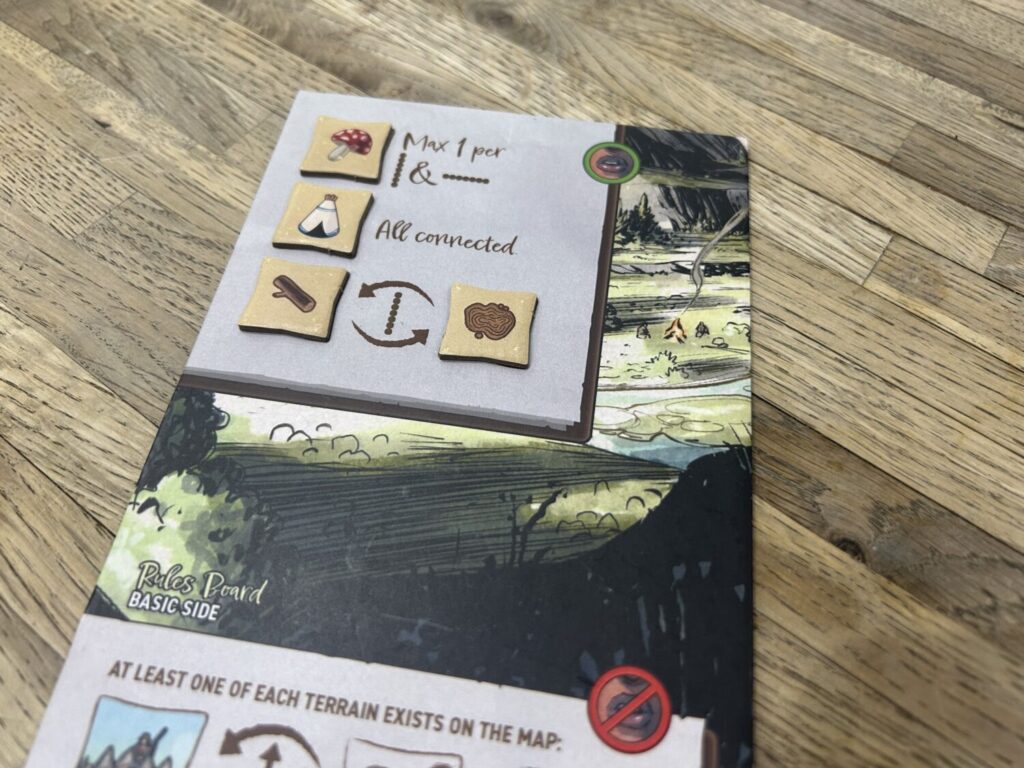
The goal of the game is to locate a Fort, which has to be placed somewhere within a 7×7 grid that satisfies ten rules. Each item is subject to one or two requirements, split between the three secret rules each of you have behind your player screens and the three public rules shown on the main board. These can dictate adjacencies, groupings, require two different items to always coexist within a row, that sort of thing. The setup is ingenious, if a bit fiddly. There are three sets of ten tiles, with each item represented once in each set. One set is split between the two players and used to determine their hidden rules for the game. All you do is shuffle them up and place them on your player card. A second set is split in the inverse, used to keep track of what you think your partner’s rules are. The third set is used to determine the public rules. It’s all designed so that nothing can contradict anything else, which is impressive work.
Every turn, you take a card from your personal deck and place it out on the table. It is not required that every single placement follow all of the rules; in fact, given that it is possible for either player to remove a card from the table during their turn, intentionally violating a rule can be a good way of learning something. Once at least one of each item is out on the table, and once you think all of the rules have been fulfilled, the active player can place the Fort. Then you go through the tableau, one rule at a time, to make sure that everything worked out. It often won’t.
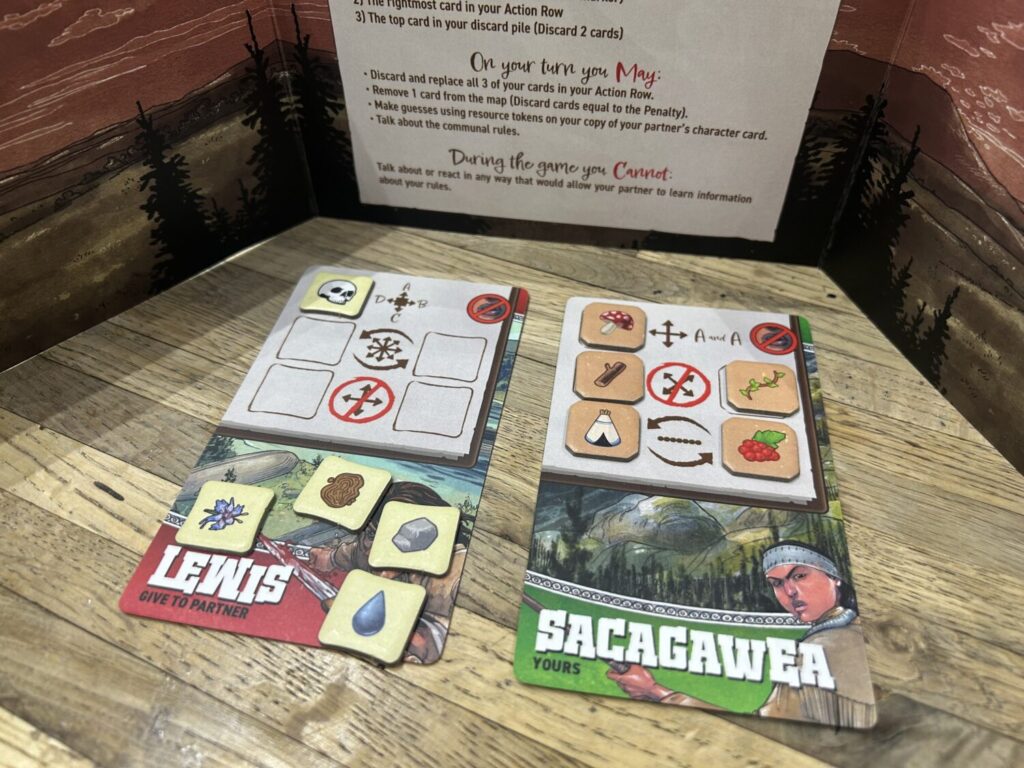
Here we reach the crux of the matter: Corps of Discovery Duo manages to be both too easy and too difficult, and for the wrong reasons in each direction. It is too easy because communicating your rules isn’t particularly difficult, nor is following them, provided you can keep them all in mind. There is satisfaction to be found in coordinating your actions to maintain fidelity to one rule or another, but those moments are seldom. It is more common that you’re off in your own little corner, taking your turn and putting down a tile. Cormier and Lim—wonderful designers both—have managed to create a heads-down communication game. The few times you make eye contact with your partner are when they violate what you’re pretty sure you knew and you shoot them a technically-against-the-rules-but-who’s-counting, “Really?”
Meanwhile, and paradoxically, Corps of Discovery Duo is too difficult because there is a bit too much to keep track of. There are a few too many of them. I’m happy to be asked to do something complex, and I’m happy to be asked to do something simple, but being asked to do enough of a simple thing such that it becomes complicated, that’s not my speed. The common rules give players a place to start and some shared information, but I can’t shake the feeling that they push the game into the realm of the Too Much. It is entirely possible that without them, there would be too little. Game design is hard.
I don’t think it’s a great sign that three of my first four games ended in a loss because of a misunderstood rule, even after a thorough explanation. The iconography is largely good, but it can cause some issues. One of the public rules has symbology that contradicts similar symbology on the player rules. These are the sorts of things that can be worked out as the game nears production, and if Off the Page Games is able to come up with a fix, that will probably help.
Again, what’s confusing here is that I did enjoy my time playing Corps of Discovery Duo. Successfully communicating a rule is satisfying. Realizing your partner has something seriously wrong is funny and panic-inducing. Once you both know all the rules and you’re trucking along, it hums like a fine-tuned machine. But then you find yourself double-checking a public rule for the tenth time this game, and the machine falters. Or you realize your partner fundamentally misunderstands one of their rules, so the entire game has to be scrapped. Or you place your sixth tile in a row that didn’t really matter all that much, just waiting for the game to come to its end. Corps of Discovery Duo promises great discoveries, but the terrain is a bit uneven.