Disclosure: Meeple Mountain received a free copy of this product in exchange for an honest, unbiased review. This review is not intended to be an endorsement.

When it comes to modern board gaming, there is no denying the impact that The Settlers of Catan (now just Catan)has had on the hobby, bringing the ideology of modern game design to players around the world in a format that’s approachable, digestible, and easy to learn. While not a perfect game by any means, it’s a game that’s launched an empire. And now, that empire is going portable.
Now, this isn’t Catan’s first foray into portability. 1996 saw the introduction of Catan: the Card Game, a small box, two-player version of the game. In 2002, the Catan: Portable Edition was released, a tiny plastic version of the base game. Then, in 2010, Rivals for Catan was released, another small box, two-player game based in the Catan universe. Each of these has its issues. Aside from the fact that the two-player games are only for two players, once the games are in progress, they turn into sprawling behemoths that take up almost as much (if not more) space than the board game they’re replacing. As for the Portable Edition, when I say it’s tiny, I’m not mincing words. The cards are miniature versions of the already small cards from the regular game. The plastic road pieces are about as long as the average thumbnail is wide.
When I think about games designed for portability, I think about games designed to be pulled out of your pocket and played at a moment’s notice, games with small footprints, effortless setup and tear down, that play quickly so you bang out a hand or two before the server arrives with your food.
That is precisely what you get with Catan: On the Road. But, how does it fare as a game? And, is it worth your time? Well, let’s talk about that.
The Setup
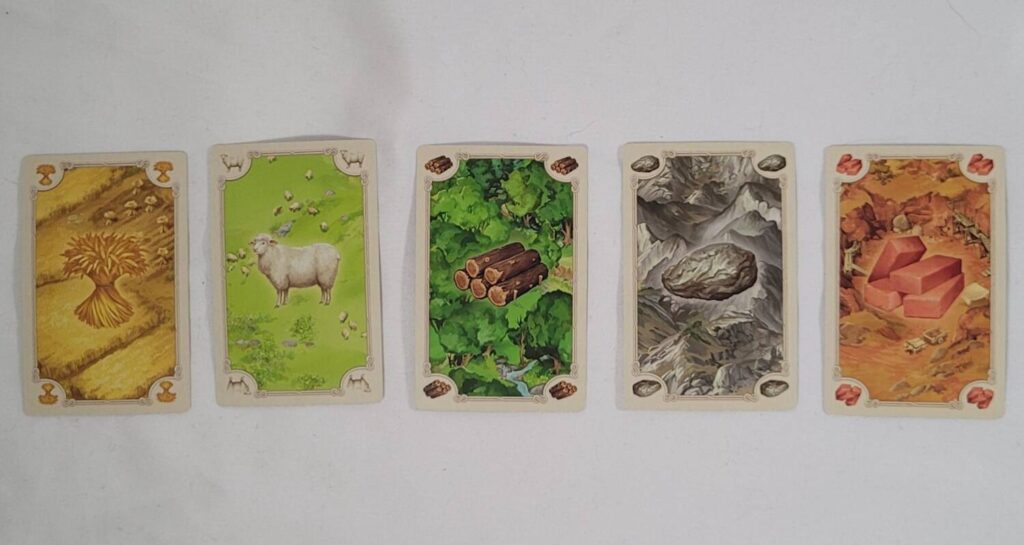
Catan: On the Road comes packaged in a deck box that’s about as wide as two standard-sized poker cards placed side-by-side, and about as deep as a deck of playing cards. Opening it up, you’ll find a deck of Resource cards (brick, wood, wool, wheat, and ore), a deck of Building cards (roads, cities, knights, and settlements), four Metropolis cards, some Event cards, some starter Settlement and Road cards, two Bonus Victory Point cards, and some player aids.
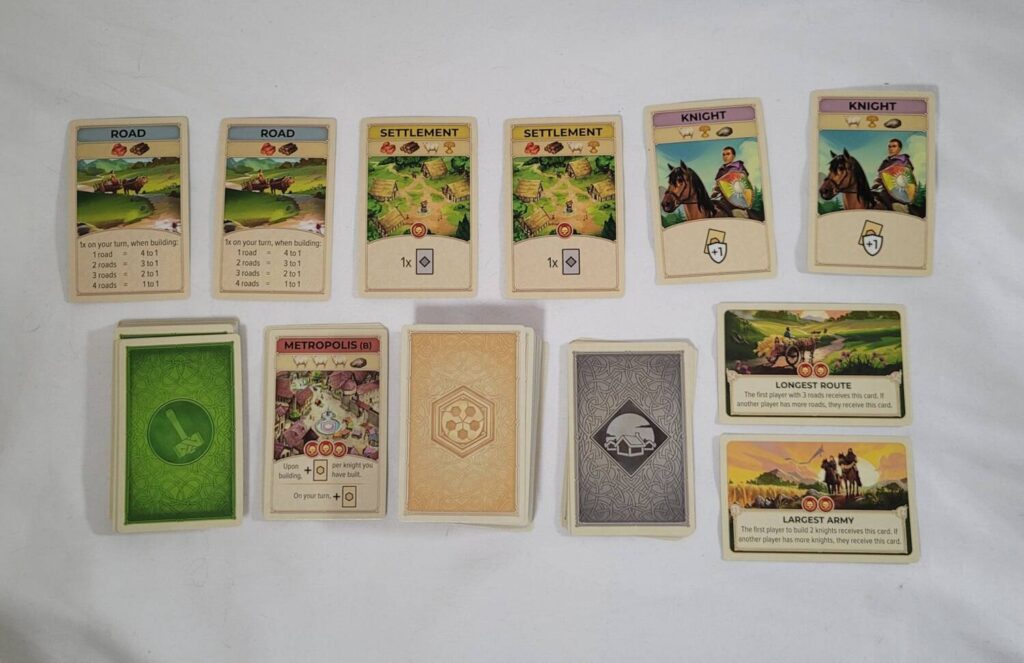
The Resource cards are shuffled to form a face down deck. The Building cards are shuffled to form a face down deck, and five cards are drawn and placed beside this in a row. The Metropolis cards are placed in a stack next to this row. The Event cards are shuffled into a face down deck and this deck, along with the Bonus Victory Point cards, is set off to the side within easy reach. Then, each player receives a randomly distributed starter Settlement card, a starter Road card, a player aid, and two cards drawn from the Resource card deck. There’s no need to figure out who the start player is going to be because one of the starter Settlement cards will dictate the holder of the card is the start player.
With setup done, you’re ready to begin playing Catan: on the Road.
How It’s Played
Each turn is played over two phases: the Harvest phase and the Action phase. During the Harvest phase, the active player will draw a card from the Resource deck and add it to their hand. If they’ve constructed Cities and/or Metropolises, they draw some additional cards. Then, every other player, in turn, will also receive one card from the Resource deck.
In the Action phase, the active player may perform a single trade with another player. Which cards are exchanged for which cards are entirely up to the players involved in the trade. After this has been done, the active player may spend the Resource cards from their hand to obtain cards from the Building card offer, adding them to their tableau. Those cards are replaced with a new card. As the game begins, there is a fixed 4:1 trading ratio that allows a player to use four copies of a Resource card as a stand-in for a different Resource. Building Roads will improve this ratio. The player who is first to build three roads will receive the ‘Longest Road’ Bonus Victory Point card. This card is worth two victory points.
If a player builds a Settlement, an Event card is drawn and the effects of the event are carried out. One of these events is the dreaded robber that will cause a player to have to discard half of their hand if they’re holding more than seven cards. A player can protect themselves from the Robber to an extent, by building Knight cards. The first player to build at least two Knights receives the ‘Largest Army’ Bonus Victory Point card. This card is worth two victory points. The only way to take these Bonus Victory Point cards away from another person is to build more of the specific Building than the player that currently holds the card.

Each Settlement is worth a single victory point. Settlements can be overbuilt with Cities, which are worth two. Cities can be overbuilt by Metropolises, which are worth three. The first player to reach seven victory points wins the game.
Thoughts
Those acquainted with Catan, having read all the above, will find the gameplay familiar and inviting. Indeed, playing this version of Catan does feel a lot like playing the regular game. The race for points is there. The feeling of being tantalizingly close to victory and praying that it makes it back to you again before the Robber appears or someone else wins first is still there. And, that gut-wrenching feeling of disappointment when the Robber does appear, eliminating half your hand of cards, is there as well. All the familiar Catan feelings.
And when I say all, I do mean ALL. One of the things about Catan that keeps people from coming back to it again and again is the helpless feeling that comes from being beholden to the whims of fate and having the dice never come up in your favor. Unfortunately, Catan: On the Road manages to emulate this by removing the dice and replacing it with a fickle deck of cards. Are you holding all the components needed to build the City that will win you the game? Well, tough. There isn’t a City card available in the Building row. And this happens time and time again. Were you able to just build whatever you want during your Action phase (like you can in the boardgame), then Catan: on the Road would be just about perfect. But you can’t, so it’s just okay.
And that’s fine. Sometimes ‘just okay’ gets the job done. Catan: on the Road is easy to set up and tear down. It doesn’t take up a lot of room. And, more importantly, it plays quickly. So, losing due to a bad card draw stings less.
Given the option between playing the boardgame or playing Catan: On the Road, I’ll choose the card game every time. This has easily become my favorite way to play Catan.