
The Inner Monologue of a Super-Fan
Steve Jackson. {deep breath} This is an interview with Steve Jackson. {fidgets nervously} I am kinda geeking out right now. Collect yourself, David. You can do this. Start by introducing the man. {deep breath}
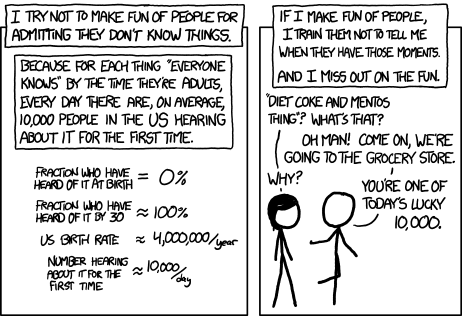
Wait… Does Steve Jackson need an introduction? I mean, if you speak to the people from my generation of gaming, most assuredly not. But new gamers are discovering these hobbies every day (which means there are 10,000 or so people just discovering him today). Sure, there are going to be those new gamers who started with the insanity that is Munchkin, or who cut their teeth on GURPS—one of the most successful lines of role-playing material ever published—but what about those who do not know Mr. Jackson and his company? I know… I will start by providing two Wikipedia articles: one about the man, and one about his company.
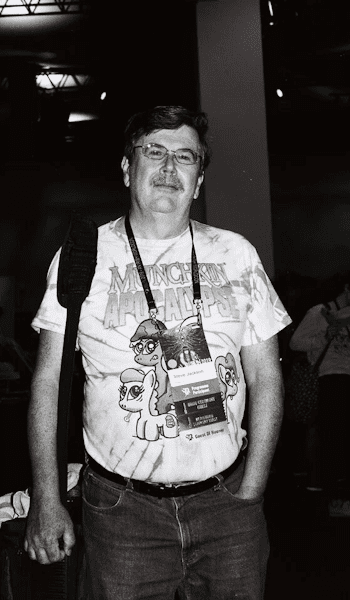
I have gotten to meet Mr. Jackson in person once, at GenCon (he signed my copies of Wizard and Melee). I have had multiple conversations with him online (not that he likely remembers me in any way). What I have experienced tells me that he is a knowledgeable, personable gentleman. So there is nothing to fear here. He is just a guy who happens to be one of the most amazing game designers of the old school.
Yes, he is a hell of a human being, but he is just a man. So let’s get to it, shall we?
Six Sides
 Steve Jackson is a name that rings loudly in gaming circles, alongside all the giants from Sid Sackson, to Richard Garfield, from Frank Mentzer to Alan R. Moon. It towers over even some of the names that have come far more recently (yes, it is quite hard to write something that suggests that Dr. Reiner Knizia is a Johnny-come-lately; but yea, he started designing games some two decades after you were already legendary). With a game design career that spans six decades (1970s to 2020s), what is it you look back on and most want to be remembered for? What have you done that you think will endure the longest once you retire? What are you most proud of? And conversely, what do you want people to forget? What do you look back on and wish you could erase? How has Kickstarter and Backerkit impacted your pipeline? Has this made things smoother or is it its own set of issues?
 Yeah, I do NOT tower over Dr. Knizia. There are some times when being senior is just being old. He has a remarkable ludography. Having said that –
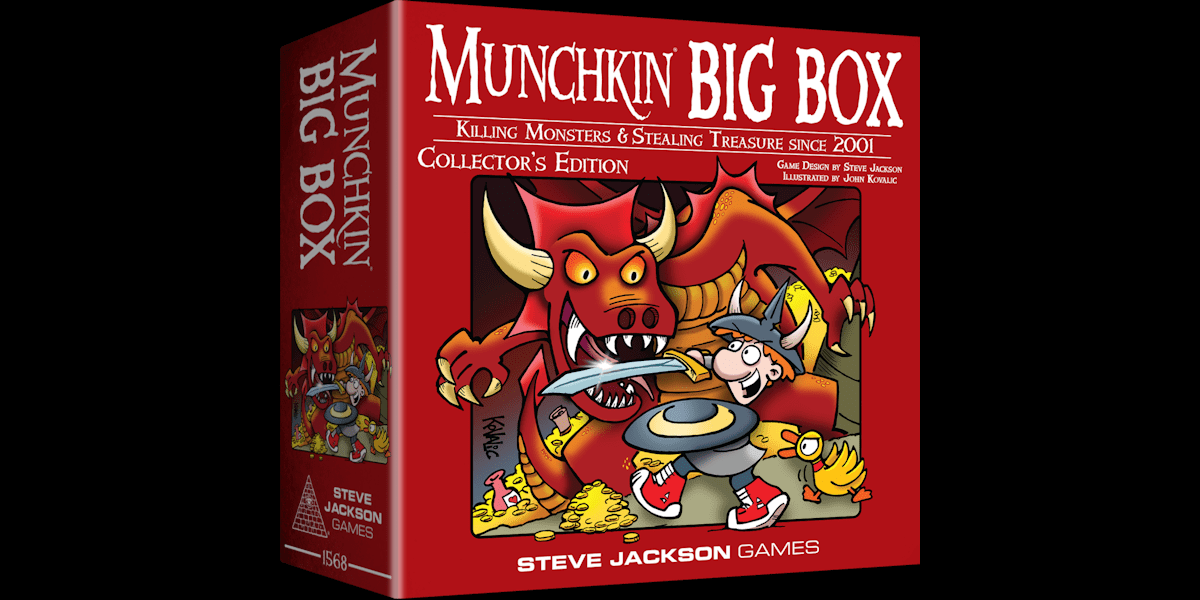
I hope that the company will endure after I’m gone. I think Munchkin has the best chance to be a forever classic, if it’s refreshed occasionally. The same might be true of GURPS but a refresh on something that big is harder.
I’m proudest of Illuminati because I think it is the least derivative ruleset that I have created.
I can’t think of any published work that I would erase, though I’d love to get back the time I spent on the Hot Lead project before concluding that my aims were self-contradictory and I’d never be happy with the result. I would not erase the unplayably mixed-up solo adventure, Bili the Axe. I would just FIX it. (That’s the one where the editor said “Looks all right from here” and didn’t actually double-check the paragraph links. It’s the only release that we have ever recalled.)
Crowdfunding has definitely not made the pipeline any smoother, and it brings its own problems, but if you do everything right and get lucky, there is a payday!

 As one who follows your company blog, The Daily Illuminator, as well as your presence on several social media sites, the last few months have been one joyous announcement after another! Fighting Fantasy is back. We are getting a new Toon. We are getting a revised GURPS 4e. Munchkin is getting an overhaul! I have met the leads on these products over the years (both online and in person), and I know they are enthusiastic, capable, amazing people with a love of what they do—so I am confident each of these will be well done. Still, I have to ask: what spawned the sudden desire to revisit these titles and bring them back in a new and updated form? Is this related to the success of the Ogre and Car-Wars re-releases (and crowdfunding campaigns)? Why these titles in particular? Which one of these are you most excited to see? What changes in these surprised you?
 Not a sudden desire by any means. Several things were in work and were delayed by a very bad 18 months or so, when we had a perfect storm of massive inconvenience with tariffs, the CEO quitting, a couple of personal health issues, and my own move to Atlanta (the company remains in its Austin HQ).
Why these titles? Err, well, they deserved it. So do TFT, Dino Hunt, Frag, and some others, but we can only do so much at once.
Which am I most excited to see? That is hard. Probably the new Munchkin, by a hair, and one reason for that is the “Caesar, thou art mortal” effect. I opposed a second edition strongly for a decade, against the advice of the late Andrew Hackard and Eric Dow, among others. I put in writing that it would never happen. But I finally came around. And this is a significantly better game. It’s lost nothing and it plays faster and more smoothly.
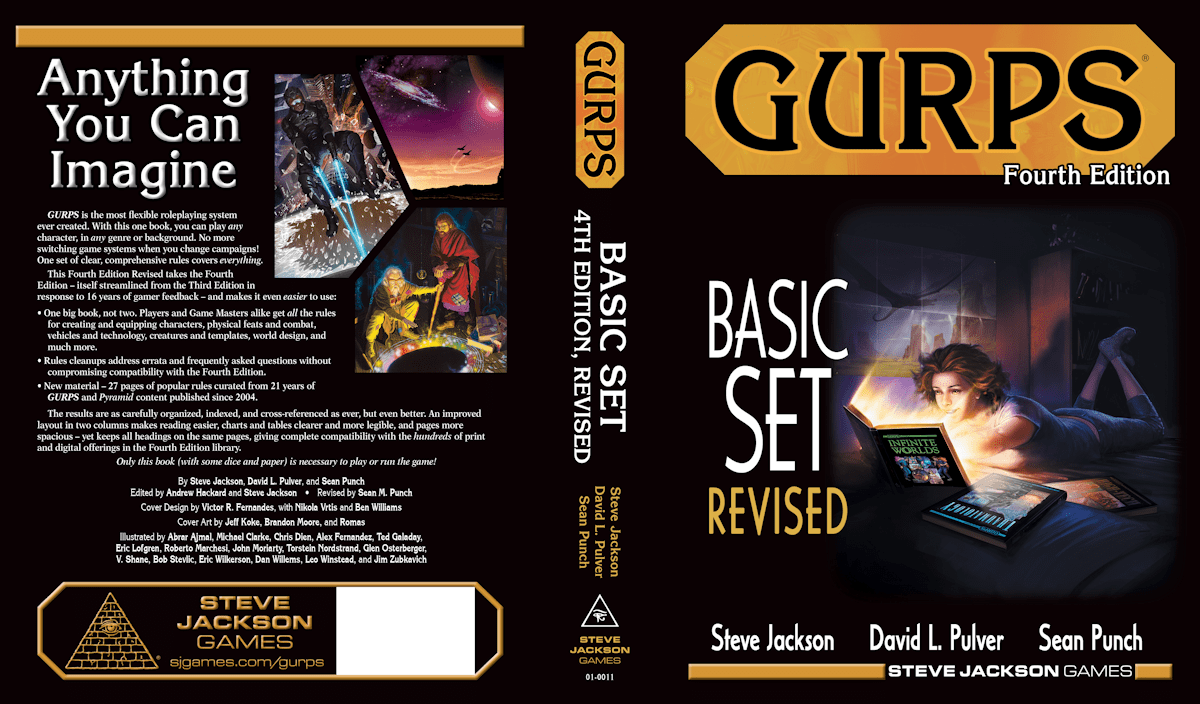
 Prior to forming Steve Jackson Games in 1980, you worked for Metagaming Concepts and designed games like Melee and Wizard (to address the shortcomings you saw in Dungeons & Dragons’ combat system—a game few truly understood at the time). I feel it is safe to say that The Fantasy Trip (1977) and its cousin, GURPS (1986), were ahead of the curve. In the intervening time, how do you feel about the evolution of the role-playing hobby? What has been good? Bad? Do you feel that The Fantasy Trip and/or GURPS hold up as modern role-playing experiences, or are they truly a part of the Old School Revival? If you were designing these games today, what would you do differently?
 “Modern roleplaying experience” can mean different things. My games don’t go into the same bucket as Mork Borg or Scurvy Buggers or Wanderhome, each of which is about telling one kind of story with rules brilliantly crafted for that story. And “Old School Revival” is too often just code for “D&D with the serial numbers filed off,” even when the game itself is killer fun. So I don’t see it as an either-or. They’re games of their time that can still be enjoyed by gamers of our time. Because, yeah, I agree, they were ahead of the curve, and in terms of flexibility and clean mechanics, the curve still has some catching up to do (with a bow to PBTA—the Powered by the Apocalypse RPG—which succeeds on both mechanics and flexibility).
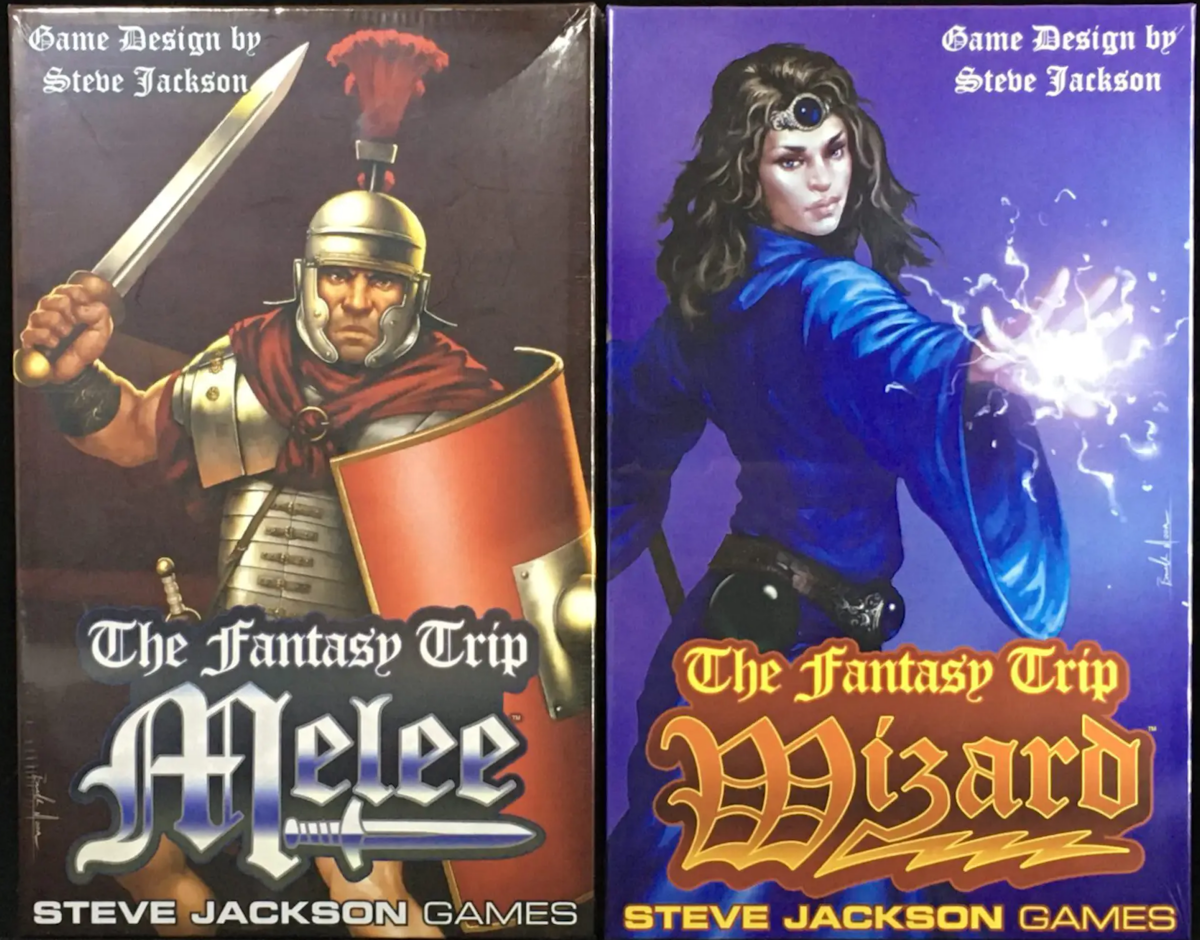
 Steve Jackson Games has produced many card, dice, and board games that, today (in my circles, anyway) are iconic. From Ogre to Illuminati (and its spin-off, Hacker; and later, Illuminati: New World Order) to Car Wars to Knightmare Chess to Munchkin to… well, too many to list. Of all the games that you and your company has produced, what game succeeded in ways you never expected? What game failed and boggled your mind? Which game did you design you are most proud of? Which game did you think you should have spent more time on?
 Munchkin was the wildly unexpected success – it was sketched out on a whim. The playtesters went nuts and things went on from there!
X-Bugs was the unanticipated flop. Licensed from Italy, it’s basically “tiddlywinks with special powers.” It’s really a fun change of pace, and it never caught on at all!
I’m proudest of Illuminati, I think, because with all its imperfections it introduced new mechanics and made them work. Second would be GURPS because it so successfully did its job, and is still doing it.
I can’t think offhand of something I should have spent more time on. It’s usually clear when something is done, or when it will never be done and should go back on the shelf.
And certainly, I’d like to bring back more oldies when time permits.
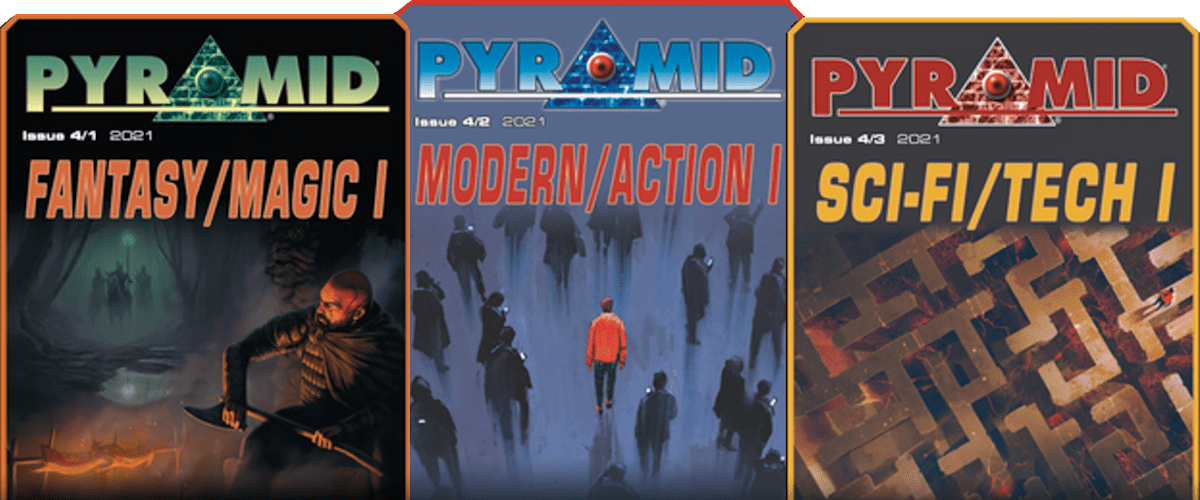
 We have talked about your games, so let’s move in another direction: you have been involved in the publication of several game-related magazines over the years. Most of these originated and spun-off from The Space Gamer until Pyramid came along. Pyramid had three versions (print, online, and PDF). There is also the Journal of the Traveller’s Aid Society, Ogrezine, and Hexagram—a favorite of mine. You have also published some things that were not so much games as they were art projects. One comes to mind I will leave nameless, but there was your own take on the Principia Discordia. What was the hardest part of putting these together? What was the most rewarding part? Do you miss doing this sort of publication? Does Steve Jackson Games have plans for a future such endeavor (perhaps to revisit one of these)? Is there some other form of publication you would like to delve into?
 I like doing zines and hope to do more. I intend for Hexagram to continue. Through Possum Creek we will also be releasing more zine-sized games.
Other types of publication – well, I wish we were a sci-fi and fantasy publishing house, because so many good books are slipping through the cracks of the current publishing system, and for every “Bobiverse” or “Carl the Dungeon Crawler” where the author persists and self-published, how many wonderful stories are never released at all because the readers at Baen or Tor or wherever don’t click with them?
 You have a unique perspective, having been a part of board gaming back before the Euro-game Revolution, and having been a part of role-playing since nearly its inception. In that time, you have managed to work with a lot of people, from Stephen V. Cole to Isaac Asimov. You have written combat rules for LEGO creations and dice games about Cthulhu. Your company has managed to pivot and remain relevant as the landscape of gaming has shifted below your feet in ways that have caused the implosion of so many of those other companies. You have even gone toe-to-toe with the Federal Government and won. So I want to ask you what you do when you are not gaming or designing or protecting our rights? What aspect of Steve Jackson is not so public facing? What would you like to do that your current schedule just does not allow? Who would you like to collaborate with, even if that is not a project related to gaming?
 Lego! About the time that gaming became a (beloved) business, Lego became my serious hobby. I also garden. And I am a train nut. (So . . . I build Lego trains and run them through elaborate landscapes.)
I would like to travel, except I hate the actual process of travelling, especially nowadays. I just like seeing the new places and meeting the new people once I am there.
I’d like to design some big, new games in genres I’ve never touched.
I am sad that I have never gotten much of anywhere with digital games. The Dire Wolf “Digital Munchkin” is an excellent piece of work, and I am very happy with both the company and the game, but I am not hands-on with it. Other efforts have collapsed, or technically continue after years but never make it to launch, or (cough Fallout cough) became time-eating personal disasters.
Collaboration – Wow. A good question. My collaboration on Tribes with Dr. David Brin was both fun and successful, so the idea of working with someone on a different kind of project is not alien. Cory Doctorow springs to mind. So does Randall Munroe. George R.R. Martin is, as you probably know, a gamer, and as you might not know, he very much likes GURPS. Also, we get along! But I’m not insane. George is BUSY and that one won’t happen.
And I am now working on two collaborations (both game projects) that I cannot yet talk about – sorry!

Infinite (or at least 216) Possibilities
So I actually interviewed Steve Jackson! I had so much more I would have liked to have asked him, but the six question format is a good one (I wanted to stick to that), and this man’s time is valuable (I did not want to take up too much of it). Still, I think I hit some good points. It was a good interview and I loved every moment of putting this together.
I have so many stories I can tell about Mr. Jackson and his company: some personal, some just from being around the company for so long. For example:
Steve Jackson, according to legend, started creating The Fantasy Trip out of a desire to remove all the specialized dice from the game and to make the combat more tactical. The result was Melee and then Wizard – which, when combined, became a full role-playing system. The owner of Metagaming Concepts refused to allow Mr. Jackson the rights to his creations when the company collapsed. This resulted in the creation of GURPS—a role-playing game that refused to be locked into a single genre. So this was a good thing in many ways. But Mr. Jackson is patient, and he knows copyright law. So when the time came, he was able to reclaim his rights and release the classic anyway.
From a more personal side:
When I was in the navy, I had a large box in which I kept my role-playing stuff. It was a lot of GURPS material, some old items (like the original Arduin Grimoire), and (stacked on top) was a bunch of folders with my campaign notes and the like. I had to keep this box at the foot of my bed (called a rack), sort of tucked away as I had no other place to really store the stuff. Anyway, we were at sea, my 12-hour shift was over, and I had grabbed the box to head to the mess deck so we could continue the campaign I was running. On the way, I was stopped and told that my Chief needed to see me. I put the box in our storage locker outside the shop and went in. It was not a big deal, just some extra work that needed to get done the next day.
I went back out to the storage locker and the box was gone. I asked around and nobody had seen it. A few moments later, one of my shipmates came back into the shop and I asked him “Did you see a box in the storage locker?” His answer sent chills down my spine.
“That box of garbage? Yea, I just threw it overboard.”
I was devastated! Much of what was in that box was not replaceable. A day or two later, I wrote a letter to Steve Jackson Games, told them of my situation, and asked how much it would cost to replace my collection of GURPS books. My expectation was to receive a quote of what they could provide, I would send them the money, and later get the books. My estimate was that this would take a couple of months, and we could continue to campaign during the last two months of the cruise.
About three or four weeks after I mailed that letter, I received a box with a bunch of GURPS books and a note that explained that they thanked me for my service and that there would be no charge. I could not thank the good people at Steve Jackson Games enough.
Yea… I am a fan. I am a fan because he and his company make good, fun games. And they are all hard-working, honest, decent people. Wonderful. Approachable. Genuine. It does not get much better than the team Mr. Jackson has cultivated.
So many of them I have known (informally, online, from conventions) and had wonderful interactions. In passing, I did ask Mr. Jackson about the people that have shaped the company but are no longer with us. As someone who has been a fan of his company since its inception (and a fan of the man prior), I have known so many of the people that make the company tick who have passed (e.g., Andrew Hackard). I asked if they would consider creating a memorial to them all on the website. He was noncommittal but did seem to like the idea. We’ll see. I’d certainly like to have a place to go and honor those good people that provided me so much fun from afar.
Steve Jackson Games has a lot going on that has many, many fans excited! If you want to know more about his company and what they have to offer, check out the Daily Illuminator—the longest running corporate blog on the internet. I am sure you will find something that tickles your particular gaming fancy.
Steve Jackson is an amazing man. It has been an honor to get a little of his time. I hope you will check out the man and his company. He is old school, but he still has a lot to teach us.