
There are board games that take twenty minutes. There are board games that take an evening. There are board games that require you to reserve a Saturday, warn your spouse, arrange childcare, purchase snacks in quantities normally associated with emergency preparedness, and begin explaining the rules sometime around breakfast. And then there is The Campaign for North Africa: The Desert War 1940-43.
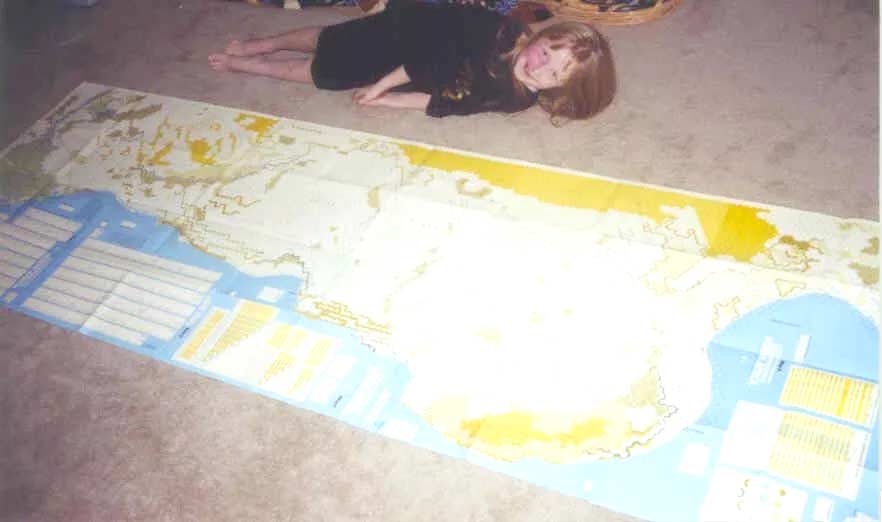
James Purcell and Andy Taeger, two friends from Newcastle, are preparing to play the famously enormous World War II simulation from beginning to end. The game contains 111 turns, each of which represents roughly one week of the North African campaign. It was designed for as many as ten players, although James and Andy are attempting it with two. Estimates for completing the whole thing run to around 1,500 hours. They think it may take them twenty years. This is obviously ridiculous. I also think it might be one of the most beautiful things I have heard about gaming in a long time.
The BBC story about their project understandably focuses on the absurdity of the undertaking. The Campaign for North Africa has achieved near mythological status in tabletop gaming precisely because describing the game begins to sound like describing an administrative punishment invented by a particularly vindictive totalitarian government. In The Campaign for North Africa you track ammunition, you track fuel, you track food, you track water (and even how much is lost through evaporation). There are more than seventy charts and something on the order of 1,600 counters. The game’s rules are sufficiently concerned with logistics that its most infamous rule requires additional water for Italian troops to account for cooking pasta.
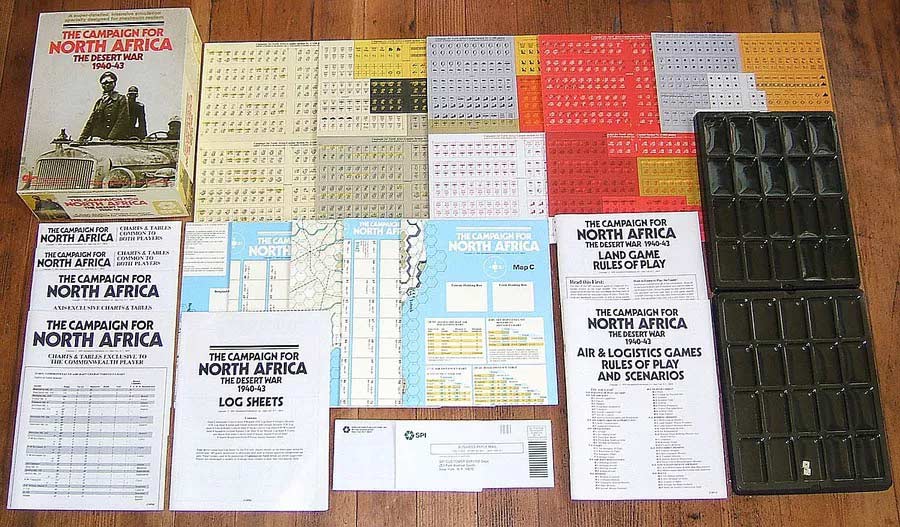
The game’s own reputation has almost swallowed the game. It has become the tabletop equivalent of one of those restaurants that serves a hamburger so large that nobody actually orders it because they want a hamburger. They order it because there is a photograph of everyone who has survived it on the wall. Except James and Andy aren’t spending an afternoon eating a hamburger.
The interesting question is no longer: Why would anyone play this game? It is instead: Why would two people promise to still be playing it with each other twenty years from now? Because that is what they have actually done.
James and Andy have already completed a six-turn practice scenario. It took them about eighteen months. I find this detail magnificent. Not because I am particularly interested in whether they successfully modeled the logistics of Graziani’s Offensive. I am sure somebody is, and I wish that person tremendous happiness. What interests me is that most of us would describe an eighteen-month gaming campaign as a substantial commitment and achievement. For them, it was the tutorial. Their actual campaign is scheduled to begin October 30, alongside the 100th episode of their podcast, War With A Mate. Their website describes the projected duration of the full campaign rather efficiently: episode 100 through the heat death of the universe.
Somewhere in all of this, The Campaign for North Africa has stopped being merely a board game. It has become a piece of infrastructure they are deliberately building into their friendship. James and Andy have built a reason to meet. We usually think friendships persist because people remain friends. But adult friendship is frequently defeated by something much less dramatic than conflict: logistics.
Someone moves. Someone gets married. Someone has children. Someone changes jobs. Wednesday stops working. Then Thursday stops working. Friendships do not always end. Sometimes they simply become increasingly difficult to schedule until the relationship exists primarily in affectionate intentions. James and Andy have created a rather extraordinary defense against this. They have given themselves unfinished business. There will always be another turn. And in doing so, they have made a peculiar kind of promise. James at 29 and Andy at 30 are making plans for men they have never met: James at 39, Andy at 40, James at 47, Andy at 48. Every long commitment contains some version of this. The person making the promise assumes a certain amount of authority over the person who will eventually have to keep it.
I have spent more than thirty years playing tabletop games, and when I think about the games that mattered most to me, I often remember remarkably little about who won. I remember where we played. I remember who was there. I remember jokes that would require fifteen minutes of deeply unsatisfying explanation to anyone outside the group. I remember people I no longer see. I remember versions of people who no longer exist, including myself. Games are very good at disguising this. They put victory points in front of us so we don’t notice that we are making memories.

It may be the story we are still telling years later. That possibility runs through tabletop gaming: catastrophic failures, impossible comebacks and misunderstood rules often survive in memory long after final scores disappear. James and Andy have simply taken this phenomenon and stretched it to an almost comical extreme. They are attempting to make one game night last twenty years. And twenty years is not only a very long time in a human life, it is an absurdly long time in board game development time. Let’s go backward for a moment.
In 2006, there was no Dominion. Donald X. Vaccarino’s enormously influential deck builder would not arrive until 2008. Dominion helped establish an entire genre built around a wonderfully strange idea: instead of constructing your deck before the game, you would construct it while you were playing. That idea now feels so ordinary that we can casually describe something as “a deck-builder” and reasonably expect most hobby gamers to know what we mean. Ascension did not arrive until 2010. Star Realms in 2014. Clank! in 2016. Dune: Imperium in 2020, using deck-building as one ingredient inside a much larger mechanical stew. An entire branch of the modern tabletop family tree had not yet grown. And deck-building is only one example. Pandemic had not been published yet; Matt Leacock’s cooperative game would arrive in 2008 and become one of the defining games of the modern hobby. There were no legacy games. Rob Daviau and Chris Dupuis’s Risk Legacy, with its permanent alterations, sealed packets, stickers and consequences that carried from one game into the next, would not appear until 2011. An enormous amount of the vocabulary we now casually use to describe tabletop games either did not exist yet or had not entered the mainstream of the hobby.
And here’s the especially strange part. Twilight Imperium: Third Edition (the version that helped cement Twilight Imperium as shorthand for “clear your schedule, we’re going to be here awhile”) had only just arrived in 2005. Even our modern idea of the enormous, all-day board game was essentially new. That was twenty years ago.
Entire mechanisms have become genres. Genres have hybridized with other genres. Ideas that once required a paragraph to explain have become words we use casually at the table. Crowdfunding changed who could publish games and what kinds of absurdly ambitious physical objects could plausibly reach consumers. But for our purposes, the point is simpler: Twenty years is enough time for the hobby to reinvent itself.
James and Andy may genuinely spend the next twenty years playing The Campaign for North Africa. Twenty years. That is enough time for someone to acquire the rights to The Campaign for North Africa. Enough time for another designer (Let’s call her Mags) to look at this legendary, nearly unplayable monster and say the six most dangerous words in game development: “I think I can streamline this.” Then Mags spends four years redesigning it. There is a Kickstarter. Obviously there is a Kickstarter. There are metal supply tokens, dual-layer logistics mats, historically researched scenarios and seventeen stretch goals nobody asked for but everyone somehow becomes furious about if they are not unlocked.
The new The Campaign for North Africa keeps the logistics, historical sweep and operatic scale while eliminating approximately 94 percent of the administrative suffering. Four to six players. Six hours. Maybe eight if somebody is new. Suddenly the game famous largely because nobody can reasonably play the whole thing occupies some of the territory currently held by Twilight Imperium: the giant ceremonial game whose appearance on the calendar means this is not an ordinary game night. The Campaign for North Africa has somehow dethroned Twilight Imperium while also dethroning itself.
And the funniest possibility is that you and I could buy this hypothetical streamlined edition of The Campaign for North Africa, spend a delightful Saturday playing the entire thing, argue about fuel allocation, order dinner, declare it one of the best games we’ve played in years, and put it back on the shelf. Then do it again. And again. Maybe an expansion comes out. Maybe we play that too. We could conceivably play the revised Campaign for North Africa ten or fifteen times. We could become tired of it. We could sell it. We could later become nostalgic for it and buy another copy. And James and Andy could still be somewhere around Turn 84. All well within twenty years.
By the time James and Andy finish The Campaign for North Africa, the tabletop gaming world they began playing will no longer exist in the same form. The game may still be sitting there. The counters may still be sitting there. But almost everything surrounding them (from the people playing games, to the games being designed, to the language we use to describe them, to the way those games reach our tables) will have changed. Twenty years is not merely enough time to finish a very long board game. It is enough time for board gaming to become something we currently do not have words for. And Mags may well have brought home her third or fourth Kennerspiel.
This is where their project becomes much more interesting than an endurance stunt. Twenty years is long enough that you cannot meaningfully imagine the people who will arrive at the end. The people sitting down to play Turn 111 may share names with the people who began Turn 1, but in most meaningful respects they will be different men, living in a different world. And the board will have been there. That’s the part I can’t stop thinking about.

Most objects in our lives move through time passively. A couch is there while things happen. A coffee mug survives several apartments. A photograph quietly becomes more important because someone in it is no longer around. Tabletop games are unusual because the objects participate. Cards get handled. Counters get moved. Dice acquire reputations. Boxes wear at the corners. A tiny piece of cardboard stops merely representing the 7th Armoured Division and becomes the piece involved in something James did eleven years ago that Andy still insists was bullshit. If James and Andy actually finish this thing, their copy of Campaign for North Africa will no longer simply be a copy of Campaign for North Africa. It will be twenty years of their friendship with a rulebook.
Of course, James and Andy may not finish. I almost hope everyone allows that possibility to remain respectable. Because one danger of projects like this is that commitment can quietly mutate into obligation. At first: Wouldn’t it be hilarious if we played this? Then: We’re actually doing this. Then: People are listening. Then: We’ve been doing this for seven years. And eventually perhaps: I hate North Africa.
Their podcast intentionally creates accountability. Their website jokes that quitting is no longer an option because listeners would ridicule them. That is funny, but it is also psychologically interesting. Games are voluntary systems. That is one of their defining pleasures. We agree that these rules matter for a while. We voluntarily care about fictional money, imaginary territory and points that will cease to exist the moment someone puts the lid back on the box. But what happens when the voluntary system accumulates history? When does “we are choosing to continue” become “we cannot stop now”? Five years? Ten? Turn 73? There may eventually be an evening when neither man particularly wants to calculate water evaporation. This seems plausible. Most human beings have evenings when they do not particularly want to calculate water evaporation.
But perhaps that is where this stops being merely about enjoyment. We have developed a strange expectation that leisure must continuously justify itself through pleasure. If a hobby stops being fun at a particular moment, why do it? But some of the most meaningful things humans do are not continuously enjoyable. Traditions aren’t. Relationships aren’t. Creative projects aren’t. Raising children certainly appears to contain stretches that would receive mixed reviews on BoardGameGeek. Meaning and pleasure overlap considerably. They are not synonyms. Sometimes we continue because something has become part of the architecture of our lives.
There is a wonderful absurdity in choosing The Campaign for North Africa for this particular experiment because the game itself is obsessed with logistics. Fuel has to get where it is going. Water has to get where it is going. Supplies have to get where they are going. Military units cannot simply exist because someone would like them to exist. Entire systems have to keep functioning behind them. Apparently friendships aren’t terribly different. Someone has to text. Someone has to host. Someone has to drive. Someone has to remember that next Thursday doesn’t work because Andy has that thing. Someone has to keep the maps somewhere. Someone has to maintain the spreadsheet. Someone has to say: “Same time next week?” The game simulates a war of logistics while the players conduct a twenty-year campaign against the logistics of adulthood. And I am increasingly convinced that this is the real game. The Axis and Commonwealth forces are almost incidental. The actual opponent is the ordinary entropy of adult life. Can two people continue making room for the same thing because they once decided together that it mattered? That is a much harder game. There is no rulebook for it.
I hope James and Andy complete The Campaign for North Africa. I want the photograph of two middle-aged men standing beside the final board in 2046, looking slightly stunned that the idiots who made a joke in a pub twenty years earlier somehow managed to get them here. But I don’t think completion is what would make the project successful.
Imagine they make it twelve years. Imagine marriages and children and illnesses and new jobs and new homes have happened around the board. Imagine they have recorded hundreds of podcast episodes. Imagine there are listeners who began listening in university and now listen while driving their children somewhere. Imagine James and Andy finally look across the table at one another and say: “We’re done, aren’t we?” Maybe they pack it away. Would those twelve years constitute failure? Only if we make the mistake of thinking the game was the game.
We talk constantly about completion. Finishing campaigns. Clearing scenarios. Winning. Getting through the shelf of shame. But games are not unfinished simply because we stop playing them. Sometimes they have already done what they were going to do. They gave us Tuesday nights. They gave us an excuse to call someone. They gave us the friend we met every week instead of the friend we kept meaning to see. They gave us stories. They gave ordinary time a shape.
James and Andy believe they are beginning a 111-turn campaign on October 30. Maybe they are. But I think they are doing something stranger. They are sending an invitation twenty years into the future. They do not know who will receive it. Those two men may have different homes, different worries, different bodies and considerably stronger opinions about evaporative water loss. But somewhere, presumably, there will still be a map of North Africa. There will still be some counters. There will still be another turn. And one of them will have to call the other. Same time next week?