Disclosure: Meeple Mountain received a free copy of this product in exchange for an honest, unbiased review. This review is not intended to be an endorsement.
Disclosure: Meeple Mountain was provided a pre-production copy of the game. It is this copy of the game that this review is based upon. As such, this review is not necessarily representative of the final product. All photographs, components, and rules described herein are subject to change.
Around these parts I’m known as the RPG guy for my love of different systems and the opportunity to immerse myself in the theme of a game. Accidental Heroes, an upcoming app-driven adventure game designed by Wojciech Grajkowski and published by Lucky Duck Games, puts your hero on a topsy-turvy joyride through an ever-changing world bursting with familiar references. Let’s hop on the tracks and see how it plays.
Accidental Heroes: The World is Your Oyster
I’ll preface my discussion of Accidental Heroes by acknowledging that my experiences are based on a prototype copy that was limited in scope compared to what’s expected in the complete game. At first I thought that the lack of content would be disappointing, but instead I was surprised by how many branching paths were available to my heroes as I played.
In Accidental Heroes, players assume the role of an “hero”, a term surrounded by quotation marks because whether or not you live up to the moniker is up for you to decide. The object of the game is to pass two difficult Tests associated with Final Missions, acquiring a pair of Dragon Eggs before any other player is able to do so.
Heroes have three main attributes: brain, body, and combat. Each of these attributes is represented in an ‘exquisite corpse’ fashion with removable tokens that become inlaid in your hero’s player board depending on their current value. For example, if your combat attribute is the lowest—a value of 1—the art on the corresponding token is likely wobbly or shriveled. A value of 6, on the other hand, would show massive expertise in one way or another. It’s a great way to visualize the strengths and weaknesses of your hero at any given time.


On your turn, move your hero up to 2 spaces on the board representing the game world segregated into hexes associated with a specific location type. If there isn’t an adventure token on the space already, draw one from the bag. This is where the Companion App comes into play.
The app prompts you to select the location type of the space you’re on, which might be a forest, for one example. You then input the number of the adventure token that you drew from the bag. The result? An Adventure specific to your token/location type combination, presenting you with a choice of how to proceed.
You are usually given up to three options to take as your hero’s response to the situation, typically resulting in a Test. This is where you will roll dice and compare the result to a given target number. The base number of dice that you roll is determined by your level in the respective attribute. You can additionally increase your dice by praying to one of the three deities in the world, assuming you have enough favor to do so. Count up the number of goblin heads on the resulting roll and tell the app whether you passed or failed.

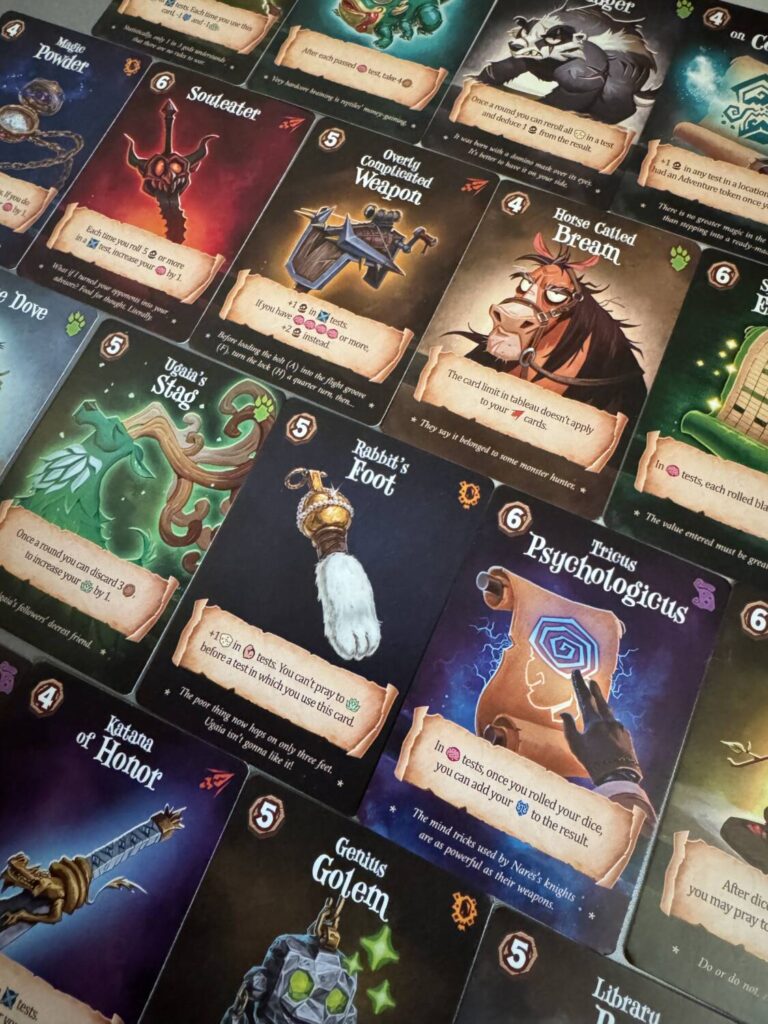
Failing results in a consolation prize of two coins, a pittance for what could have been a defining moment in your hero’s journey. Passing, however, can award any number of benefits from an attribute increase, increased favor for a deity, Item cards, or coins. Some Adventures might even give a Quest card, requiring you to go to a certain location type to collect on its reward.
The aforementioned Final Missions are challenging. Up front, you know exactly what attribute and target number you need to hit, but they also carry some other twist that shakes up the Test, like providing additional goblin heads on the result for every relic Item in your hand. There’s something unique for each one, and you can only claim one Dragon Egg from a given attribute, meaning that you will eventually have to max a second. No one-trick ponies allowed!
Accidental Heroes: Get Your Glow Up
Accidental Heroes doesn’t pretend to take itself seriously. It’s a tongue-in-cheek smash and grab through pop culture that warps the source material enough to generate chuckles and chaos. You’ll encounter the accidental equivalents of the Merry Men and Don Quixote as you overcome obstacles to make your hero worthy of similar songs and tales told in respectable taverns everywhere.
I’m normally not one to seek out board games that require apps to function. At that point you’re halfway to a video game, oftentimes with players passing a phone or tablet around the table, buried in a screen. With Accidental Heroes, the core mechanic of the game simply requires a digital aid, lest the table instead be bogged down by the tedium of thumbing through a massive tome of Adventures. The Adventure scenarios are succinct in their presentation, so that narration adds to the experience of one of those stories where you Select Your Own Outcome. If you know, you know.
As far as the various options in the Adventures are concerned, I appreciate that as you become more familiar with the game that you can at least determine what outcomes might be favorable to specific deities. The game has your standard order, nature, and chaos deities. You keep track of your standing with each deity with cubes on your player boards; earning enough favor can earn you up to two rolls on the Blessing die, granting a random attribute increase. Spend or lose enough favor and you earn the opposite: a random attribute decreases thanks to the Punishment die.

Although I don’t fully understand how Dragon Eggs really play into the overarching story of the game, with such a variety of Adventures on the road to the end, there’s always going to be a certain level of zaniness to the experience. Hopefully the final rulebook sets that up with a finer point, as right now the ‘why’ eludes me.
The amount of Adventures is staggering. This prototype copy came with 15 Adventure tokens, which results in 75 potential outcomes when you consider the 5 location types available. Over 200 Adventures are present in the final version of the base game, meaning that every game will put your hero through a completely new gauntlet.
I also really like the hero attributes being represented through the tokens on the recessed, double-layered player board. It’s something that could have easily been tracked via another cube, but the ever-changing tableau that is your hero is deserving of this grand, sometimes grotesque portrayal. It’s another way that Accidental Heroes leans into the wacky, a reminder that you’re playing a game.
Without trying the cooperative mode or the solo mode—as they weren’t available with the prototype—I was happy with the simple mechanics, humorous storytelling, and satisfying dice rolling. There are few things that bring me greater joy than chucking a handful of ten engraved dice at once. Accidental Heroes feels like a cheeky blend of Call to Adventure and My Father’s Work, with an extra couple doses of witty banter.
Despite the name, the fun this game provides is no accident.