
Disclosure: Meeple Mountain received a free copy of this product in exchange for an honest, unbiased review. This review is not intended to be an endorsement.
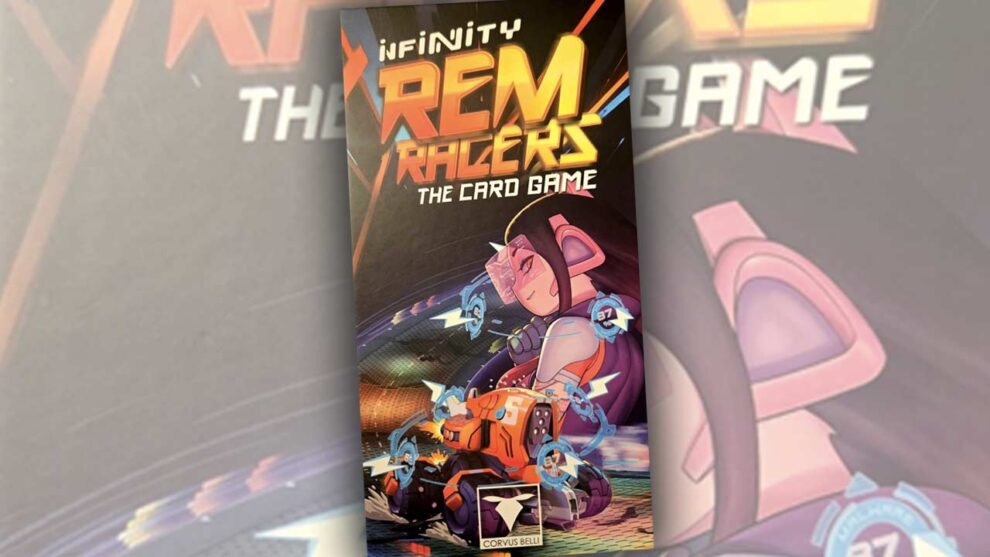
REM Racers. A name I didn’t expect to hear again. Around this time last year, I reviewed the REM Racers board game, and as the name suggests, it’s a racing game, a futuristic one at that. The box art is high-fidelity, the components are fantastic, and all of it would lead you to believe I’m about to gush. Instead, this was one of the least enjoyable gaming experiences I’ve had in a long, long time. I’m trying to be professional here.
So when they announced a card game version, I was a bit taken aback. From what I understand, the original wasn’t well-received, and that usually doesn’t earn you a spin-off. Then again, card games are cheap, and this one promises a runtime of roughly 20 minutes. Is it an improvement? Is it a good game? Am I going to stop asking questions? Yes.
They Did It Again
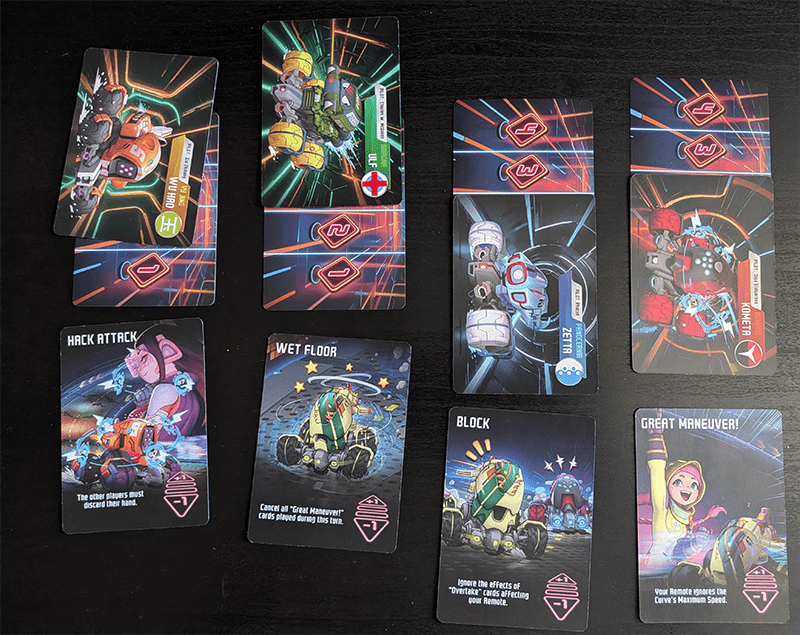
The title’s a bit of a spoiler: it’s a race. Everyone picks a pilot with a unique ability, and the goal is to finish first. But since there’s no board or physical race track, the whole thing plays out pretty abstractly. Player positions are tracked by lining up everyone’s car card in a row, first place to last. The track is represented by the “curve deck,” a series of cards numbered 1 through 4 with the Finish Line buried somewhere in the back half. Each number is the speed limit for that turn.
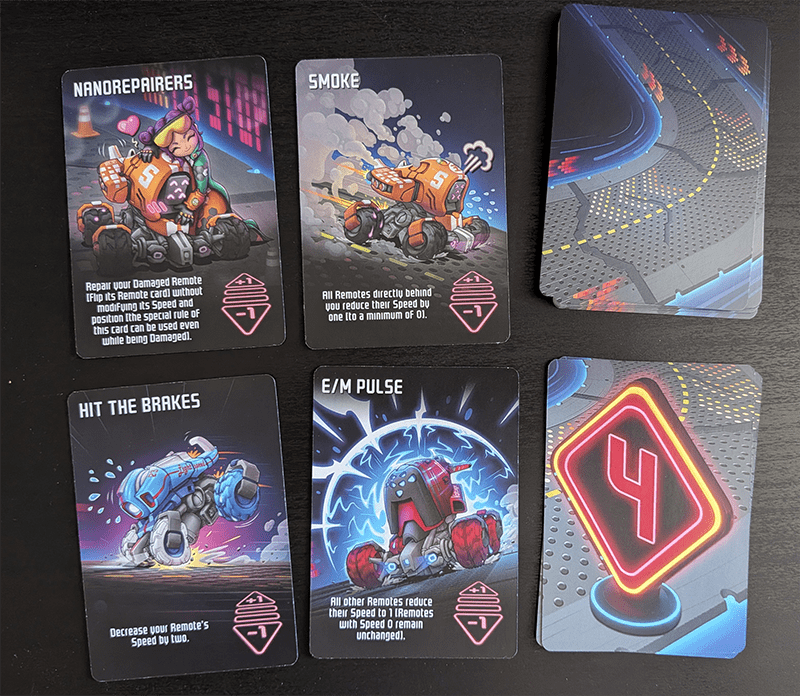
The main deck is the “maneuver deck” and everyone always holds three of these cards. They’re gorgeous, each one with a clear description of its effect and a small icon reminding you that you can discard it to adjust your speed. That’s it. There’s no sprawling iconography to memorize, no weird multi-use card nonsense. If you can read, which I assume you can do since you’re here, you’ve got 90% of the game figured out.
As for the flow, it’s about as complicated as reading a stop sign. Each round starts by flipping the top card of the curve deck, announcing the speed limit to the table. Players then study their hand and choose a card to play facedown next to their vehicle. Yes, there’s a bit of programming and hand management involved.
Once everyone has chosen, the player in the lead reveals first. Their options are straightforward: do nothing, adjust their speed by 1 in either direction, or trigger the card’s text effect. Then the next player reveals, and so on down the line until everyone has played their card.
Behind The Wheel
Next up is the Over-braking check. Did you stay within the speed limit? Equal or under, you’re fine. Go over, and you’re bumped to the back of the pack at a reduced speed. The bigger the gap, the worse the penalty.
The last step is the position check. Players are re-sorted by speed, fastest to the front. Ties advance together without changing order between them.
A few extra details worth knowing. Your car can take damage through card effects or by exceeding the speed limit, and a damaged car loses access to both text effects and your pilot’s special ability. That ability is a once-per-game nuke, and like your maneuver cards, it tells you exactly what it does right on the card.
There are also blind turns and the Wild Zone to shake things up. Some curve cards carry a blind turn symbol, meaning the next curve card stays facedown, forcing you to gamble on the speed limit. The Wild Zone is a special maneuver card that forces the next turn blind. It also triggers a speed gamble before anyone plays a card: jump up by 2 or drop all the way down to 1. Your call.
Race Day
Outside of that, you’ve got the whole game. It’s one of the easiest I’ve ever had to teach, and the 20-minute promise on the box actually holds up, which is rarer than it should be and worth acknowledging.
But that’s about where the praise ends. REM Racers isn’t offensively bad. I don’t dislike it. I just don’t care about it either. It sits in a kind of purgatory, generating no strong feelings in either direction. The most I can say is I can confirm its existence.
Part of me is genuinely frustrated to say that, because the foundation looks solid on paper. Using cards to abstract a Mario Kart-style race is a great idea. I’ve reviewed games in the same space, like Shuffle Grand Prix by the now-defunct Bicycle Games, but even accounting for that, this feels like a lane that hasn’t been fully explored yet.
Card text is doing a lot of heavy lifting here. And that’s fine, plenty of great games are built that way. But when card text is the engine, it needs a chassis to bolt onto. The cards need to talk to each other, and to the systems underneath them. Otherwise you’re just reading flavored instructions.
Fender Bender at Best
REM Racers Card Game stumbles on exactly that. The interactions and relationships between cards just don’t hold up. Take the core decision each turn; you’re discarding a card to either manipulate your speed or trigger its effect. That should create genuine tension. It doesn’t, because the cards themselves are rarely ambiguous about when they should be played.
A few examples illustrate the problem. Smoke reduces the speed of everyone behind you by 1, so if you’re at the back of the pack, the text effect is dead on arrival. E/M Pulse forces everyone else to drop their speed by 1, making it an obvious hold for the final stretch. Except Hack Attack forces everyone to discard their hand, which makes any long-term planning feel pointless.
The curve deck feels like a missed opportunity too. Right now it’s just numbers 1 through 4 with the occasional blind turn icon – functional, but flat. There’s a real opening here to have some cards represent a distinct section of the track, something with its own rule or restriction that changes how you play that turn. As for the blind turns themselves, the tension of guessing the speed limit sounds more interesting than it actually is.
The Long Stretch
That’s my biggest issue with REM Racers. It’s a game full of untapped potential. The card effects aren’t as thoughtful as they could be, and before long the optimal play becomes obvious. I’m not asking for complexity; the target audience is clearly casual families, and that’s fine.
But even a casual game should give you something to indulge on past the first couple of plays. Instead you’re going through the motions, and there’s only so many times you can do that before the whole thing feels hollow as Sabrina Carpenter’s lyrics.
There’s a good game somewhere inside REM Racers Card Game. The concept works, the presentation is clean, and the runtime is honest. But good concepts don’t win races; execution does. Right now this one’s stuck in the middle of the pack, and there’s no card in the deck to fix that.