
Disclosure: Meeple Mountain received a free copy of this product in exchange for an honest, unbiased review. This review is not intended to be an endorsement.
Millennia: Tracks of Time joins a long lineage of civilization-building games, a theme that never seems to lose its luster in The Hobby. Guiding a culture from humble beginnings to glorious heights still hits the dopamine center the way evergreen giants like 7 Wonders and Sid Meier’s Civilization always have. Designers keep returning to history because, well, history keeps selling.
This one claims it brings something new, hence the “Tracks of Time.” And to its credit, Millennia blends card drafting, worker placement, and track progression across eight rounds in a way that feels surprisingly approachable. There’s genuine complexity under the hood, but the game never feels like it’s punishing you for showing up.
Finally, A Rulebook That Doesn’t Hate You
A massive part of that accessibility comes from the production. The game includes inserts tailored for sleeved cards and an insert guide, something borderline mythical in board games. Even better, the rulebook is exceptional. Clear steps, numbered cards, a detailed reference section, and player aids that ensure nobody gets lost. If more games taught this well, we’d all argue less and play more.
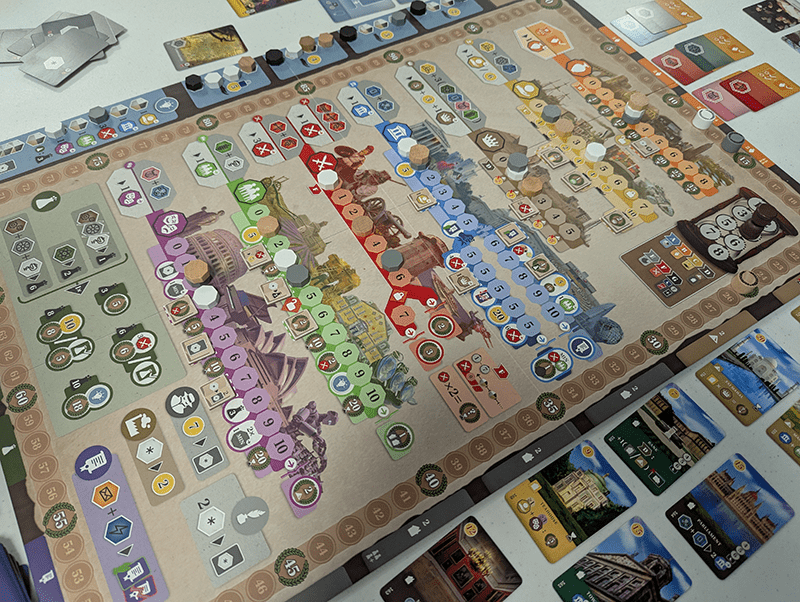
The core loop is familiar to anyone who has touched a euro: four action tokens, limited spaces, and worker placement spots that give immediate benefits like tech cards or track advancement. Yes, it’s a system older than some of the wonders in the box, but it has been proven to work time and time again.
However, don’t be fooled by all the track movement. Drafting is the beating heart of the game. Technology cards sit in a grid along the board, and placing a marker on a row lets you draft from that row. Cards form your tableau and power your engine. Income, track advancement, abilities, you name it.
Eight Rounds of Beautiful Suffering
‘Wait,’ you say. ‘Didn’t you just mention that some spots let you advance on tracks? Why bother with cards?’ Because the designers are smarter than you think.
After drafting comes Prosperity. This is essentially a check to see whether your tableau matches the current Prosperity pairings for the round. If it does, you climb the Prosperity track. And you’d better care about that, because end-game scoring is massive. Aggressively massive. “Ignore this and die” massive.
Then comes Income. Look at your drafted markers, add trading track gains, rake in your money, and get ready to spend it on buildings. The player holding the architect token goes first, and gets a discount, but the only way to grab it is to draft a specific tech card each round. Someone will always fight for it. Someone will always get salty about losing it. Tradition.
It’s A Wonderful World
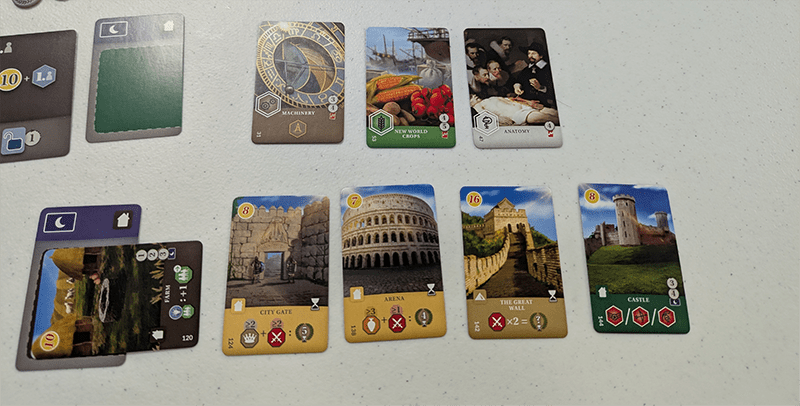
Buildings matter. Brown and green buildings give ongoing abilities, often sparing you from spending cards just to move up tracks or other interesting quirks. Gold and wonders deliver end-game scoring and are permanent.
Permanent? Oh yeah, I almost forgot. The big gimmick behind Millennia: Tracks of Time is that all the technology cards and brown and green building cards have a limited lifespan. Some might last a single round, while rarer ones persist for three.
This is a brilliant system on two fronts. Mechanically, this forces you to stay engaged. Your once-beloved tech tire irons itself right out of usefulness, and you have to adjust. Drafting becomes essential because you’re constantly replacing pieces of your engine. Millennia: Tracks of Time is far more interested in forcing tactical decisions over long-term strategic planning.
Thematically, it makes perfect sense. The disappearance of technology cards signifies that the technology has either become obsolete or achieved such widespread adoption that it no longer provides a distinct advantage. This also sidesteps the classic civ-game absurdity where your “modern empire” still fields muskets or spears because it wasn’t ‘optimal’ to pursue military advancement.
Making It Work
After Buildings, you hit the action phase. Thankfully, this part is simultaneous; otherwise, the game might last until the real world hits futurism. You exhaust tech cards to move on tracks, generate science, or grab diplomacy cards. Everyone quietly panics and does math. It’s charming, in a stressful way.
I won’t go through all the tracks since there are quite a few, but I’ll give you some ideas of what they offer. Besides end-game points and the previously mentioned income, tracks can provide discounts on wonder buildings, unlock additional sections of another track, grant immediate bonuses, and even award points under specific conditions if you’ve reached the peak. That last benefit is especially important for the military track. Yes, all of these matter. No, you won’t grasp it all in your first game.
Then there are the “side-hustle” actions: trading tech cards for cash, generating research points, and playing with diplomacy cards.
Diplomacy cards are single-use boosts that range from “neat” to “you’ve got to be kidding me.” Some give you a tactical jolt at just the right moment, such as moving up the military track or an instant infusion of gold coins. They’re flexible, powerful, and almost always tempting. The board-game equivalent of having a secret snack hidden in your coat pocket.
Research points, however, are their own little ecosystem. You burn technology cards to generate research points, and then immediately convert those points into rewards. You’re usually going after victory points or research cards, and those research cards are no joke. They’re permanent passive abilities that stay with you for the entire game. If the tracks are your long-term engine, research cards are the weird aftermarket upgrades you bolt onto it to see if it’ll go faster.
Sun Tzu Disapproves
Following the actions is the War phase. Well, calling it “war” is generous. Sun Tzu would call it “strongly worded encouragement.” Players compare positions; the weakest gets reset to zero, everyone else moves back the same amount, and that’s it. It is something you need to pay attention to because any player that goes to the end of the military track can keep scoring points with little effort.
Complete the upkeep phase, and the round is over. Repeat this seven more times, and the game concludes. End-game scoring plays a major role, as you tally points from your wonders, yellow buildings, and the various tracks you’ve advanced on.
Full honesty: I had no idea this game existed until it arrived on my table. Never saw the Kickstarter. Never caught a preview. It missed my radar so thoroughly I might as well classify it as submarine technology. But now, writing this in December 2025, I’m confident in calling Millennia: Tracks of Time my sleeper hit of the year.
It mixes familiar mechanisms like drafting, tracks, and tableau-building, but uses them with far more personality than most euro contemporaries. The game feels like a classic Euro, full of forward momentum and choices, but wrapped in a sleek, modern ruleset. There’s even has a hint of roguelike energy: the “one more run” feeling, minus the permadeath and crushing despair.
Welcome to Your New Addiction
The brilliance of the game lies in its network of trade-offs. Drafting cards lets you climb tracks, but most tracks require two matching symbols, meaning two actions. So maybe you hit special action spaces instead, since they only cost one action. But those don’t generate income. Or contribute to Prosperity pairs. Or help end-game scoring.
Meanwhile, turn order threatens everything you want to do. Those perfect cards? Gone. That juicy action space? Gone. That plan you lovingly crafted like a Renaissance architect? Gone. Time for Plan B. Or C. Or F.
AP-prone players will melt under this constant recalculation. But for everyone else, it’s delightfully taxing.
The game isn’t complicated, but it does take time. Our three-player sessions consistently hit 90–120 minutes. Higher player counts function mechanically but add little joy, just more waiting. It’s like inviting extra people to watch paint dry: possible, but questionable.
I also have to point out that the game doesn’t actually evolve, unlike what’s expected in many modern designs. Round one decisions feel similar to round eight. The disappearing-card system keeps your options tight, but you’re fundamentally repeating the same pattern. Certain building cards will skew the value of specific tracks and technologies, but otherwise you’re essentially repeating the same processes each round. The structure is clean and functional, even if it starts to feel you’re cycling through a well-organized to-do list.
There are also, dare I say, possible balance issues. Throughout my review sessions, no one grabbed the permanent research cards with any regularity. Apparently, everyone in my games collectively decided these cards weren’t worth the cardboard they’re printed on. They demand specific conditions and usually force you to sacrifice something more immediately valuable. Meanwhile, hitting the top tier of research points in a single round gives you a massive point injection and a free action. It’s not subtle.
The Final Tally Will Humble You
There are also two tracks that are extremely difficult to advance on: empire and politics. This makes sense given that their end-game scoring multiplies off each other. Speaking of end-game scoring, it’s absolutely crucial. If you plan properly, your end-game points can triple or even quadruple what you’ve earned throughout the game.
I’ve seen games where end-game scoring allowed one player to vault past everyone else, mainly through wonders and yellow buildings. Narratively speaking, this makes sense. Civilizations are recognized for their greatness long after they’ve fallen, not in the moment. Try explaining that to the person who just got obliterated in the final scoring.
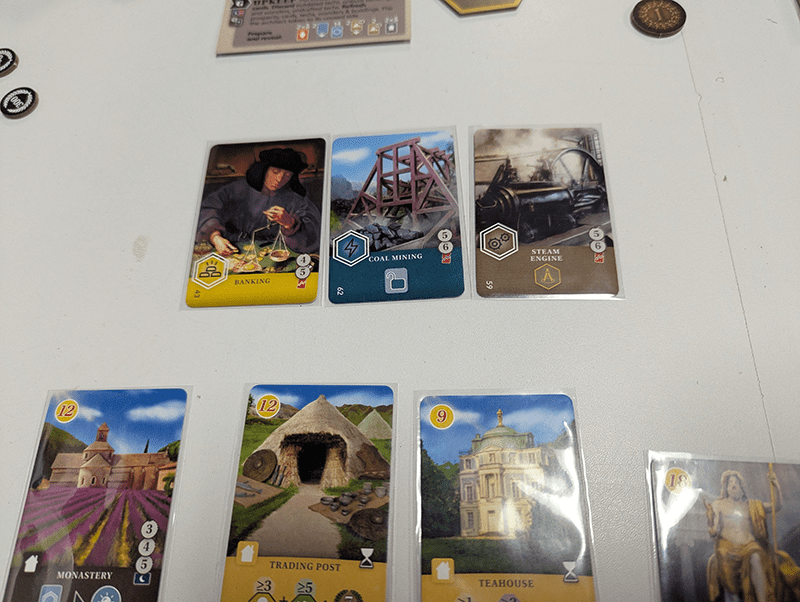
Even though it doesn’t play a huge part in the game, I need to mention the art. It’s a wonderful mix of striking beauty and ‘what the hell happened’ all over the place. Many of the wonders and buildings capture their real-world counterparts gorgeously, with vibrant color saturation that feels refreshing. It’s a nice change of pace from Hollywood’s obsession with making everything from the past look muddy and drab.
Art Is Complicated
Then you hit cards clearly inspired by real artwork but run through enough Photoshop filters to make them legally distinct. And the pièce de résistance: the final-round “Exosuit” military card, which looks suspiciously like it escaped a certain sci-fi franchise beginning with “H” and ending with “alo”.
Look, Millennia: Tracks of Time isn’t perfect. It overstays its welcome at higher player counts, the research cards feel undercooked, and you’re essentially doing the same dance for eight rounds straight. But here’s the thing: I keep wanting to do that dance again. And again. There’s something genuinely compelling about the constant recalculation, the scramble for cards, and the overwhelming number of choices that remain surprisingly easy to understand.
While other Civ games are busy trying to simulate the entire span of human history in excruciating detail, Millennia figured out how to capture the essence in under two hours. Your technologies will become obsolete. Your carefully laid plans will crumble. Your opponents will take that card you desperately needed. And somehow, that’s exactly what makes it memorable and worth the time to invest in.