Cards and Points
If you have read my interview with Earl Patterson, you know how we met. Congress of Gamers has been a fount of good times, good games, and good connections for me ever since I moved to the DMV (the D.C., Maryland, Virginia area). Meeting Mr. Patterson was a joy. The first game we discussed was Make Your Words Count! and it takes very little time to discover that this is his baby.
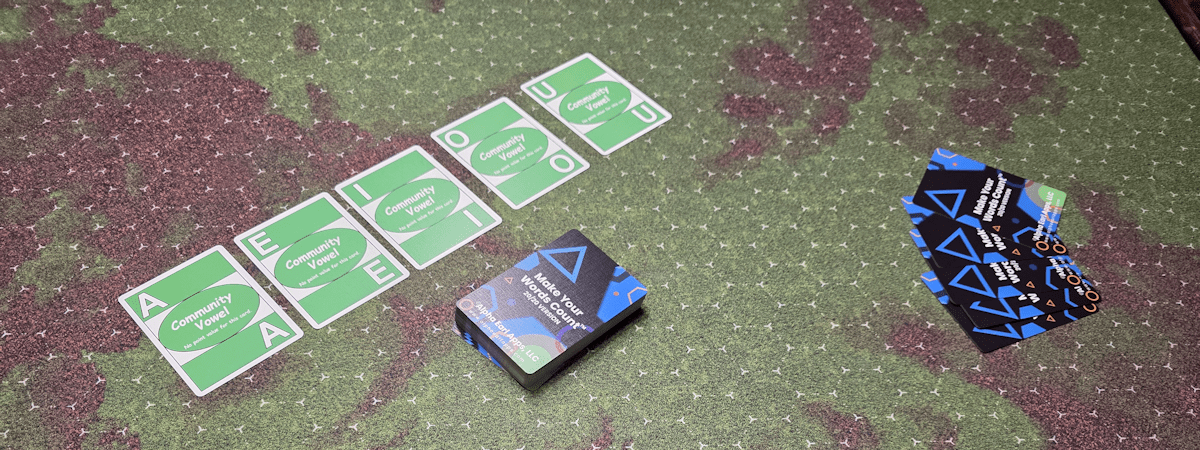
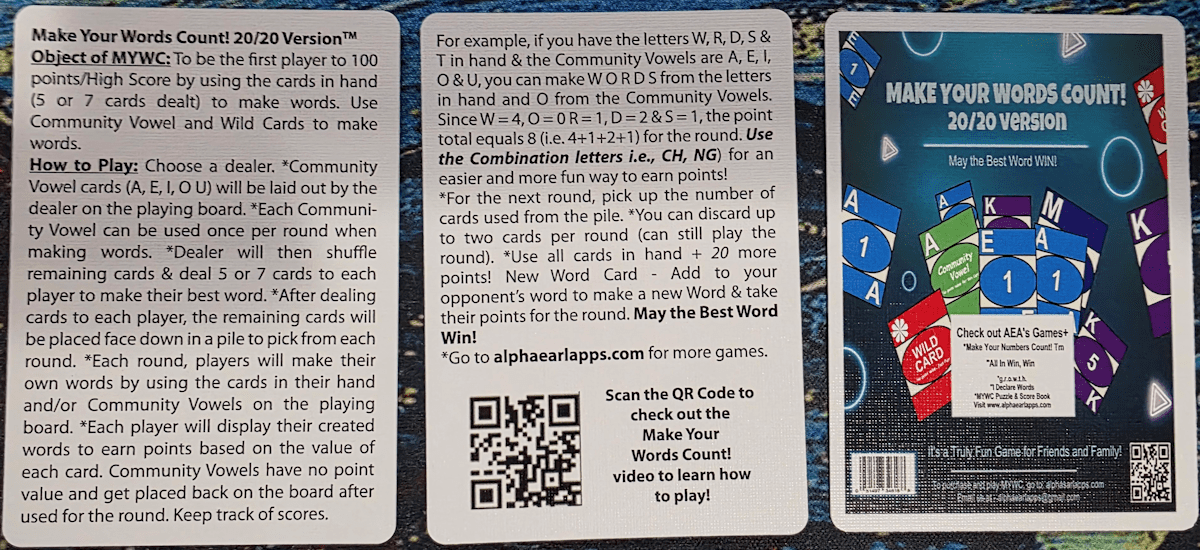
The game is relatively simple. From a deck of letter cards, players are dealt 5 or 7 cards (decided at the start of the game). They also determine the score goal; recommended is 100 points, but players can decide on a shorter or much longer game if they wish. In the center of the table are Community Vowels, one each of “A”, “E”, ‘I”, “O”, and “U”—these are each worth 0 points and are usable by everyone every round to ensure that there is always something the player can do. Note that there are standard vowel cards in the main deck that are worth 1 point each.
On each player’s turn, they take the letter cards from their hand and make words. They can use the Community Vowels, but no more than one of each (you would need an “O” in your hand to spell “COOK”, but you could use all five of them to add to your hand cards of “C”, “D”, “N”, and “T” to spell “EDUCATION”). Players sum the points of their cards and score that many for the round. If a player empties their hand, they score a 20-point bonus.
There are a couple of cards in the deck (called New Word cards) that allow a player to interrupt another player’s turn, add one or more cards to the word they made, and steal the points. After a play, a player may discard up to two cards before refilling their hand to the 5 or 7 card hand size.
This is the game. Simple. Elegant. Quick. And fun!
Standard Card Distribution – Points and Frequency
The base game has the following letter distribution:
| Letter | Pts | # | Letter | Pts | # | Letter | Pts | # | ||
| A | 1 | 1 | K | 5 | 2 | U | 1 | 1 | ||
| B | 3 | 2 | L | 1 | 2 | V | 4 | 1 | ||
| C | 3 | 1 | M | 3 | 2 | W | 4 | 2 | ||
| D | 2 | 2 | N | 1 | 2 | X | 8 | 1 | ||
| E | 1 | 1 | O | 1 | 1 | Y | 4 | 2 | ||
| F | 4 | 2 | P | 3 | 2 | Z | 10 | 1 | ||
| G | 2 | 2 | Q | 10 | 1 | |||||
| H | 4 | 2 | R | 1 | 2 | Special Cards | ||||
| I | 1 | 1 | S | 1 | 2 | New Word | 0 | 2 | ||
| J | 8 | 1 | T | 1 | 2 | Wild Card | 0 | 2 | ||
Blended Card Distribution – Points and Frequency
While I was attending the convention and speaking with Mr. Patterson, I discovered that he has an extended deck for the game with blended sounds. These are quite interesting and add in an element that is missing in many word games: the bonus of having more than one letter to play on one piece, with the restriction of having to play all of those letters in that order. A truly fun little twist. If you pick up this game, I highly recommend getting this extra set of cards as well.
These blended cards have the following letter distribution:
| Blend | Pts | # | Blend | Pts | # | Blend | Pts | # | ||
| BL | 4 | 1 | LE | 2 | 1 | SL | 2 | 1 | ||
| CH | 7 | 1 | ND | 3 | 1 | SS | 2 | 1 | ||
| CK | 8 | 1 | NG | 3 | 1 | ST | 2 | 1 | ||
| DE | 3 | 1 | NK | 6 | 1 | TH | 5 | 1 | ||
| DGE | 5 | 1 | QU | 11 | 1 | WH | 8 | 1 | ||
| FF | 8 | 1 | SH | 5 | 1 | |||||
| LD | 3 | 1 | SK | 6 | 1 |
The Stem Version
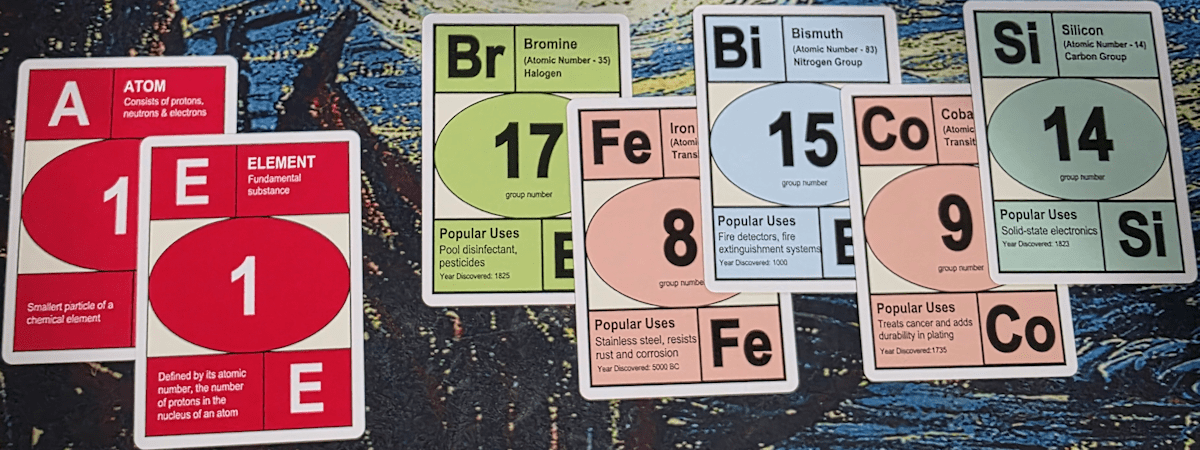
Mr. Petterson has a special version of the game called the STEM Version. This one is made up of 49 cards that are all letters representing the symbols of the elements on the Periodic Table. When I first sat down to play this one, I thought it was quite clever! And it is—but it is tough. A set of Community Vowels are provided in addition to the hand cards. Also, by way of aid, there are two cards in the hand decks for “A” (Atom) and for “E” (Element). These do help. But a lot of these cards are symbols that were meant to be unique identifiers, not parts of a word game. This means that many, many of these make for difficult hands of cards to spell words with. Not a knock of the game’s potential, but perhaps a humbling example of the limits of my brain’s word power. Point values on these cards range from 1 to 18 (all based on the elemental group number), and five cards which have a ×2 value (doubling a word’s value); these are Ho (Holmium), La (Lanthanum), No (Nobelium), Th (Thorium), and U (Uranium).
Initial Thoughts
If you look at the Base Game distribution, above, you will find that this is a total of 45 cards, each letter appearing in the deck 1 or 2 times. Given the existence of the Community Vowels, this feels about right. In play, it works quite well.
The point distribution, however, feels off. Granted, given that each player is working with the same cards, this is not so much a problem as it is a quirk of the game. My point in bringing this up is this: the “Q” (for example) is worth 10 points here. This is the same as its value in Scrabble, so one might not blink an eye. But the fact that you will always have access to a “U” (thanks to the Community Vowels), the “Q” is giving you a lot more points than (I believe) it should. In fact, the point distribution of letters and their points needs to take the Community Vowels much more into account.
In my opinion, the vowels in hand should be 1 point, and consonants should range from 2–5 (or, on the outside, 2–6) points. The zero points from the community vowels would still be impactful, and the other letters would be more in line with the difficulty of using them.
With the Blended Cards, this is even more of an issue. The point values here range from 2–11. For some reason, having the “Q” with a built-in “U” grants as many points as having both those letters in hand. I would say, again, that the range of points for these cards should be in the 1–5 (or, again, on the outside, 1–6) point range, with some thought going into whether the blend makes it easier or harder to play the more difficult letter in the group.
In a two-player game, we found that the blended cards could easily end up clogging a player’s hand. In fact, I was getting 5-card hands with 3+ blends and 7-card hands with 5+ blends, all while my wife was not seeing them very often. I think that, in order to better use the blended cards, we might get another copy of the base cards so as to make them less frequent. As it is, you have 45 base cards and 19 blends… this makes them ~29% of the deck. Thinning that out a bit, I believe, would make things better.
Next, let’s look at the STEM version. Decisions like making the cards a stand alone game, and basing the points on the elemental group number were (in my humble opinion) mistakes. From a game design standpoint, having single cards in a 100-point game worth 18 points and then allowing a vowel to double the points for the entire word is wrong. I understand the thought process, but gameplay has to take priority! I believe that if that particular set of cards were put into a deck with (say…) two sets of base cards, and then had their particular blends reduced to the same 1–5 (1–6) point range, then we would have a potentially great game on our hands!
Final Thoughts
Earl Patterson is a wonderful human being and a designer of fun games. I think that he has the potential to make this game a runaway hit if he were to take some time to rebalance some of the distributions. With a 45-card deck, playing this game with 4+ players will mean shuffling the discards a lot.
I have played the base game, the blends, and the STEM version. In the end, I think that, in the future, if he were to make a base game with (say…) 60 or 80 cards representing the hand cards, include the Community Vowels (total of 65 or 85 cards), then make 40 card expansions that include 30 new cards (blends, elements) along with 10 additional base cards chosen as cards that work well with the additional cards, each designed to be added to and shuffled into the base game… then this game could be perfected and replace all the current word games I play!
As it stands, it is a game that will get pulled off the shelf and played as a warm-up for other things. In other words, it is a solid addition to my game collection. But it is not the revolutionary, expandable, and educational word game I believe is simmering right below the surface. Just waiting to be discovered.